

Matthew Omolesky
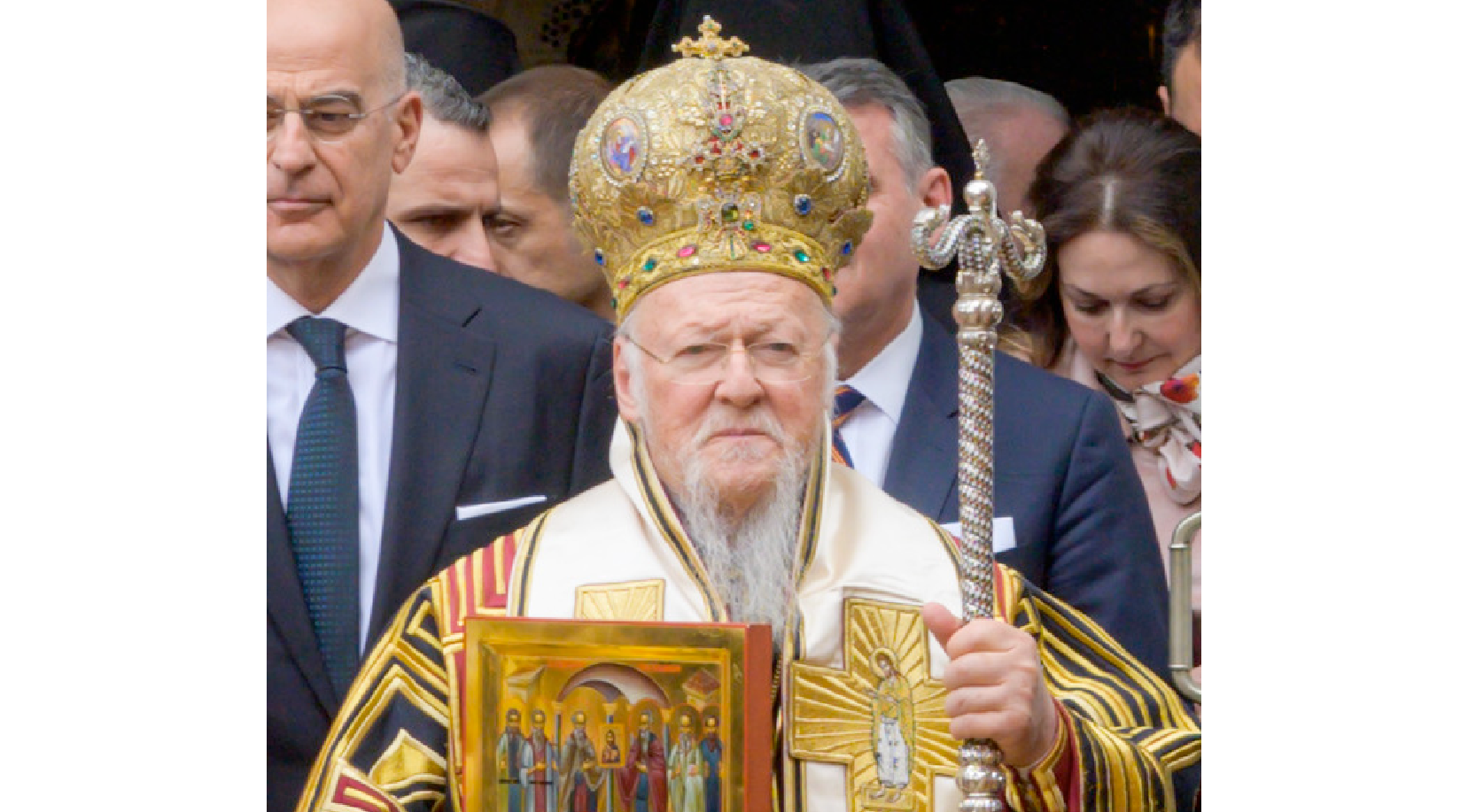
(ZENIT News – Bitter Winter / Moscow, 02.12.2026).- On January 12, 2026, the press bureau of Russia’s Foreign Intelligence Service (SVR) issued one of the more unusual communiqués ever to emanate from a state organ, lurid even by contemporary Russian standards, concerning His All Holiness Bartholomew I, Ecumenical Patriarch of Constantinople. It is a document seemingly the product not of an intelligence agency’s communications office, but a soapbox ranter at Speakers’ Corner, and for that reason alone is well worth quoting in its entirety:
***
“Patriarch Bartholomew of Constantinople: ‘Antichrist in a Cassock’
The press bureau of the Foreign Intelligence Service of the Russian Federation reports that, according to information received by the SVR, Patriarch Bartholomew of Constantinople, who dismembered Orthodox Ukraine, is continuing his schismatic activities in the Orthodox Church space. He has now directed his evil eye towards the Baltic nations. This ‘devil in the flesh’ has become obsessed with the idea of displacing Russian Orthodoxy from the territory of the Baltic states, establishing in its place church structures fully controlled by the Phanar [i.e. the site of the Ecumenical Patriarchate’s headquarters in Istanbul, often used as a pejorative term in Russian ecclesiastical-political rhetoric].
He is being strongly supported in all this by the British intelligence services, which are actively fueling Russophobic sentiment in Europe. Meanwhile Bartholomew, already mired in the mortal sin of schism, has found a common language with the authorities of the Baltic states, in an effort to bring turmoil to the Russian Orthodox world. Relying on ideological allies in the form of local nationalists and neo-Nazis, he is trying to tear away the Lithuanian, Latvian and Estonian Orthodox churches from the Moscow Patriarchate by luring their priests and flocks into puppet religious structures artificially created by Constantinople.
The aggressive appetites of the ‘Constantinople Antichrist’ are not limited to Ukraine and the Baltic States, which with cunning are gradually covering the lands of Eastern Europe. In order to strike at the ‘particularly obstinate’ Serbian Orthodox Church, he intends to grant autocephaly to the unrecognized ‘Montenegrin Orthodox Church.’
Church circles are alleging that Bartholomew literally tears the living Body of the Church. Thus, he is likened to the false prophets, of whom it was said in the Sermon on the Mount: ‘They come to you in sheep’s clothing, but inwardly they are ferocious wolves… You will know them by their fruits.’
Press Bureau of the SVR of Russia
12.01.2026.”
***
In response, the Ecumenical Patriarchate expressed in a rather more temperate fashion its “deepest sorrow” over this most recent Russian attempt at demonization, adding that the “imaginative scenarios, fake news, insults, and fabricated information of various propagandists will not deter the Ecumenical Patriarchate from its ministry and global mission.”
The SVR’s allegation of schismatic activity on the part of Bartholomew I refers primarily to the “tomos,” or decree, signed by the Ecumenical Patriarch on January 5, 2019, granting autocephaly (self-governance) to the Orthodox Church of Ukraine, a move which caused the Holy Synod of the Russian Orthodox Church to break communion with the Ecumenical Patriarchate. Yet the tomos was hardly without justification. The Patriarch of Constantinople represents the “primus inter pares,” the “first among equals” among the various heads of the autocephalous churches that make up the Eastern Orthodox Church and possesses the authority to regularize schismatic hierarchies in the absence of local solutions. Given that the Kyivan Metropolia was founded under the aegis of Constantinople in 988, and it was only the revocable authority to ordain the Metropolitan of Kyiv that was granted to Moscow in the seventeenth century, the position of the Ecumenical Patriarch stands on solid ecclesiastical ground, and the blame for the Moscow-Constantinople schism therefore may fairly be laid at the feet of the Muscovite, rather than Constantinopolitan, authorities.
It stands to reason that Ukraine, with its large Orthodox population and obvious desire for ecclesiastical independence, was a model candidate for autocephaly. The same might be said for the Estonian Apostolic Orthodox Church, which was granted autonomy in the 1920s before being suppressed during the Soviet era, and recognized by Constantinople again in 1996. Montenegro is a more complex case, since between the seventeenth and twentieth centuries it did possess an autonomous church in practice, with the Prince-Bishops of Cetinje exercising internal self-governance beyond the reach of the Serbian Patriarchate, a tradition the modern-day, non-canonical Montenegrin Orthodox Church has attempted to resuscitate with limited results. (And contrary to the SVR’s allegations, Patriarch Barthomolew has shown little interest in promoting the Montenegrin Orthodox Church, stating that the “Church in Montenegro is the Serbian Orthodox Church, and there will never be any changes,” and at one point suspending its erstwhile leader, Miraš Dedeić, for adultery and embezzlement).
The circumstances of Latvia and Lithuania, also mentioned by the SVR, are admittedly even less promising in this regard, since the Latvian Orthodox Church never constituted an independent church, and the minuscule Orthodox Church in Lithuania has never functioned as anything other than a diocese of the Russian Orthodox Church. In its curiously immoderate letter, the SVR maintained that the “Constantinople Antichrist” is plotting to recognize all of these various Churches as autocephalous, whereas the Ecumenical Patriarchate has, in reality, proceeded carefully in these regards, always acknowledging that that autocephaly is a matter of historical continuity or precedent, defined territory, pastoral necessity, ecclesial reality, and broad consensus.
We have seen, since the beginning of the Russo-Ukrainian conflict in 2014, and its escalation into full-scale war in 2022, the systematic propagation of eliminationist and genocidal language by the Kremlin and its propagandists. Ukraine has been described as a “historical aberration” for which there is “no historical basis,” and Ukrainians as “lice,” “vermin,” “rabid dogs,” “cockroaches,” and “demons,” among other things, and now we find similar rhetoric targeting the Ecumenical Patriarchate—“Antichrist in a cassock,” the “Constantinople Antichrist,” a “devil in the flesh” with an “evil eye” and grasping hands that “tear the living Body of the Church.” This sort of verbiage, repeated ad nauseam, is employed for a purpose.
As Mikhail Yampolsky observed in his 2022 essay “Regime of Imperial Paranoia: War in the Age of Empty Rhetoric,” these increasingly grotesque allegations and slurs, meant to reinforce in-group/out-group dynamics, are part of a propaganda structure that “generates the illusion of significance. It is completely exhausted by the repetition and reproduction of the despot’s nonsense. The primary effect of such a system is that repetition functions to produce feelings of loyalty, devotion, and inclusion rather than meaning. No one can explain the meaning of the war, but it is possible to keep on stretching this chain of signs ad infinitum so that, when they reach their imagined limits, they hold the promise of meaning. However, this never happens. What occurs is an outward expansion of the signs to encompass an ever larger group of people. And, while this paranoia produces only the endless repetition and replication of incoherence, it is pervasive, leaving no room for silence or evasion.”
Such language is, at the same time, unintentionally revealing of certain collective historical anxieties that warrant further exploration.
Russia’s campaign of terror directed at the Ukrainian people, and the antagonistic and contemptuous rhetoric aimed at the Ecumenical Patriarchate, can both be traced deep into the past. Let us recall that it is one of the more curious accidents of history that the obscure medieval principality of Moscow, concealed within the primeval forests and marshlands of the upper Volga basin, would one day amount to anything of consequence, let alone the seat of a great realm, and eventually a world empire. Far removed from the economic, cultural, and religious center of Constantinople, and languishing in the shadow of cities like Kyiv, Novgorod, and Vladimir, Moscow counterintuitively came to benefit from its own peripherality. Its rulers could easily avoid the internecine clan conflicts that tore apart the heartlands of the Kyivan Rus’, while the Mongol invasions could be weathered by a cynical strategy of submission to the Horde. Over the course of the fourteenth and fifteenth centuries, the princes of Muscovy found themselves in a position to absorb nearby territories, whether through marriage alliances or violent takeover, meeting with such success that they started to refer to themselves as the “sobiratel’ russkoi zemli,” the “gatherers of the Rus’ lands.”
It was only after the fall of Constantinople that the Muscovites began to adopt truly grandiose pretensions, with Philotheus of Pskov, the hegumen (head) of the Yelizarov Monastery near Pskov, first advancing the idea of Moscow as the Third Rome, the successor to the empires of Rome and Byzantium. “Two Romes have fallen,” wrote Philotheus to his grand prince, Basil III, “but the third stands, and a fourth their will not be.”
A few centuries earlier, the very notion of Moscow as the center of Orthodox Christianity, and the immediate antecedent to the City of God, would have been unthinkable, but this triumphalist, expansionist conceit struck a chord that would resound throughout Russian history. No less a luminary than Fyodor Dostoyevsky would maintain that Russia’s mission was “the general unification of all the people of all tribes of the great Aryan race” within a pan-Slavic Christian empire, an idea that survives to this day in the form of the so-called “Russkiy Mir,” the all-encompassing “Russian World,” or the neo-Eurasianism propounded by the extremist philosopher and Putin acolyte Aleksandr Dugin.
At the same time, as Dmitri Obolensky rightly noted in his magisterial 1971 study “The Byzantine Commonwealth,” the state ideology of post-medieval Russian rulers in practical terms “resembled neither the Christian universalism of Byzantium nor Philotheus’ notion of a world supremacy excercised by the Muscovite tsardom.” Instead, they “confined themselves to claiming the inheritance of the Russian lands over which their Kievan forbears had ruled. ‘Moscow the Second Kiev,’ not ‘Moscow the Third Rome,’ was a hall-mark of their foreign policy.”
It is all well and good to claim the mantle of the “Third Rome” and the “Second Kyiv,” but this fixation on one’s illustrious predecessors can create an internal psychological complex, a sort of anxiety of influence, particularly when Kyiv and Constantinople both still exist. Despite the best efforts of the Russian military, Kyiv remains the capital of an independent nation, and home to Saint Sophia Cathedral and the Pechersk Lavra cave monastery complex, two of the preeminent centers of Eastern Christianity. And Constantinople still exists, not as the capital of the Byzantine Empire, but as the home of the the Oikoumenikón Patriarkhíon Konstantinoupóleos, the Ecumenical Patriarchate of Constantinople, with its seat at St. George’s Patriarchal Temple in the Fener quarter of Istanbul, just a few paces off from the Golden Horn.
There could be no more complete repudiation of the Russkiy Mir than Patriarch Bartholomew’s pained reaction to the Russian invasion of Ukraine—“This is the theology that the sister Church of Russia began to teach, trying to justify an unjust, unholy, unprovoked, diabolical war against a sovereign and independent country”—and his tomos granting autocephaly to the Orthodox Church of Ukraine.
Russia’s state ideology, whether in the czarist, Soviet, or Putinist era, is fundamentally teleological in nature, construing history as a directed process towards the recovery, consolidation, and fulfillment of some notional civilizational whole, regardless of the preferences of formerly or presently captured nations. The furious resistance of the Ukrainians, and the deliberate and dignified behavior of the Ecumenical Patriarchate, have given the lie to these absurd pretensions.
Patriarch Kirill of Moscow may claim that “Russia has never attacked anyone,” that Russian soldiers’ “sacrifice in the course of carrying out your military duty washes away all sins,” and that a “holy war” is justified against a “West that has fallen into Satanism.” Ideologues like the Novosibirsk-based archpriest Alexander Novopashin may justify the Russian atrocities in Ukraine as the only way to arrest the “spread of cultism, Nazism and overt Satanism on the scale of an entire state, something from which Ukraine now has to be freed and cleansed.” The Russian SVR may characterize the Ecumenical Patriarch as a “devil in the flesh,” an “Antichrist,” a “false prophet.” But these diatribes are so bizarre and excessive as to be immediately self-discrediting.
Patriarch Bartholomew, meanwhile, has spoken so movingly in a recent interview with the Greek “Ta Nea” newspaper about how “deeply distressing” it is “that the architects and supporters of the so-called ‘Russian world’ do not hesitate to instrumentalize religious sentiment and to distort Orthodox theology and tradition by labeling this war as ‘holy.’ Yet the victims of this war, to this day, number in the tens of thousands of lives, including young soldiers on both sides, civilian populations, and, tragically, many small children. And, as I have stated on other occasions, I am grieved that even ecclesiastical figures have adopted and echoed this unholy and heretical narrative, evidently submitting to the dictates of political authorities, perhaps in exchange for the multifaceted support provided to them by various propaganda mechanisms and services.”
His conclusion: “Why should I fear Russian propaganda? I fear neither the false and fabricated information they disseminate, nor their orchestrated dirty attacks planned by various services, nor the slanders they hurl against our Patriarchate and against my person, nor the Russian internet trolls, nor their websites that function as mouthpieces.” Would that such moral clarity and sense of purpose were more widely found among the religious and political leaders of the world.
Thank you for reading our content. If you would like to receive ZENIT’s daily e-mail news, you can subscribe for free through this link.

