

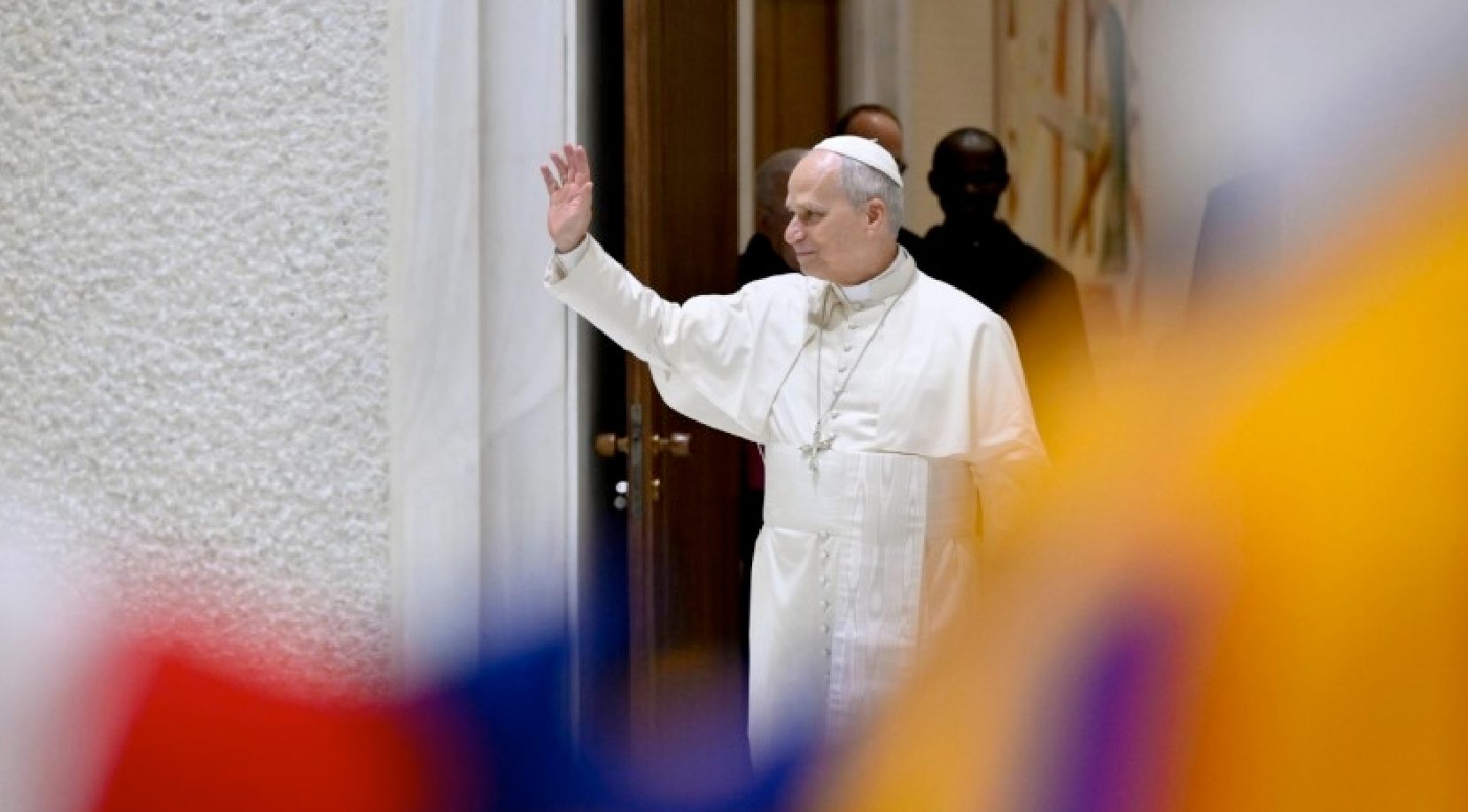
(ZENIT News / Rome, 02.20.2026).- One year after stepping onto the central loggia of St. Peter’s Basilica and greeting the world as Bishop of Rome, Leo XIV will mark the anniversary not in the Vatican, but before an icon of the Virgin Mary.
On 8 May 2026, the first anniversary of his election, the Pope will travel to the Shrine of the Blessed Virgin of the Holy Rosary in Pompeii, one of Italy’s most frequented Marian sanctuaries. The date is not incidental: 8 May coincides with the traditional day of the Supplica to Our Lady of Pompeii, a devotional prayer composed in 1883 by Blessed Bartolo Longo, founder of the shrine and canonized in October 2025 in a Mass presided over by Leo XIV himself.
The choice is symbolically dense. On 8 May 2025, immediately after his election, Leo XIV appeared before tens of thousands gathered in St. Peter’s Square and reminded them that it was the day dedicated to Our Lady of Pompeii. He led the crowd in an Ave Maria and granted a plenary indulgence. “Our Mother Mary,” he said then, “always wishes to walk with us, to remain close, to help us with her intercession and love.” Returning to Pompeii a year later frames his pontificate within that Marian horizon.
The morning visit will include participation in the famous Supplica and other liturgical moments at the sanctuary, described last November by Cardinal Pietro Parolin as “a house of prayer and hope.” In the afternoon, the Pope will move 25 kilometers north to Naples, where he will meet clergy and religious in the cathedral before addressing the wider public in Piazza del Plebiscito, one of southern Italy’s most emblematic civic spaces.
Campania will see the Pope again on 23 May, when he travels to Acerra, in the area grimly known as the “Terra dei Fuochi.” For years, this territory between Naples and Caserta was scarred by the illegal dumping and burning of toxic waste, much of it orchestrated by the Camorra, the powerful Neapolitan criminal organization. The environmental devastation—sometimes described as “ecomafia”—has been linked to alarming public health concerns, including increased cancer rates. The visit comes on the eve of the anniversary of Laudato si’, Pope Francis’ encyclical on care for our common home. Francis had intended to visit Acerra on 24 May 2020, but the pandemic prevented the trip. Leo XIV’s presence will therefore carry both environmental and pastoral overtones, offering proximity to communities still living with the consequences of ecological crime.
On 20 June, the Pope heads north to Pavia, where the relics of St. Augustine have been preserved since 725 in the Basilica of San Pietro in Ciel d’Oro. The remains rest in a monumental 14th-century marble ark, enclosed in glass. For a pontiff who introduced himself to the world as “a son of Saint Augustine,” the visit is more than devotional. Leo XIV belongs to the Augustinian order, founded in the 13th century and inspired by the great Doctor of the Church. At his first public appearance, he quoted Augustine’s famous formula: “With you I am a Christian, for you I am a bishop.” In Pavia, that intellectual and spiritual lineage becomes visible stone and history.
The itinerary then moves to the Mediterranean’s frontier. On 4 July, the Pope will travel to Lampedusa, the southernmost point of Italy and a symbol of the European migration drama. Lampedusa was the first destination outside Rome for Francis in July 2013. There, he denounced what he called the “globalization of indifference” toward migrants who perish at sea and threw a wreath into the waters in memory of the dead. Since then, the island—geographically closer to Africa than to mainland Italy—has become a moral reference point in Catholic social teaching on migration.
Leo XIV has already signaled his attention to Lampedusa. In a video message sent on 12 September for the candidacy of the project “Gestures of Welcome” to UNESCO’s intangible cultural heritage list, he praised the islanders’ “enormous commitment to hospitality,” calling it an immaterial but real patrimony. His July visit suggests continuity with Francis’ emphasis on the peripheries, though framed within his own pastoral style.
The summer will continue in Assisi. On 6 August, Leo XIV will go to the Basilica of Santa Maria degli Angeli to meet young people gathered for the 800th anniversary of the death of St. Francis of Assisi. The year 2026 marks eight centuries since the “Poverello” died, and has been declared a Jubilee year in his honor. From 22 February to 22 March, the public exposition of his remains will allow pilgrims to obtain a plenary indulgence under the usual conditions. During the August encounter, the Pope will address the youth at 9:00 a.m. and celebrate Mass at 10:30 a.m., concluding with a missionary sending. It will be his second visit to Assisi as Pope, after presiding over the closing of the Italian Bishops’ Conference assembly there in November.
The Italian itinerary culminates on 22 August in Rimini, where Leo XIV will participate in the 47th Meeting for Friendship Among Peoples, organized by the Communion and Liberation movement. The annual gathering, which attracts hundreds of thousands of visitors and volunteers, has evolved into a significant platform for cultural, political, and religious dialogue. In Rimini, the Pope will meet participants and celebrate the Eucharist with the faithful of the local diocese. Bernhard Scholz, president of the meeting’s foundation, has already described the anticipation as a “great joy,” linking the event to the Pope’s call to build places of love, peace, and reconciliation.
Altogether, seven Italian destinations are scheduled before the end of August. The Vatican rarely publishes such a dense domestic agenda so far in advance. With the Holy Year 2025—during which millions of pilgrims came to Rome—now concluded, Leo XIV appears freer to move within and beyond the Eternal City. Reports also indicate that he is considering international trips later in 2026, including possible visits to Africa and to Latin America, particularly Peru, Argentina, and Uruguay. Notably absent from this year’s calendar is a trip to the United States, the country of his birth.
Born in Chicago and a missionary for two decades in Peru before serving two six-year terms as superior of his Augustinian order, Leo XIV has often spoken of his love of travel. Yet this first Italian circuit is not tourism; it sketches a pastoral map. Pompeii highlights Marian devotion. Acerra embodies ecological and social wounds. Pavia recalls doctrinal heritage. Lampedusa confronts migration. Assisi summons evangelical simplicity and youthful hope. Rimini engages culture and dialogue.
A year after his election, the Pope’s movements across the peninsula suggest a programmatic message: the Church must pray, heal, remember, welcome, and engage. In tracing that path, Leo XIV is not only marking an anniversary. He is outlining the coordinates of his pontificate.
Thank you for reading our content. If you would like to receive ZENIT’s daily e-mail news, you can subscribe for free through this link.

Publicaciones relacionadas:
 7 out of 10 Spanish citizens believe that Leo XIV’s papacy will be good or better than that of Pope Francis
 Pope Leo XIV will visit Lebanon, according to official statements by the Archbishop of Beirut
 Luxembourg has a new Grand Duke: this is what the Pope said in his message on the day of his coronation
 Taiwan’s president writes to Pope Leo XIV: ‘Taipei wants peace, human rights, and democracy’
