

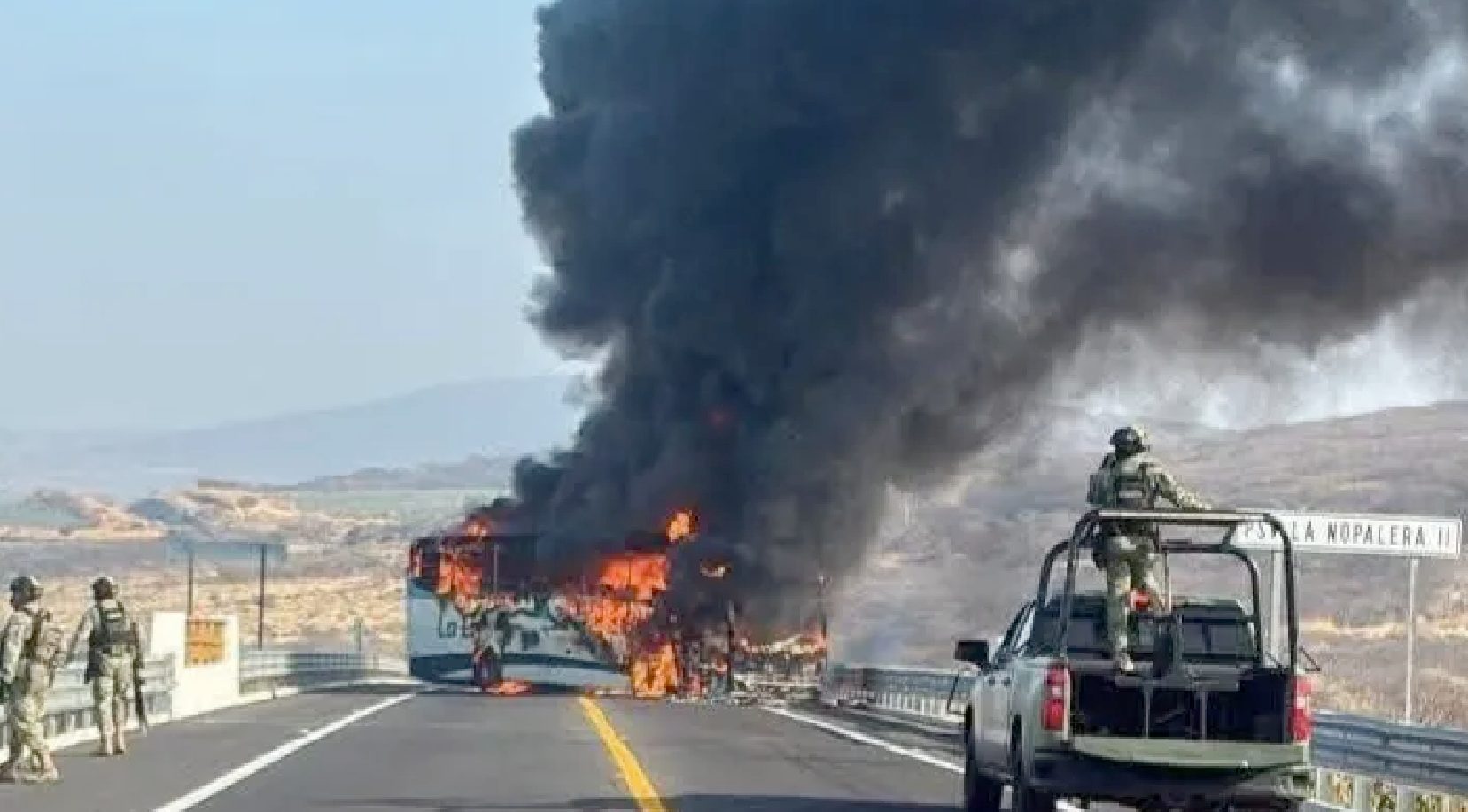
(ZENIT News / Guadalajara, 02.23.2026).- The killing of Nemesio Oseguera Cervantes, known as “El Mencho,” has left Mexico suspended between relief and dread. Within hours of the army operation that ended the life of the 60-year-old leader of the Cártel Jalisco Nueva Generación (CJNG) on February 22, violence rippled across the country, exposing both the fragility of public order and the depth of organized crime’s reach. As roads burned and gunfire echoed, the Catholic bishops of Mexico responded not with political slogans, but with a call to prayer, prudence and renewed civic courage.
At least 73 people died in the operation and the wave of unrest that followed, according to figures released February 23 by security authorities. The toll includes 11 individuals killed in the initial operation, 25 members of the National Guard, a prison guard, a Jalisco state prosecutor’s office official, one woman, and 34 alleged criminals. Seventy suspects were arrested in various locations. The circumstances of some of the deaths remain unclear.
The confrontation began in southern Jalisco, where Mexican armed forces had tracked Oseguera through surveillance of one of his romantic partners. The trail led to Tapalpa, a wooded area where special forces located and wounded Oseguera and two bodyguards after a violent exchange. All three died while being transported to Mexico City, Defense Secretary Ricardo Trevilla said.
What followed was a coordinated show of force by the CJNG. Security Secretary Omar García Harfuch reported more than 250 road blockades in 20 states, 27 attacks on authorities and a spate of arson and shootings, particularly in Jalisco and neighboring Michoacán. One cartel commander—later killed in a separate clash—was offering more than $1,000 to gunmen for each soldier killed, Trevilla said.
Guadalajara, the capital of Jalisco and Mexico’s second-largest city, was nearly paralyzed on Sunday. Vehicles were torched, highways obstructed and businesses shuttered. More than 1,000 people were stranded overnight at the Guadalajara Zoo, sleeping in buses for safety. By Monday morning, mothers wrapped in blankets carried small children out of vehicles so they could use restrooms, while police trucks patrolled the perimeter. Zoo director Luis Soto Rendón said families had been trapped since Sunday morning and were unable to return to neighboring states such as Zacatecas and Michoacán. “We decided to let them stay inside for their own security,” he explained.
Elsewhere in the city, long lines formed outside one of the few pharmacies open, where goods were passed through a chained door. José Luis Ramírez, a 54-year-old therapist, ventured out for the first time since the violence erupted. “We have to think with a cool head,” he said, reflecting a cautious resilience shared by many residents. Others, like 43-year-old hotel security guard Irma Hernández, struggled to find transportation as employers arranged private cars and families stayed indoors.
President Claudia Sheinbaum urged calm during her Monday morning press conference, stating that blockades had been cleared and that “virtually all activity has been restored,” though a national command center remains active. The military deployed 2,500 additional troops to Jalisco, reinforcing the 7,000 already stationed there.
Ver esta publicación en Instagram
The United States confirmed that it provided intelligence support for the operation and praised Mexico’s armed forces. The U.S. State Department had previously offered up to $15 million for information leading to Oseguera’s capture. In February 2025, the Trump administration designated the CJNG as a foreign terrorist organization, increasing diplomatic pressure on Mexico to produce measurable results against fentanyl trafficking. The White House has repeatedly warned of tariffs or even unilateral action if progress falters.
Ambassador Ron Johnson hailed the operation as evidence that bilateral cooperation has reached “unprecedented levels” under Presidents Donald Trump and Claudia Sheinbaum. Analysts suggest the blow to the CJNG could temporarily ease U.S. pressure. David Mora of International Crisis Group described the episode as a potential turning point in Mexico’s security strategy, signaling that intelligence-sharing can yield high-value targets.
Yet uncertainty looms. Some experts warn that the cartel could fragment, intensifying local conflicts, or retaliate with greater ferocity. Analyst David Saucedo cautioned that Mexico could face a scenario reminiscent of Colombia in the 1990s, marked by car bombs and high-profile assassinations. Former DEA international operations chief Mike Vigil argued that authorities must capitalize on the cartel’s moment of weakness with a sustained, intelligence-driven offensive, supported by Washington.
It was against this backdrop that the Mexican Bishops’ Conference issued a message on February 22 to “the People of God who pilgrim in Mexico.” Signed by its president, Bishop Ramón Castro Castro, and secretary general, Bishop Héctor M. Pérez Villarreal, the statement acknowledged widespread fear and urged citizens to strengthen personal and community safety measures, remain at home when necessary and avoid unnecessary travel, always following civil authorities’ instructions.
The bishops called for intensified prayer “in families, parishes, during Sunday Eucharist and in every community,” framing it not only as supplication to Christ, “Lord of history and Prince of Peace,” but as a commitment to become “sowers of reconciliation and fraternity.” In communion with a Church that “suffers, prays and hopes,” they entrusted the nation to the maternal intercession of Our Lady of Guadalupe, invoking her as Queen of Peace to protect families and guide the country toward justice and hope.
The appeal is consistent with a broader ecclesial strategy. In January 2026, more than 1,300 participants—including bishops, victims of violence, academics, business leaders and local authorities—gathered for a National Dialogue for Peace aimed at drafting a comprehensive agenda to address insecurity. The Church has increasingly positioned itself as both moral voice and convener in a nation where organized crime has entrenched itself across regions.
Cardinal Carlos Aguiar Retes, Archbishop Primate of Mexico, reinforced the message in a separate appeal titled “Let Us Build Peace.” Addressing clergy, religious and lay faithful in Mexico City, he urged collaboration to heal the wounds of those directly or indirectly affected by violence. The struggle against evil, he wrote, remains a permanent duty for disciples of Jesus, whom he described as “the Master of Peace.”
Mexico’s homicide rates and the territorial control exerted by criminal groups have for years placed the country among the most violent in the Western Hemisphere. The death of Oseguera, often described as one of the world’s most significant fentanyl traffickers, may mark the end of a chapter. Whether it opens a path to stability or to further fragmentation depends on how state institutions, civil society and criminal networks recalibrate in the weeks ahead.
For now, the image of families sleeping in buses at a zoo, of parishes praying for calm, and of soldiers reinforcing highways captures a nation at a crossroads—grappling with the cost of confronting organized crime and searching, amid smoke and sirens, for signs that justice and peace can take root together.
Thank you for reading our content. If you would like to receive ZENIT’s daily e-mail news, you can subscribe for free through this link.

Publicaciones relacionadas:
 Pope Averts Schism in Germany: Full Text of Vatican Letter
 Liverpool’s Modernist Crown Jewel Secures Grade I Listing as a Landmark of Postwar Faith and Vision
 Childhood Home of Pope Leo XIV at the Center of Preservation Battle in Dolton, Illinois
 Dispute Over Torreciudad Remains Unresolved: Opus Dei denies that an agreement has been reached
