

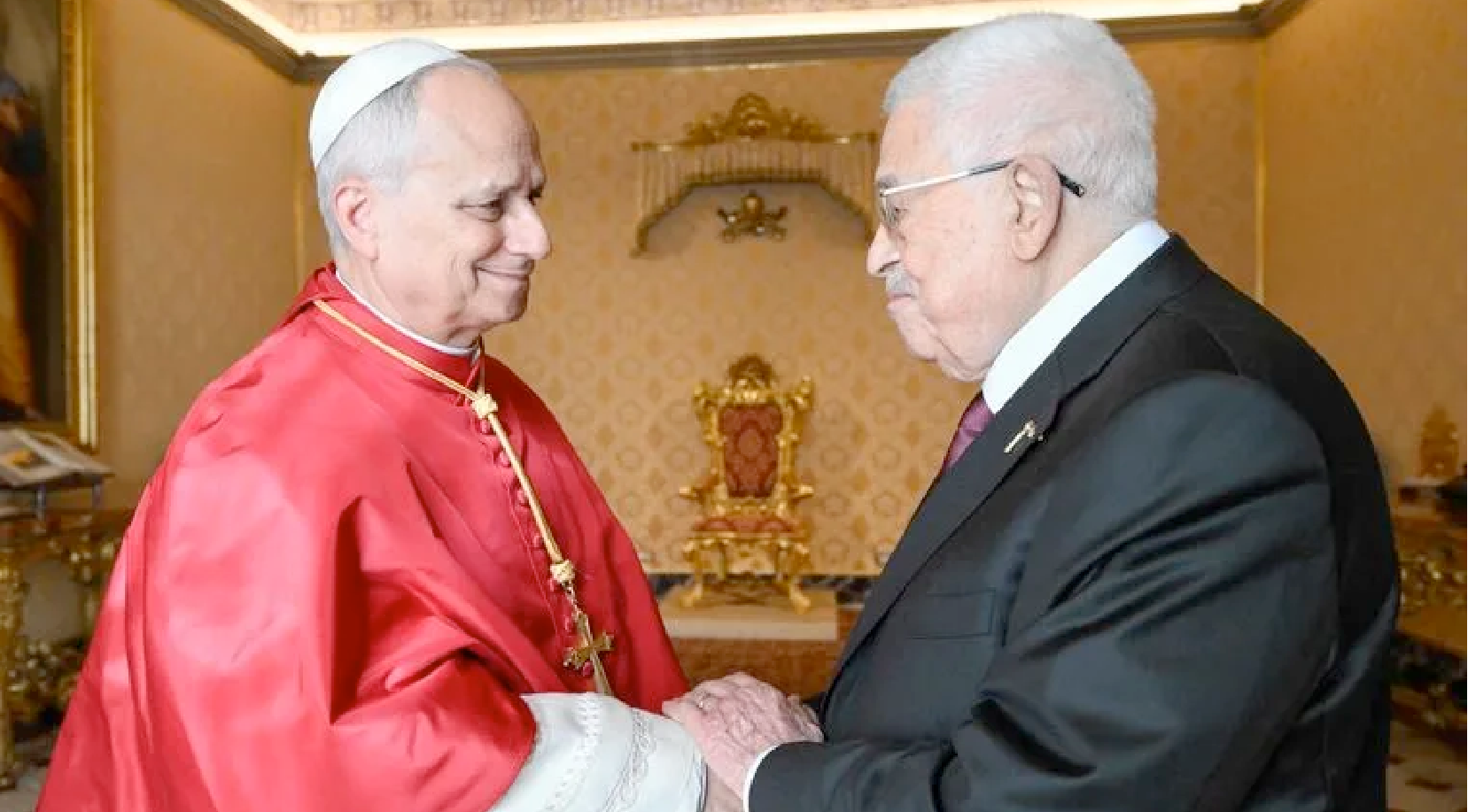
(ZENIT News / Roma, 03.17.2026).- In the midst of an increasingly volatile Middle East, a but politically charged conversation took place on the morning of March 16. Pope Leo XIV received a telephone call from Mahmoud Abbas, focusing on what the Vatican later described as the “worrying developments” of the conflict and the deteriorating living conditions of the Palestinian population.
According to the Holy See Press Office, the exchange was explicitly diplomatic. The Pope reiterated the Holy See’s long-standing position: peace must be pursued through political negotiation and diplomacy, anchored in full respect for international law. In a region where military escalation often eclipses dialogue, the Vatican’s language remains deliberately consistent—almost formulaic, yet increasingly countercultural.
The call gains additional significance when placed against the backdrop of recent months. On November 6, 2025, Abbas had been received in audience at the Apostolic Palace, marking the tenth anniversary of the comprehensive agreement between the Holy See and the State of Palestine. That accord, signed in 2015, formalized a relationship that had already been politically meaningful: the Vatican was among the early international actors to recognize Palestinian statehood, well before the current cycle of violence.
During that earlier meeting, both sides had emphasized two priorities that remain unresolved today: the urgent need for humanitarian relief in Gaza and the necessity of ending hostilities within a broader political framework. Central to that framework is the two-state solution, a concept that has gradually receded from practical diplomacy but continues to function as a normative reference point in Vatican discourse.
What distinguishes the Holy See’s approach is its dual register. On one level, it operates as a sovereign entity with diplomatic relations and treaty commitments; on another, it speaks as a moral authority seeking to shape the ethical horizon of international politics. This duality allows it to maintain channels of communication with actors who may otherwise remain isolated from one another.
The conversation with Abbas illustrates this balancing act. By addressing both the humanitarian dimension—“the conditions of life of the Palestinian people”—and the legal-political framework of the conflict, the Pope situates the crisis within a broader vision that resists reduction to immediate military calculations.
There is also a historical continuity at play. The Holy See’s recognition of the State of Palestine predates many of the current geopolitical alignments and reflects a long-standing commitment to the principle that two peoples should be able to coexist within internationally recognized borders. This position, rooted in decades of Vatican diplomacy, has survived successive pontificates and shifting political realities.
Yet the persistence of this line also reveals its limits. The two-state solution, while repeatedly invoked, faces mounting obstacles on the ground: territorial fragmentation, demographic shifts and a deep erosion of mutual trust. In this context, the Vatican’s insistence on dialogue and international law can appear aspirational, even detached from the logic currently driving events.
Still, the Holy See’s interventions are not designed to compete with military or economic power. Their function is different: to preserve a language of negotiation when it risks disappearing altogether, and to remind international actors of principles that might otherwise be sidelined.
The March 16 phone call, then, is less about immediate outcomes than about maintaining a diplomatic and moral framework in which those outcomes might one day become possible. In a conflict increasingly defined by escalation, the Vatican continues to invest in a slower, less visible form of influence—one that relies not on leverage, but on continuity, credibility and the persistent appeal to a peace that remains, for now, out of reach.
Thank you for reading our content. If you would like to receive ZENIT’s daily e-mail news, you can subscribe for free through this link.

Publicaciones relacionadas:
 Pope Leo XIV, the US-Iran war, and a forceful call in a Middle East on the brink of the abyss
 A Church Against the Logic of War: Vatican Voices, Middle East Realities, and the Risk of a Vanishing Christianity
 Israeli Prime Minister Calls Pope After Military Attack on Catholic Parish in Gaza
 From Castel Gandolfo, Pope Leo XIV Calls for Peace Amid Gaza’s Agony and UN Genocide Allegations
