

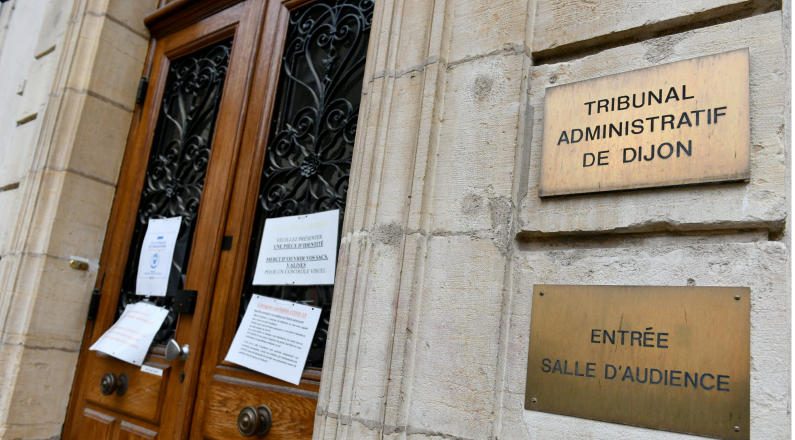
(ZENIT News / Paris, 03.24.2026).- A ruling by an administrative court in eastern France has brought one of the country’s most sensitive principles—laïcité, or state secularism—back into sharp focus, highlighting the tension between individual religious expression and institutional neutrality in public office.
On March 18, the Administrative Court of Dijon validated a decree issued by Gilles Platret, mayor of the city of Chalon-sur-Saône, which prohibits elected officials from wearing “ostentatious” religious symbols during municipal council sessions. The judges concluded that the measure does not constitute a “serious and manifestly illegal violation” of freedom of conscience, affirming instead that such freedom must be reconciled with the obligations imposed by secular governance.
The case was brought by two local representatives affiliated with La France Insoumise, Damien Saley and Lamia Sabrina Sari. Sari, who wears an Islamic headscarf, argued that the decree directly targeted her ability to exercise her elected mandate. Their legal challenge framed the issue as a matter of fundamental rights: whether participation in democratic institutions can be conditioned on the visible renunciation of religious identity.
The court rejected that argument. In its reasoning, it emphasized that public officials, once acting within institutional settings, are bound by a duty of neutrality derived from France’s secular framework. This principle, deeply embedded in French political culture, traces its modern legal expression to a series of laws, including the 2004 ban on conspicuous religious symbols in public schools and subsequent regulations extending similar restrictions to other public spheres.
Platret explicitly grounded his decree, issued on January 14, in these precedents, as well as in internal rules adopted by the French National Assembly in 2018. For the mayor, the logic is straightforward: if national legislators are subject to such constraints, local councils should not operate under looser standards. The court’s decision, he said, offers “a model” that other municipalities might adopt.
His legal counsel, Julie Callot, reinforced this argument by insisting on the measure’s neutrality. The ban, she noted, applies equally to all visible religious markers—whether a large Christian cross, a Jewish kippah, or an Islamic headscarf—and is intended to prevent what she described as “proselytizing attire” within official proceedings.
Opposing counsel, Marion Ogier, advanced a different interpretation of laïcité, one that prioritizes individual liberty over institutional uniformity. In her view, the decree risks excluding certain elected representatives from full participation, effectively penalizing them for their beliefs. The court, however, sided with a more restrictive reading of secularism, one that places the burden of neutrality on those exercising public authority.
The ruling cannot be understood in isolation from the broader political profile of Platret himself. Recently re-elected with more than 61 percent of the vote in a city of approximately 45,000 inhabitants, the mayor has built a reputation on assertive—and often controversial—interpretations of public order and identity. Past initiatives have included an attempted ban on Palestinian flags within the municipality, later suspended by the courts, as well as efforts to regulate school menus and workplace language.
His political trajectory also reflects the shifting landscape of the French right. Formerly associated with Les Républicains, he has reportedly moved closer to positions aligned with Reconquête!, the movement led by Éric Zemmour, known for its hardline stance on immigration and cultural identity.
Beyond the local context, the Dijon ruling touches on a broader European question: how far secular democracies can or should go in regulating religious expression within public institutions. France’s model of laïcité, more stringent than that of many of its neighbors, has long sought to confine religion to the private sphere, particularly in contexts where the authority of the state is exercised.
Critics argue that such an approach risks disproportionately affecting religious minorities, especially Muslims, for whom visible markers of faith are more common. Supporters counter that the principle is indivisible and essential to preserving the neutrality—and therefore the legitimacy—of public institutions.
For now, the court has drawn a clear line: elected office does not exempt individuals from the expectations of secular conduct. Whether that line will hold under future legal or political challenges remains uncertain. What is clear is that, in France, the balance between freedom of conscience and the demands of laïcité continues to be negotiated case by case, often in courtrooms rather than in parliament.
Thank you for reading our content. If you would like to receive ZENIT’s daily e-mail news, you can subscribe for free through this link.

