

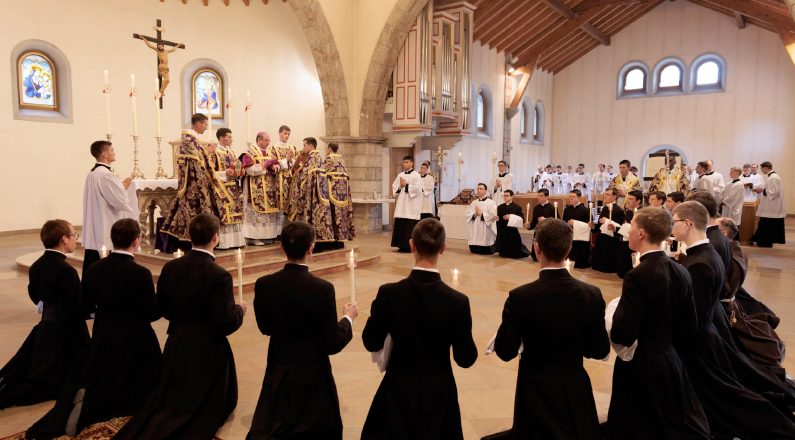
(ZENIT News / Econe, 03.24.2026).- The fragile equilibrium between Rome and the traditionalist movement known as the Society of Saint Pius X (or Lefebvrians) appears once again at risk, as the group advances plans to consecrate new bishops without papal mandate—an act that, in canonical terms, strikes at the very heart of ecclesial unity.
According to a preliminary schedule released by its seminary in Écône, the episcopal consecrations are set for July 1, with a solemn Pontifical Mass at 9:00 a.m., followed by liturgical celebrations throughout the day, including Second Pontifical Vespers dedicated to the Precious Blood. One of the newly consecrated bishops is expected to celebrate his first Pontifical Mass the following morning. While the Society has not officially disclosed how many candidates will be elevated to the episcopate, internal reports suggest the possibility of up to five new bishops.
The choice of Écône is far from incidental. It was here, in 1988, that Marcel Lefebvre carried out the illicit consecration of four bishops without papal approval, triggering automatic excommunication for himself, the co-consecrating prelate, and the newly ordained bishops. That moment marked one of the most serious ruptures in modern Catholic history following the Second Vatican Council.
The Society’s leadership argues that similar measures are necessary to ensure its institutional survival. The Superior General, Davide Pagliarani, has made clear that the dwindling number of bishops—only two of the original four remain alive, both in their seventies—poses a structural threat. Without bishops, the Society cannot ordain priests, a sacramental bottleneck that directly affects its global operations.
Yet from Rome’s perspective, the stakes are theological as much as juridical. The consecration of bishops without pontifical mandate is not merely an administrative irregularity but a schismatic act carrying the penalty of automatic excommunication. This position has been reiterated in recent weeks by several prominent figures within the Church hierarchy.
Among the most forceful critics is Robert Sarah, who warned that such a move could endanger souls and deepen ecclesial fragmentation. Similarly, Joseph Zen, while expressing some sympathy for the Society’s concerns, cautioned against the risk of formal schism. Other voices, including Marian Eleganti and Gerhard Ludwig Müller, have underscored the gravity of the act, framing it as a rupture not only with Church discipline but with communion itself.
The Vatican has not remained passive. In a notable but ultimately unsuccessful effort, Víctor Manuel Fernández, prefect of the Dicastery for the Doctrine of the Faith, met with Pagliarani shortly after the announcement. The encounter was intended to explore possible avenues of agreement. However, the Society swiftly dismissed the prospect of doctrinal convergence. In a candid exchange, Pagliarani acknowledged that both sides were fully aware of the depth of their disagreements, particularly regarding the interpretation and legacy of Vatican II and subsequent papal teachings.
This frank admission highlights a central paradox: the Society insists it does not seek schism, yet its actions repeatedly test the boundaries of communion. Its leadership maintains that the crisis within the Church—especially in doctrinal and liturgical matters—justifies extraordinary measures. Critics, however, argue that such reasoning risks creating a parallel ecclesial structure, effectively institutionalizing division.
Even logistical details surrounding the planned consecrations hint at the scale of the event. Pilgrims are expected to attend in significant numbers, though, unlike previous years, camping near the seminary will not be permitted. Instead, organizers plan to provide food services on-site, suggesting a controlled yet sizable gathering.
At its core, the unfolding situation raises a question that has haunted the Church since 1988: can a movement claim fidelity to tradition while acting outside the juridical and sacramental framework that defines Catholic unity? The answer, once again, may hinge on decisions taken in a quiet Swiss valley—but with consequences that will resonate far beyond it.
Thank you for reading our content. If you would like to receive ZENIT’s daily e-mail news, you can subscribe for free through this link.

