

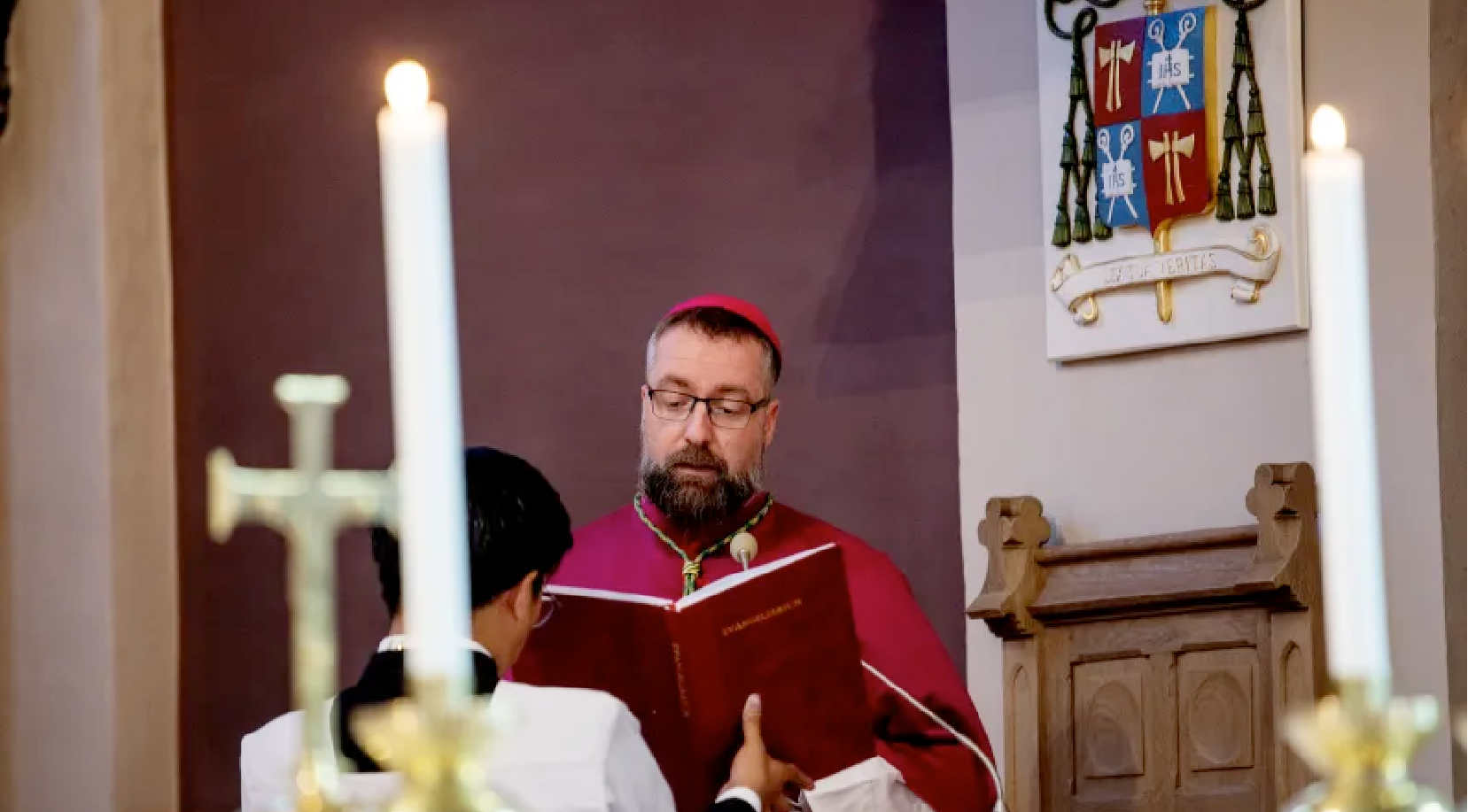
(ZENIT News / Oslo, 03.24.2026).- At a time when many pastoral priorities in Europe (and in the episcopal world) orbit around social or ecological concerns, the Catholic bishop of Oslo has chosen a different focal point: the state of the soul. In a pastoral letter dated the Fifth Sunday of Lent 2026, Bishop Fredrik Hansen places the sacrament of penance at the very center of Christian life, not as an abstract doctrine but as an urgent, practical and deeply personal call.
What makes the document notable is not only its subject, but its tone and method. Hansen does not settle for theological reminders or general encouragement; he combines doctrinal clarity with a strikingly direct pastoral strategy: he asks the faithful to return to confession regularly—at least three times a year—and, more unusually, invites those who struggle with the sacrament to write to him personally, explaining their difficulties.
The proposal is as simple as it is revealing. In a Church often concerned about declining sacramental practice, particularly in Northern Europe, Hansen identifies a concrete obstacle: many Catholics no longer approach the confessional, not necessarily out of rejection, but out of hesitation, ignorance or fear. His response is to lower the threshold—spiritually and psychologically—by addressing those barriers explicitly.
The letter situates confession firmly within the broader architecture of Catholic sacramental theology. The seven sacraments, Hansen recalls, are not symbolic constructs developed over time, but acts instituted by Christ himself, integral to the Church’s liturgical life and oriented toward sanctification, ecclesial unity and the worship of God. Within this framework, penance is presented as a “means of grace and salvation,” a place where forgiveness is not merely declared but sacramentally effected.
Yet the bishop insists that understanding confession requires confronting a more uncomfortable reality: the nature of sin. Drawing on biblical language and liturgical formulas, he describes sin as an act that fractures relationships—first with God, but also with the Church and with others. The distinction between mortal and venial sin is not treated as a technicality, but as a real spiritual diagnosis: some sins weaken communion, others sever it entirely. Left unaddressed, he warns, sin isolates the individual and sets in motion a pattern of further moral disintegration.
This diagnosis leads to what is perhaps the letter’s central theological assertion: that mercy, not sin, has the final word. Confession is therefore reframed—not as a burdensome obligation—but as an encounter with divine mercy that restores what has been broken. The bishop underscores that the act of confessing is less about recounting failures than about re-entering a relationship, both with God and with the ecclesial community.
From this theological foundation, Hansen moves decisively into pastoral instruction. He reminds the faithful of a key disciplinary norm: those conscious of grave sin should refrain from receiving Communion until they have been absolved, in accordance with canon law. But he goes further, proposing a concrete rhythm for sacramental life: confession during Lent, again in summer before the feast of St. Olav—Norway’s patron—and once more during Advent. In doing so, he effectively integrates penance into the liturgical year as a recurring spiritual checkpoint.
Preparation for confession is also treated with specificity. The bishop recommends silence, prayer and a thorough examination of conscience, aided by the Ten Commandments or biblical texts. He outlines the essential dispositions: contrition, honest confession and the firm intention to amend one’s life. The emphasis is pedagogical as much as spiritual, suggesting a concern that many Catholics have lost familiarity with the practice itself.
The most distinctive passage, however, is addressed to those who no longer approach the sacrament. Hansen lists the reasons with notable psychological realism: the passage of time since the last confession, uncertainty about what to say, fear of the priest’s reaction, or the burden of sins perceived as unforgivable. Rather than dismiss these concerns, he acknowledges them—and then makes an uncommon gesture. As bishop, he writes, he feels obliged to help, and therefore asks the faithful to contact him directly so that, together, they can find ways to make confession a living reality again.
This move subtly redefines episcopal ministry. It is not only about teaching or governing, but about actively diagnosing and removing pastoral obstacles at the level of individual conscience. In a secularized environment like Norway, where Catholicism is a minority presence, such proximity may also reflect a strategic awareness: sacramental practice cannot be restored without rebuilding trust.
Hansen’s appeal extends to his clergy. Priests, he insists, must lead by example through regular confession themselves and by making the sacrament more accessible, more inviting and more trustworthy. He signals institutional follow-up as well, announcing that the diocesan presbyteral council will be tasked with developing concrete proposals to strengthen confession in the coming years.
The letter closes by situating the entire reflection within the approach of Holy Week. The Paschal mysteries—Christ’s death and resurrection—are presented as the ultimate source of victory over sin and death, a victory that, in Catholic theology, becomes personally operative through the sacrament of penance.
In its substance, there is little in Hansen’s teaching that would surprise a theologian. In its delivery, however, the letter marks a departure from the cautious generalities that often characterize contemporary episcopal communication. By naming the problem, prescribing a rhythm, and inviting direct dialogue, the bishop of Oslo has transformed a familiar doctrine into a pastoral intervention—one that, at least in intention, seeks not merely to remind the faithful of confession, but to bring them back inside it.
Thank you for reading our content. If you would like to receive ZENIT’s daily e-mail news, you can subscribe for free through this link.

