


(ZENIT News / Rome, 03.27.2026).- A sweeping new set of surveys suggests that the moral landscape of the United States is neither collapsing nor cohering—but fragmenting in complex and revealing ways. Far from embracing moral relativism across the board, Americans are drawing selective lines: permissive on many personal behaviors, sharply condemnatory on others, and deeply divided along political, religious, and generational fault lines.
The data, drawn from two large-scale 2025 surveys conducted by the Pew Research Center, paint a portrait of a society that has largely normalized practices once considered contentious, while still maintaining strong moral boundaries in specific areas—especially those touching on trust and fidelity.
Permissiveness with limits
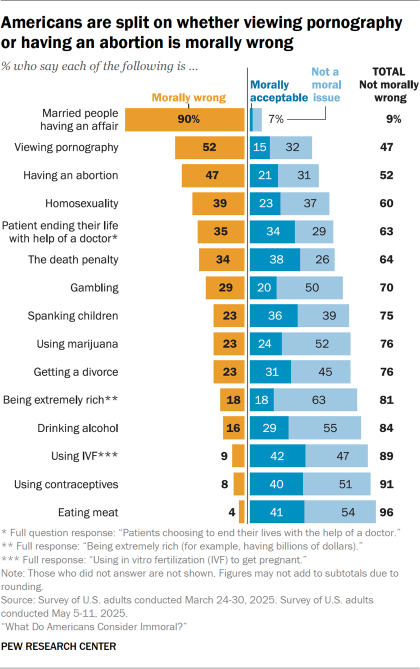
On a wide range of everyday behaviors, Americans show a striking degree of moral acceptance. Eating meat is almost universally regarded as morally unproblematic, with 96% of adults expressing no ethical concern. Similarly, 91% say the use of contraception to prevent pregnancy raises no moral issue.
This permissiveness extends into more contested territory. Three out of four Americans—75%—do not consider spanking children a moral problem. A clear majority, 63%, say that physician-assisted suicide is morally acceptable or not a moral issue, while 60% express the same view regarding homosexuality.
Yet this broad tolerance has clear boundaries. Extramarital affairs stand out as a near-universal taboo: nine in ten Americans consider them morally wrong, making infidelity the only behavior in the survey to draw overwhelming condemnation.
Between these poles lies a zone of unresolved tension. Pornography and abortion divide the country almost evenly. Viewing pornography is considered morally wrong by 52% of respondents, while 47% see it as either acceptable or not a moral issue. Abortion produces a similarly split picture: 47% view it as morally wrong, while 52% regard it as morally acceptable or outside the moral domain altogether.
Politics as a moral lens
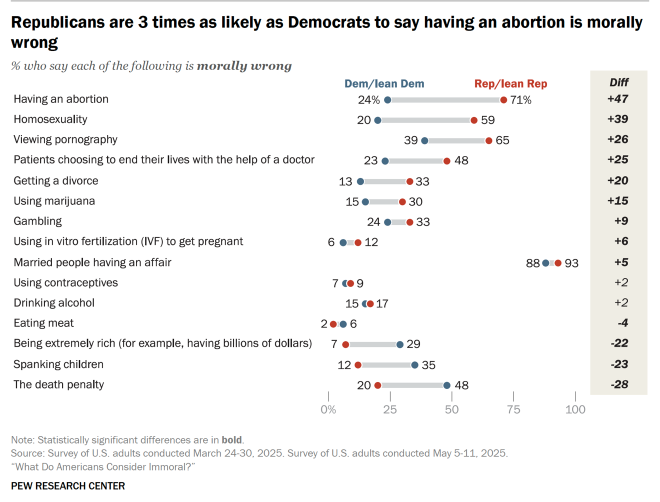
If the overall picture suggests ambiguity, political affiliation brings sharper definition. On abortion, the divide is stark: 71% of Republicans and Republican-leaning independents consider it morally wrong, compared with just 24% of Democrats and their leaners.
This pattern extends across issues related to sexuality and family life. Republicans are far more likely than Democrats to view homosexuality (59% vs. 20%), pornography (65% vs. 39%), and divorce (33% vs. 13%) as morally wrong.
Democrats, by contrast, are more inclined to take restrictive moral positions on other matters. Nearly half—48%—say the death penalty is morally wrong, compared with only 20% of Republicans. A similar gap appears on corporal punishment of children, with 35% of Democrats opposing it on moral grounds versus 12% of Republicans.
These divergences suggest that moral reasoning in the United States is increasingly filtered through broader political identities, rather than anchored in a shared ethical framework.
Religion and moral continuity
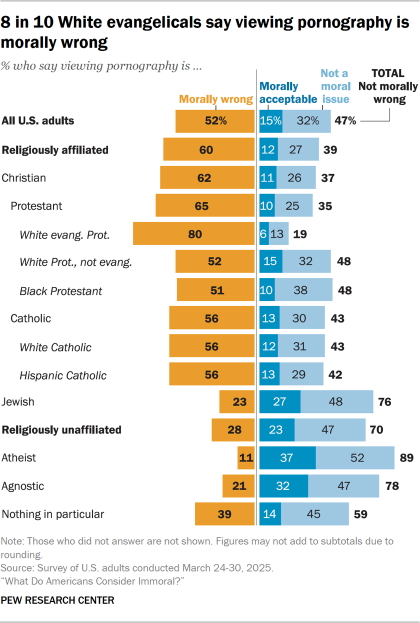
Religious affiliation continues to shape moral judgments, though not uniformly. White evangelical Protestants emerge as the most consistently aligned with traditional moral teachings across multiple issues. Eighty percent say pornography is morally wrong, compared with roughly half of other Protestants and 56% of Catholics.
On homosexuality, 72% of white evangelicals consider it morally wrong, a figure that drops to 34% among Catholics and just 13% among the religiously unaffiliated. Similar patterns appear in attitudes toward abortion and physician-assisted suicide, where evangelicals are more likely to express moral opposition.
At the same time, evangelicals are among the least likely to oppose the death penalty, with only 20% describing it as morally wrong—highlighting the selective nature of moral conservatism even within religious groups.
Other communities diverge in different directions. Jewish adults and those without religious affiliation are significantly less likely to frame issues such as pornography in moral terms at all, with roughly half saying it is not a moral issue.
Generational shifts without uniform direction
Age introduces another layer of complexity. Younger Americans are not uniformly more permissive; rather, their moral judgments shift depending on the issue.
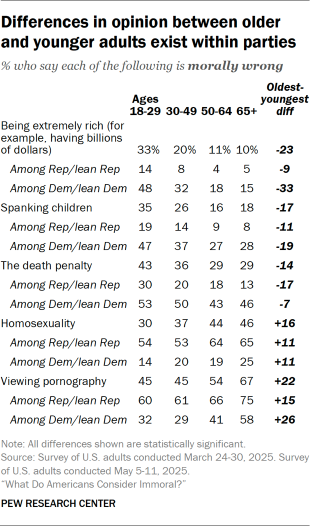
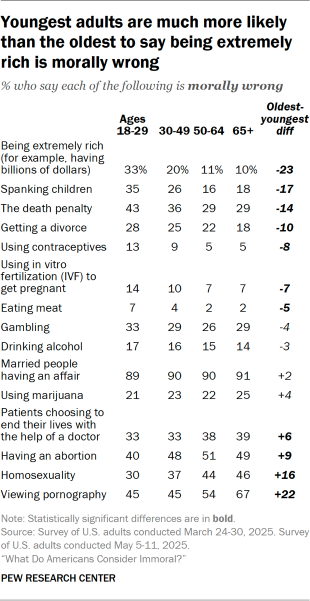
Adults aged 18 to 29 are more likely than older cohorts to see extreme wealth as morally problematic, with 33% expressing that view compared to just 10% of those aged 65 and older. They are also more inclined to question the morality of physically disciplining children.
Yet on other issues—such as homosexuality—young adults are somewhat less likely than older Americans to label the behavior as morally wrong, though the differences are narrower than might be expected: 30% of young adults still consider it immoral, compared with higher shares among older groups.
These generational gaps persist even within political parties, suggesting that internal evolution is underway beneath the surface of partisan alignment.
A nation unsure of itself
Perhaps the most revealing finding lies not in attitudes toward specific behaviors, but in how Americans judge one another. Only 47% of respondents describe their fellow citizens as morally good, while a majority—53%—say Americans are morally somewhat or very bad.
This places the United States at odds with most other countries surveyed by the Pew Research Center, where majorities tend to view their societies in more positive ethical terms.
The result is a paradox: a society broadly tolerant in personal moral judgments, yet deeply skeptical of its own moral character.
In that tension lies a defining feature of contemporary American life. The question is no longer simply what individuals believe to be right or wrong, but whether a shared moral language—capable of bridging political, religious, and generational divides—still exists at all.
Thank you for reading our content. If you would like to receive ZENIT’s daily e-mail news, you can subscribe for free through this link.

