

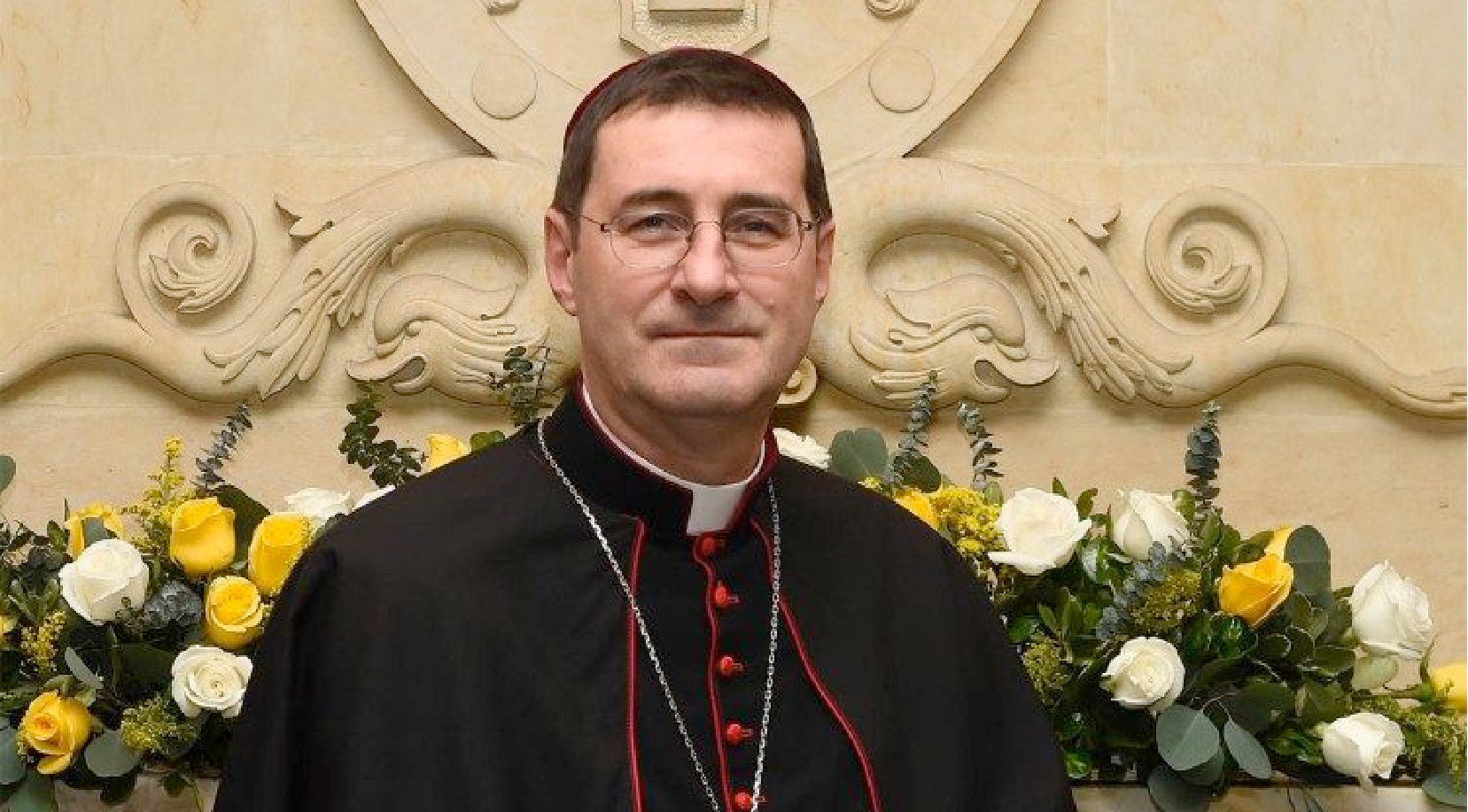
(ZENIT News / Vatican City, 03.31.2026).- Less than a year into his pontificate, Pope Leo XIV has moved decisively to recalibrate the machinery of governance at the heart of the Catholic Church. The appointments announced on March 30 redraw the operational map of the Roman Curia, placing experienced diplomats at key nodes of influence and signaling a preference for discreet, technically proficient leadership after years marked by turbulence.
At the center of the reshuffle stands the appointment of Paolo Rudelli as Substitute for General Affairs in the Secretariat of State, a role often described—without exaggeration—as the Vatican’s “chief of staff.” At 55, the Italian prelate becomes the third most powerful figure in the Holy See’s hierarchy, after the Pope and the Secretary of State, Pietro Parolin. The office he now assumes oversees the daily coordination of the Curia, manages internal governance, and maintains a privileged channel of direct access to the Pope.
Rudelli’s trajectory reflects the profile Leo XIV appears intent on promoting: a career diplomat formed within the institutional culture of the Holy See. Ordained in Bergamo in 1995, trained at the Pontifical Gregorian University in moral theology and canon law, and later at the Pontifical Ecclesiastical Academy, he has spent more than two decades navigating the Vatican’s diplomatic network. His postings—from Ecuador and Poland to Zimbabwe and most recently Colombia—have placed him at the intersection of ecclesial and political realities, often in contexts marked by instability. That experience, combined with a previous tenure within the same section he will now lead, made him a natural candidate for a role that demands both administrative precision and political judgment.
In accepting the appointment, Rudelli invoked the spirit of Praedicate Evangelium, the 2022 reform of the Curia, suggesting continuity with the missionary and decentralized vision promoted under the previous pontificate. Yet the context in which he takes office is anything but neutral. His predecessor, Edgar Peña Parra, leaves behind a complex legacy shaped by global crises and institutional strain. Appointed in 2018, the Venezuelan diplomat navigated the Secretariat through the COVID-19 pandemic, the death of Pope Benedict XVI, and the transition that led to the election of Leo XIV. At the same time, his tenure was overshadowed by the controversial London real estate investment, a failed operation that cost the Vatican approximately 400 million dollars and triggered an unprecedented judicial process involving ten defendants.
Peña Parra now moves to a different kind of post as Apostolic Nuncio to Italy and San Marino—a position of prestige but limited strategic weight. In his farewell, he described his years in the Secretariat as both demanding and formative, likening his ecclesial service to a train journey marked by successive stations: moments of intense responsibility followed by transitions that are not endings but passages. His words carried a mixture of relief and realism, acknowledging the “institutional suffering” caused by legal scrutiny while emphasizing the largely invisible yet essential nature of the work carried out in the Section for General Affairs.
The chain of appointments extends further. Petar Rajič, until now nuncio to Italy, has been named Prefect of the Pontifical Household, a role that operates at the delicate boundary between protocol and power. Though less publicly scrutinized, the office is crucial: it regulates access to the Pope, orchestrates audiences, and manages the ceremonial framework of papal activity. In practical terms, it determines who enters the papal orbit and under what conditions—a function that carries significant influence in a system where proximity often translates into authority.
Rajič’s own background mirrors that of Rudelli: born in Toronto to Croatian parents from Bosnia-Herzegovina, formed in canon law and Vatican diplomacy, and seasoned through postings ranging from the Arabian Peninsula to the Baltic states and Angola. His appointment also fills a position that had remained vacant since 2023, restoring a key element of the Curia’s institutional equilibrium.
Beyond these headline changes, Leo XIV has also made targeted additions to other bodies, reinforcing areas that have gained prominence in recent years. The Dicastery for Promoting Integral Human Development receives new members, including experts in migration, while the Pontifical Commission for the Protection of Minors is strengthened with the inclusion of figures linked to international legal and academic institutions.
Taken together, the decisions suggest a coherent direction. Rather than pursuing highly visible reforms, Leo XIV appears to be consolidating governance through personnel choices: privileging continuity in structure but renewal in those who operate it. The emphasis on diplomatic experience is particularly striking, as if the Pope were seeking to stabilize the Curia by entrusting it to men accustomed to negotiation, discretion and long-term strategy.
In Vatican terms, such moves rarely produce immediate headlines. Their effects are measured instead over time, in the tone of decision-making, the management of crises, and the subtle balance between central authority and global outreach. What is clear is that the new pontificate is beginning to define itself not only through words, but through the careful placement of those who will translate vision into governance.
Thank you for reading our content. If you would like to receive ZENIT’s daily e-mail news, you can subscribe for free through this link.

Publicaciones relacionadas:
 A New Phase in the Leonine Pontificate: Pope Reshapes His Inner Circle with a Surprising Appointment
 Pope Leo XIV to publish new document on Catholic education and declare Newman co-patron of Catholic education
 Mystical Phenomena and Holiness Explained by Pope Leo XIV
 Leo XIV perfects the mission of the Pontifical Academy for Life
