

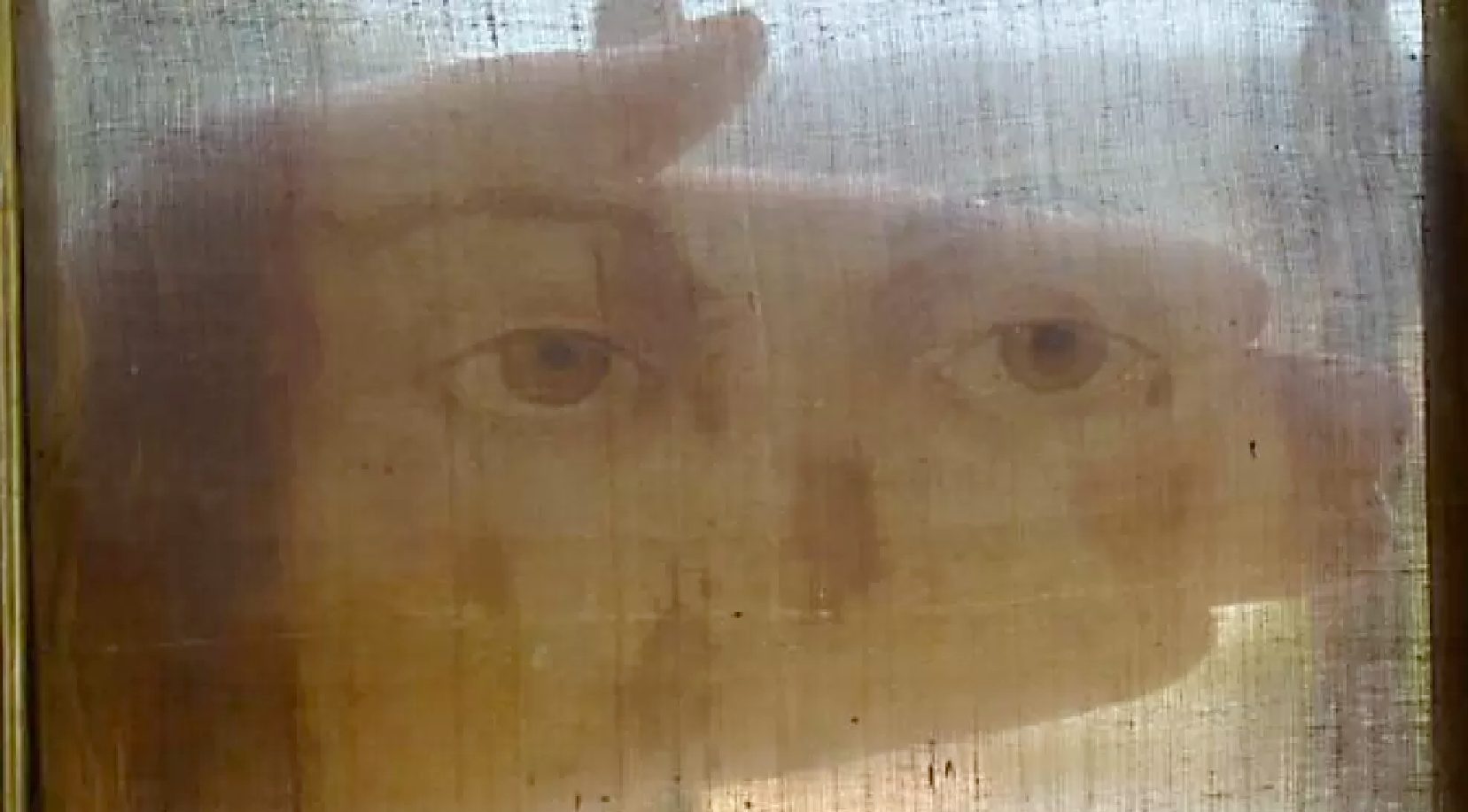
(ZENIT News – Porta Luz / Manoppello, 04.10. 2026 – Manoppello, an Italian town of 5,000 inhabitants, located in Abruzzo, 30 km from Pescara — near the Shrine of the Eucharistic Miracle of Lanciano — safeguards a treasure about which saints, scientists, and the Son of God Himself have spoken.
It is a shroud kept in the Basilica Volto Santo of the city, a cloth of 17 by 24 cm, which is protected between glass with a silver frame — which is displayed on the main altar of the Shrine of the Holy Face of Manoppello –, and contains the image of the Face of the Risen Christ.
The Image Is Not a Human Creation
For more than 20 years, eminent scientists have conducted exhaustive studies of the mysterious relic that displays the Face of Christ, preserved in Manoppello. Their results establish that this image was created in a way inexplicable to science. As with the miraculous image of Our Lady of Guadalupe in Mexico or the image of Christ’s dead body on the Shroud of Turin, scientific investigations have determined that it is not a painting and cannot be considered a human creation.
In 1998-1999, Donato Vittore, professor at the Faculty of Medicine of the University of Bari, investigated the fabric using a high-resolution digital scanner. Vittore’s reported result was that no trace of coloured pigments was visible in the space between the warp and weft threads. Further investigations using microscopy and spectroscopy were carried out by Giulio Fanti, professor of Mechanical and Thermal Engineering at the University of Padua. Ultraviolet light analysis with a Wood’s lamp confirmed a test that had already been performed in 1971: neither the fabric nor the image of the face showed any noticeable fluorescence, as would be expected in the presence of coloured pigments.
Under microscopic magnification, it is clearly visible that there is not the slightest trace of paint or other pigments on the canvas. If, on the contrary, the painting had been done with oil paint, it would undoubtedly have been deposited in the spaces between the eyes. It has also been ruled out that the painting was done with watercolour, since the shapes and features of the eyes and mouth are so sharp that it is impossible to paint them in this way.
The most striking feature of the Face on the Shroud of Manoppello is the transparency of the linen and the fact that the image is perfectly visible from both sides, as if it were a transparent sheet. It contains no pigments. It is, without a doubt, unique in the world. Another characteristic of the Manoppello image is that it changes appearance depending on the light. With the change in light, the image changes, as if it were alive. If viewed under bright light, it is invisible because it becomes transparent. This extraordinary facial image has some of the qualities of a painting, a photograph, or a hologram, but it is neither a painting, nor a photograph, nor a hologram. The shadows of the portrait are more subtle than anything the greatest geniuses of painting could create. The reflection of the face exhibits many inexplicable phenomena that make the shroud a great mystery for science.
The Mystery of a Precious Fabric
The Holy Face of Manoppello is an astonishing image painted on a precious fabric dating back to the 1st century. It is made of byssus, also called marine silk, which was the most expensive fabric of antiquity. Technically, it is impossible to paint anything on marine silk. The structure of this fabric was studied by professor Giulio Fanti, who concluded that it is a very fine material, woven with threads of an average cross-section of 120 microns. It is finer than nylon, a synthetic fiber first produced in 1945. The way it is woven is traditional and, therefore, simple and irregular. Between the threads there are gaps of 150 to 350 microns. The fabric is transparent, which is why it is called a veil. The gaps between the threads are devoid of pigments or other materials. It is important to highlight something unique, namely, that the spatial tone of the colours of unknown origin here is 0.5 millimeters, while in the Shroud of Turin it is one centimeter.
Scientific investigations on the Veil of Manoppello, carried out by professor L. Portoghesi, a specialist in 1st-century textiles, have established that it is byssus, that is, the most expensive ancient material. Professor Chiara Vigo, the world’s leading expert on byssus fabrics, after a thorough study of the Veil of Manoppello, has concluded that it is marine byssus, a fabric made from the silky threads produced by the marine mussel Pinna nobilis. These invaluable fabrics were produced in antiquity. Today, only the island of Sant’Antioco, near Sardinia, is the sole place in the world where small quantities of byssus are produced. Up to 2 grams of fiber can be obtained from a single Pinna nobilis shell.
Professor Vigo states that only byssus can be as transparent and delicate as the Veil of Manoppello and at the same time as refractory as asbestos. No human being is capable of painting anything on this type of material, much less an image as perfect as the one found in Manoppello. Byssus can soak up paint, but it is absolutely impossible to paint on it: you cannot apply paint to such a fine fabric.
The colours oscillate in the light between amber, sienna, silver, slate, copper, bronze, and gold; they seem to emerge as on the wings of a butterfly, because under the microscope no traces of paint or of the material are visible, and in the light coming from behind it becomes transparent like crystal; then the traces of the folds also disappear. This type of phenomenon can only be observed in byssus (sea silk), the most precious fabric of the ancient world (…). In the light, the canvas becomes completely transparent, while in the shade it appears graphite grey.”
The Son of God Reveals the Truth to Valtorta
In the tenth volume of the private revelations of the celebrated Italian mystic Maria Valtorta (all her writings were published at the behest of Pope Pius XII on February 22, 1942), the following words that Jesus spoke to her are recorded: «The Veil of Veronica is an encouragement to your skeptical souls. You rationalists, hypocrites, wavering in faith, who carry out soulless investigations, compare the reflection of the Face in the Veil with the reflection in the Shroud of Turin. The first is the Face of the Living, the second that of the Dead. But the length, the width, the physical features, the shape, the characteristics are the same. Superimpose these two reflections, you will see that they correspond. It is I. I want to remind you who I was and who I have become for love of you. So that you do not get lost, so that you do not become blind, these two reflections should be enough to lead you to love, to conversion, to God» (Maria Valtorta, «L’Evangelo Come Mi e Stato Rivelato,» Centro Editoriale Valtoriano, 2003, p. 414).
The long study of the Shroud of Manoppello, begun more than 20 years ago by the nun and icon specialist Blandina Paschalis Schlömer, attracted the interest of other scholars and led to the surprising discovery that the Face of the dead man on the Shroud of Turin and the Face of the living man in Manoppello are the same person. The images of these two faces coincide exactly, so both images represent the same person.
For researcher Paschalis, «from a scientific point of view, there is no doubt that both Faces — that of the Holy Shroud and that of Manoppello — correspond 100% in structure and dimensions.»

Publicaciones relacionadas:
 After 7 months without being able to return, Catholic priest manages to re-enter his parish in Gaza
 Catholic member of British royal family to have Catholic funeral attended by the King and Queen of England
 This Is the Catholic Priest Who Won the «Asian Nobel» Prize and Here’s the Reason for the Award
 16 Children, Sometimes Not Perfect, but United and Faithful: The Story of an Influencer Marriage
