(ZENIT News – Porta Luz / Santiago de Chile, 07.23. 2026).- People commonly associate cults with religion, an association rooted in reality, given that throughout the 19th and 20th centuries, cult-like groups emerged within the realm of spirituality, either as offshoots of major religious traditions or as novel, alternative worldviews for contemporary humanity. However, in the 21st century, we are witnessing the rise — and widespread success –, of monstrous cults operating in entirely different spheres.
Areas such as therapy, the wildly popular field of coaching, self-help and personal growth techniques, and even corporate or leadership training have taken on such manipulative and depersonalizing characteristics that, in some instances, they can truly be described as cults. These groups and movements coexist alongside traditional cults, bearing out the adage that there is a cult for every type of person. Whatever an individual’s interests or aspirations may be, these cults will adopt the most appealing persona to seduce and enslave them.
Its focus: The Impact of Techniques
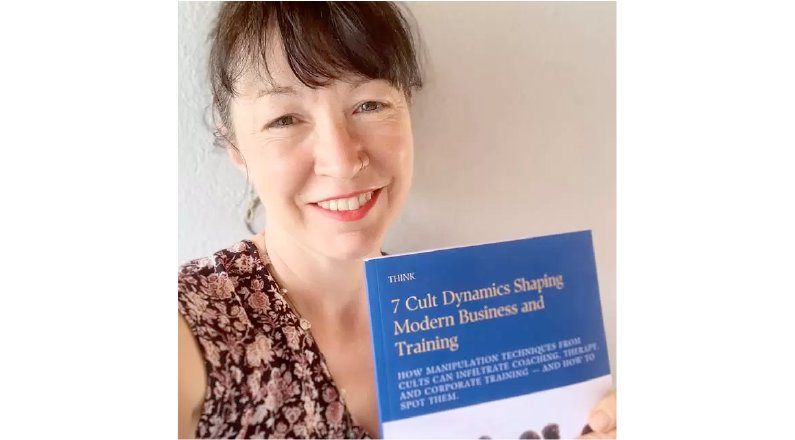
In this context, a short book has just been published that describes this phenomenon and serves as a practical guide for spotting it. It is titled Seven Sectarian Dynamics in Modern Business and Training,”and its author is Jenni Walford, a British artist, therapist, and educator who has spent most of her life in Argentina and Spain (which is why the book has been released in both English and Spanish). The work’s subtitle further clarifies its content: Cult-like Manipulation Techniques in Coaching, Therapy, and Corporate Training… and How to Spot Them.
As early as the first page, Walford clarifies that she does not claim «contemporary training, coaching, or development organizations are ‘cults,'» nor does she assert that those who design or deliver these programs act in bad faith. However, she also warns that, in many instances, «good intentions do not eliminate the effects of certain techniques, especially when those techniques originate in cult-like, high-control, or coercive environments.» Her focus, she emphasizes, «is not intention, but impact.»
Through her experience guiding and assisting victims, the author has observed that «certain dynamics that emerged in cult-like contexts, such as the quasi-religious use of specific words and expressions, emotional manipulation, authority dynamics, and ‘limited choice’, have been repackaged and normalized within contemporary corporate training, coaching, wellness spaces, and organizational development.»
To help protect against such coercive strategies, she has identified seven of them, which we summarize below.
- Sacred Language and Jargon
Retreats, training courses, and coaching workshops have their own vocabulary, featuring words that «seem to convey a depth of meaning that everyday language cannot quite reach», something that can sound «exciting, fresh, exotic, and full of promise» to a newcomer.
What is the danger? It is a thought-reform technique: according to Jenni Walford, «in manipulative systems, this type of jargon does more than create community; it reconfigures the way reality itself is perceived.» Furthermore, «adopting this language is often the first step into a closed world.»
- Hypnosis and Hypnotic Activities
In these types of activities, «what appears to be a harmless guided meditation, a breathwork session, or an energizing chant can, in the right setting, bypass critical thinking and place participants in a highly suggestible state.» Other elements can include chanting, repetitive music or percussion, grueling schedules, and abrupt shifts in emotional state…
According to prominent cult experts cited by the author, these practices reinforce control over adherents by «regulating mental states until people accept ideas they would otherwise reject.» The resulting sense of momentary euphoria is interpreted as transformation or growth, seemingly validating the message of the trainer or facilitator.
- Group Cohesion and Forced Belonging
Since human beings are social by nature — as Aristotle observed –, we «need to belong, to be recognized, seen, and accepted,» and cult-like groups «know this and exploit it.» That is why, from the very beginning, «participants are encouraged to reveal personal details, applaud and cheer for strangers, and take part in exercises that rapidly strip away privacy.»
What «may seem stimulating» to the newcomer is, in reality, a meticulously designed strategy of cohesion and conditional belonging, one that «lasts only as long as you meet their expectations. The moment you doubt, resist, or question the process, the warmth turns cold.»
- Unsolicited Contact and Violation of Personal Boundaries
Walford acknowledges that «contact can be healing, grounding, and deeply human, but only when it is freely chosen.» The problem here is that in many corporate training activities, «physical contact is imposed as the default norm, whether it’s hugs upon arrival, holding hands during exercises, or even back massages framed as ‘healing’.»
And here is the caveat: «what might appear harmless or even kind is, in practice, a violation when informed consent is not sought from participants.» In healthy group settings, permission is requested beforehand, and refusals are accepted. However, «in manipulative environments, consent is assumed, and refusal is pathologized.» The result is not connection, but coercion.
- Forced Vulnerability and Emotional Exploitation
Vulnerability is neither good nor bad in itself; it is simply a characteristic of the human condition: we are vulnerable. In fact, the author notes that «it can be transformative when freely chosen. In safe contexts, sharing a fear or a personal story can build trust and foster growth.» However, this is not the case in certain therapies, workshops, and training courses where vulnerability «is imposed.»
How does this happen? «Participants are pressured to reveal intimate details, not for their own benefit, but to reinforce group cohesion and the leader’s authority, and to gather information that can later be used against them.» Consequently, in these environments, «what looks like courage is often conformity in disguise.» Publicly confessing one’s sins and mistakes «creates dependency on the group or the leader,» who then «knows better how to manipulate you.»
- Confusion and Contradictions
In a group dynamic, «when messages contradict each other and rules constantly change, participants stop trying to make sense of what is happening and come to rely on the leader for guidance,» according to Jenni Walford. This confusion or arbitrariness is not synonymous with an absence of rules; rather, it becomes «one of the most effective tools in the manipulator’s arsenal.»
It is very common in many coaching and New Age training initiatives, appearing «in the form of contradictory teachings, pseudo-scientific jargon, or promises that clarity will arrive ‘at the next level’.» What the therapist or facilitator seeks (and so often achieves) is «dependency: the more confused participants feel, the more they return to the program to resolve that confusion.» Autonomous thinking and independent judgment are abandoned in favour of deferring to the leader.
- Authority Games and Power Dynamics
Authority is necessary in any human group. As the author explains, «in healthy contexts, it can provide security, structure, and expertise.» This is not the case in a cult-like environment where leadership is destructive and authority «turns into a game of domination in which the leader is elevated above everyone else, and the participants’ worth is measured by their obedience.»
Indeed, obedience is enforced, eliminating any possibility of personal autonomy; as psychologists specializing in cults point out, this results in «gradually building a self-contained system where submission feels increasingly natural.» The guru ends up controlling the group’s emotional landscape, deciding, in a highly personal manner, «who receives praise, who is humiliated, and who gains access.» It is not a matter of charisma, but of control.
Conclusion: Protecting Ourselves from Abusers and Abuse
Jenni Walford, who presents real-life cases illustrating the tactics used beyond «classic» cults, insists that these patterns are very common across a wide range of coaching, corporate training, professional development, personal growth courses, and marketing programs… «they have been inherited, passed down from one program to another.» Trainers and facilitators do not invent anything new; instead, they simply repeat what they were taught.
This has led to the normalization of this style in many circles, where it is «perceived not as manipulation but as ‘best practices'»; consequently, what are actually coercive techniques spread, become institutionalized, and are accepted without question. Ultimately, they come to be viewed as a sort of ritual necessary for transformation.
That is why it is so crucial to be able to detect and recognize these dynamics, to «become an informed consumer,» which «helps in giving (or withholding) informed consent» and also «helps protect ourselves and others from abuse.»
Article originally published by Porta Luz.