

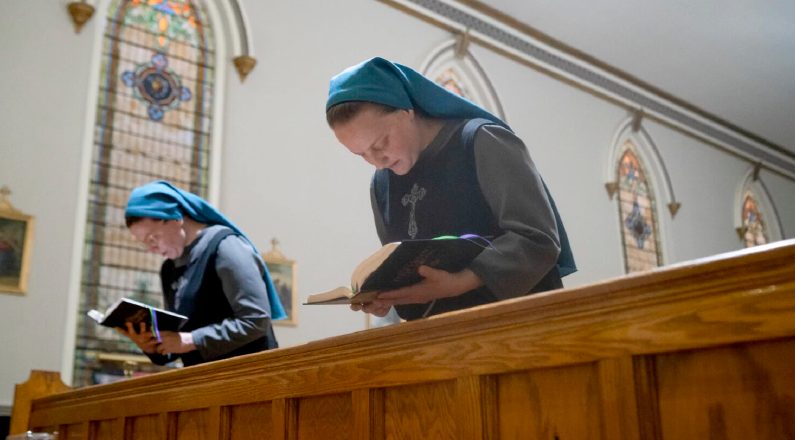
(ZENIT News / Washington, 07.24.2026).- The first question asked of a woman considering religious life is not usually what she has suffered. It is whether she is willing to give her life away. For Sisters Theresa Aletheia and Danielle Lussier, the two questions have become inseparable.
Their proposed religious community in Kentucky is being born from an experience that neither woman would have chosen: the discovery that a priest who had served as their spiritual director had been accused of sexually abusing one of their fellow sisters. Both women had spent at least ten years in the Daughters of Saint Paul before leaving the congregation in 2022. They also came to believe that the same priest may have been grooming them for abuse.
Their response was not to turn away from religious life, but to reshape their understanding of what their own vocation might require.
Today, the two women are building the Sisters of the Little Way of Beauty, Truth and Goodness, a community whose entire apostolate is centered on people wounded by abuse within religious and other settings. They accompany survivors of sexual, spiritual, emotional and financial abuse, most often through online meetings with people who contact them from across the United States.
If their community eventually receives full recognition as a religious institute, it would represent something highly unusual in Catholic history: a congregation whose specific charism is the accompaniment of those harmed by abuse and the recovery of a Church’s capacity to listen to them.
The project has already received permission to establish itself in the Diocese of Lexington, where the sisters moved in 2025. Bishop John Stowe has welcomed their presence, arguing that their own experience of spiritual abuse gives them an ability to understand survivors without treating their stories as a threat.
That may be one of the community’s most distinctive features. The sisters are not approaching survivors from a distance, as specialists examining a problem that belongs to somebody else. They know what it means to discover that spiritual authority can become dangerous precisely because it has first been trusted.
Their ministry begins, therefore, with something deceptively simple: listening.
John Bellocchio, who was abused as a teenager by former cardinal Theodore McCarrick, said that being heard by someone wearing a religious habit helped him begin to rebuild his relationship with faith. McCarrick was removed from the clerical state in 2019 after being found guilty of sexual misconduct in a canonical process.
For survivors whose faith has been damaged by the actions of Church leaders, the presence of a religious sister can carry an ambiguity that the Kentucky community is attempting to confront directly. The habit may recall the institution that failed them. It may also become, through a different encounter, a sign that religious life itself need not be reduced to the failures of those who have abused its authority. That is the delicate ground on which the two sisters are working.
Their community is currently a private association of the faithful, an initial stage in the Catholic Church’s process of discerning whether a new religious foundation can develop into a formally recognized institute. The path is necessarily slow. A community must demonstrate stability, a viable form of life and a genuine vocation capable of enduring beyond its founders.
The caution is especially significant in the aftermath of the abuse crisis. The Church has increasingly sought to prevent new communities from concentrating spiritual, financial and personal authority in ways that can leave members vulnerable. The creation of a new religious order is therefore not simply a matter of approving an inspiring idea.
It requires proving that the idea can become a safe and durable way of life.
The sisters now hope to meet women interested in joining them during the summer of 2026. The traditional invitation to prospective religious vocations remains unchanged: come and see.
But what these women would come to see is unlike the familiar image of a religious community.
There are approximately 2,000 communities of Catholic women religious around the world, although no exact global figure is easily established. Across history, their ministries have evolved in response to human needs. Franciscans devoted themselves to poverty and service to creation; the Missionaries of Charity made care for the poorest their defining mission. Women religious have worked as educators, nurses and servants of vulnerable communities in circumstances ranging from impoverished neighborhoods to war zones.
The Kentucky sisters belong to that same historical logic, but with a strikingly contemporary focus. They have identified a need inside the Church and are attempting to make responding to it the work of their entire lives.
Their question is not only how to help those already harmed. It is also how to prevent others from having to learn the same lessons through suffering.
“How can we help people in the Church recognize these patterns without having to experience the harm themselves?” Sister Theresa Aletheia asks.
That question points beyond individual cases. Abuse is not only an event; it can also involve patterns of manipulation, secrecy, excessive dependence and the misuse of spiritual authority. The sisters want to help people recognize those patterns earlier, before trust has been transformed into vulnerability.
Their work is consequently both pastoral and educational.
Yet they are careful not to present themselves as having solved the Church’s abuse crisis. Their distinctive contribution is more modest—and perhaps more demanding. They want to create a place where survivors are not treated merely as people who need to be repaired, but as people whose experience can reveal truths the wider Church has failed to see.
Sister Danielle Lussier argues that those who occupy the least visible places in the Church may be essential to its renewal.
There is a profound ecclesial implication in that conviction. A Church that listens only to its institutions will hear the language of its structures. A Church that listens to those wounded by its structures may hear what those structures have concealed.
The sisters’ mission therefore carries an unavoidable paradox. They are trying to help heal people injured by the misuse of religious authority while remaining convinced that religious life itself can still be a path of genuine service and holiness.
Their answer is not to pretend that the wound does not exist. Nor is it to conclude that the existence of abuse makes faith, priesthood or consecrated life meaningless.
It is to place the wounded at the center of the question.
The crucified Christ embroidered on the sisters’ black aprons offers an appropriate image of what they are attempting. It is not a symbol of pain made sentimental or conveniently explained away. It is the image of suffering that must first be acknowledged.
The future of their community remains uncertain. It may grow; it may face the same demanding discernment that every new religious foundation must undergo; its ultimate recognition will depend on time, stability and ecclesial judgment.
But its emergence already says something important about the Catholic response to the abuse crisis.
Sometimes renewal does not begin with a new policy, a new commission or a new institutional slogan.
Sometimes it begins with two women who have been forced to confront the danger of spiritual authority deciding that the answer to a wounded Church is to spend the rest of their lives listening to its wounded.
Thank you for reading our content. If you would like to receive ZENIT’s daily e-mail news, you can subscribe for free through this link.

Publicaciones relacionadas:
 Three nuns receive English recognition for their fight against human trafficking
 The Case of Marko Rupnik: An Artist’s Perspective
 Resurrection: The Method of Accompaniment in Transcendent Mourning That Heals and Evangelizes
 «Adoption Is Not a ‘Plan B’, It’s a True Vocation»: Young Influencers Who Bet on Adoption
