

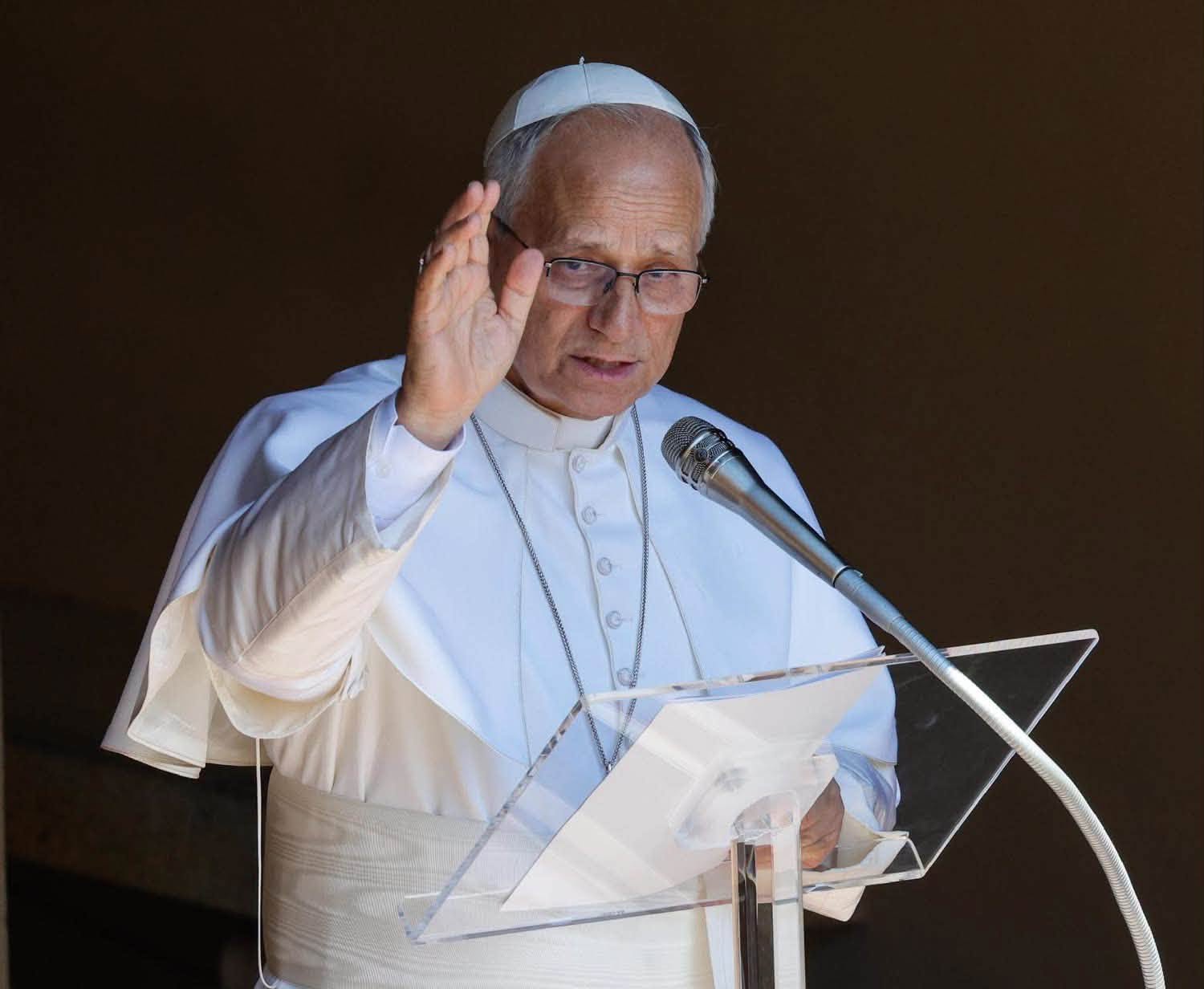
(ZENIT News / Vatican City-Jerusalem, 08.16.2026).- Pope Leo XIV chose unusually direct language on Sunday as he addressed the faithful in Castel Gandolfo: the violence against Palestinian civilians in the West Bank must stop, and the international community must urgently revive the path toward a two-state solution. His appeal came as the village of Qusra, south of Nablus, entered its second week of an extraordinary confrontation in which Palestinian families have been confined to their homes while Israeli settlers established makeshift positions around them.
The episode has become more than another isolated clash in the West Bank. It has exposed, in a matter of days, the convergence of three increasingly serious problems: settler violence, the difficulty of protecting Palestinian civilians under occupation, and the weakening of the institutions that provide basic services to them.
At Qusra, two Palestinian families have spent days effectively trapped inside their homes, with access to water, electricity, food and movement disrupted. Reports in the material provided describe six residents confined to their houses, while another account estimated that around 15 people, including at least two young children, were initially caught in the siege of three homes.
The crisis began on August 9, when settlers surrounded houses, erected tents and blocked access routes. Water and electricity supplies were cut. Attempts by activists, medical personnel and others to reach the families were repeatedly obstructed. One particularly disturbing episode involved a two-year-old girl with a high fever whose ambulance was reportedly prevented from reaching her until the residents were eventually evacuated.
The confrontation continued even after Israeli forces declared the area a closed military zone. On August 15, a municipal team attempting to restore electricity to one of the affected homes was reportedly attacked by settlers. According to the accounts provided, a group of about 15 settlers approached the area despite the military closure.
The case attracted unusual international attention because one of the homes belongs to Loui Ridi, a Palestinian-American. US Ambassador to Israel Mike Huckabee described the siege as an “act of terrorism” and condemned the intimidation of the family. Washington subsequently pressed Prime Minister Benjamin Netanyahu to publicly denounce what had happened.
Israeli authorities eventually dismantled two settler outposts in Qusra and nearby Jalud and opened an investigation into the military response. The Israeli army said the incident was serious and would be examined, including why it reportedly took 48 hours to initially remove one illegal outpost and another day to remove it again.
The question raised by the episode is therefore not simply whether the army eventually intervened. It is whether civilian protection can be guaranteed before a confrontation reaches the point of international alarm.
William Shomali, vicar general of the Latin Patriarchate of Jerusalem, offered a sobering assessment. The attention given to Qusra, he observed, should not obscure the fact that similar reports of settler violence arrive daily. Even after settlers retreat from the immediate vicinity of a house, he noted, they can remain on nearby hills and return.
That distinction between a temporary withdrawal and genuine security is crucial. For families living under repeated intimidation, the ability to remain physically present on their land cannot depend on whether armed groups choose to stay away on a particular day.
The scale of the broader problem is reflected in figures cited by the material. Israeli security sources reportedly recorded 660 incidents of settler “nationalist” violence in the first six months of 2026, compared with 405 during the same period of 2025. By the end of June, United Nations figures indicated that about 2,200 Palestinians had been displaced in the West Bank during 2026 because of settler violence.
And the crisis is not confined to security.
A report published on August 6 by Physicians for Human Rights Israel warned that the Palestinian public health system in the West Bank is approaching collapse. Of the 590 facilities operated within the Palestinian Ministry of Health system, 447 had substantially reduced their activity, in many cases functioning only once or twice a week.
For five consecutive days, Israeli settler terrorists are surrounding the home of an American citizen in the Palestinian village of Qusra in the occupied West Bank, leaving the family trapped inside their own home.
Yes, the owner of this house is an American citizen.
For five… pic.twitter.com/iaPyeISGzj
— Ihab Hassan (@IhabHassane) August 12, 2026
The financial figures are equally stark. The Palestinian health authorities reportedly owe more than $1.18 billion to private hospitals and pharmaceutical suppliers. Of approximately 1,260 essential medicines normally maintained in stock, 160 were already unavailable, around 600 had supplies expected to last only a few days, and roughly 250 were available only in limited quantities. Patients requiring treatment for cancer, kidney disease, diabetes and other chronic conditions are consequently facing growing obstacles to basic care.
The report links much of the financial crisis to Israel’s withholding of Palestinian clearance revenues — customs and tax revenues collected by Israel on behalf of the Palestinian Authority. These revenues account for roughly 65 to 70 percent of the Palestinian Authority’s public budget and finance salaries and essential services.
According to figures cited in the study, monthly Israeli withholdings increased after October 2023 from roughly 200 million Israeli shekels to 500 million, reducing the revenues transferred to the Palestinian Authority by more than half. Between February 2019 and July 2024, Israel had withheld 3.54 billion shekels, equivalent to slightly more than €1 billion and approximately 5 percent of Palestinian GDP in 2023. In June 2026, the mechanism was reportedly expanded to permit deductions exceeding 100 percent of certain payments owed by the Palestinian Authority.
Whatever one’s position on the wider Israeli-Palestinian conflict, the humanitarian principle is difficult to escape: civilians should not bear the consequences of political disputes through the loss of food, water, electricity or medical treatment. The same principle applies to Israelis and Palestinians alike.
HORRIFIC: A video shows Israeli settler children attacking Palestinian civilians in Khirbet at-Tawil in the occupied West Bank.
Israeli settlers are now involving their own children in attacks and harassment against Palestinians—raising another generation and teaching them to… pic.twitter.com/4YYgl5EObY
— Ihab Hassan (@IhabHassane) August 16, 2026
That is also the logic behind Pope Leo XIV’s appeal. His August 16 intervention was not presented as an endorsement of one side’s political program, but as a renewed demand for equal human dignity, protection of civilians and a negotiated political settlement. He urged the international community to advance a two-state solution capable of delivering a “just and lasting peace.”
The Pope had already called on July 26 for renewed negotiations and warned against military actions and unilateral decisions that undermine the rights of civilians or the status of holy places.
For the Catholic Church, the stakes are not merely geopolitical. The West Bank is also home to an ancient Christian presence whose survival depends on security, freedom of movement and the possibility of sustaining ordinary family life. What happens to Palestinian civilians therefore inevitably affects Christian communities as well.
Shomali’s proposed remedy is notably institutional: strengthen international law and give greater weight to the United Nations and the Security Council. Spain has likewise reiterated its support for a two-state settlement and called on Israel to prevent arbitrary violence and intimidation against Palestinians. France has called for the arrest and prosecution of settlers involved in the Qusra siege and for the protection of Palestinian civilians under international law.
The events of Qusra suggest why diplomatic language alone is no longer enough. A family without electricity cannot wait indefinitely for a political settlement. A child needing urgent medical care cannot live on diplomatic assurances. A health system lacking essential medicines cannot function while its financing remains trapped in a prolonged political dispute.
Pope Leo’s appeal therefore arrives at a revealing moment. The central question is not whether another statement will be issued, but whether international pressure can translate into protection on the ground.
Qusra has shown how quickly a local confrontation can become a test of international credibility. If civilian protection is a universal principle, it must be applied before the next house is surrounded, the next water line is cut or the next family decides that remaining on its land has become too dangerous.
For the Palestinians of the West Bank — and for the Christians who have lived alongside them for generations — the meaning of peace begins with something much more basic than diplomacy: being able to stay in one’s home without fear.
Thank you for reading our content. If you would like to receive ZENIT’s daily e-mail news, you can subscribe for free through this link.

Publicaciones relacionadas:
 From Castel Gandolfo, Pope Leo XIV Calls for Peace Amid Gaza’s Agony and UN Genocide Allegations
 Pope Leo XIV, the US-Iran war, and a forceful call in a Middle East on the brink of the abyss
 A Church Against the Logic of War: Vatican Voices, Middle East Realities, and the Risk of a Vanishing Christianity
 Trump Attacks the Pope for the Second Day, and Meloni Defends Him. The World Reacts While the Catholic Vice-President of the USA Supports Him
