

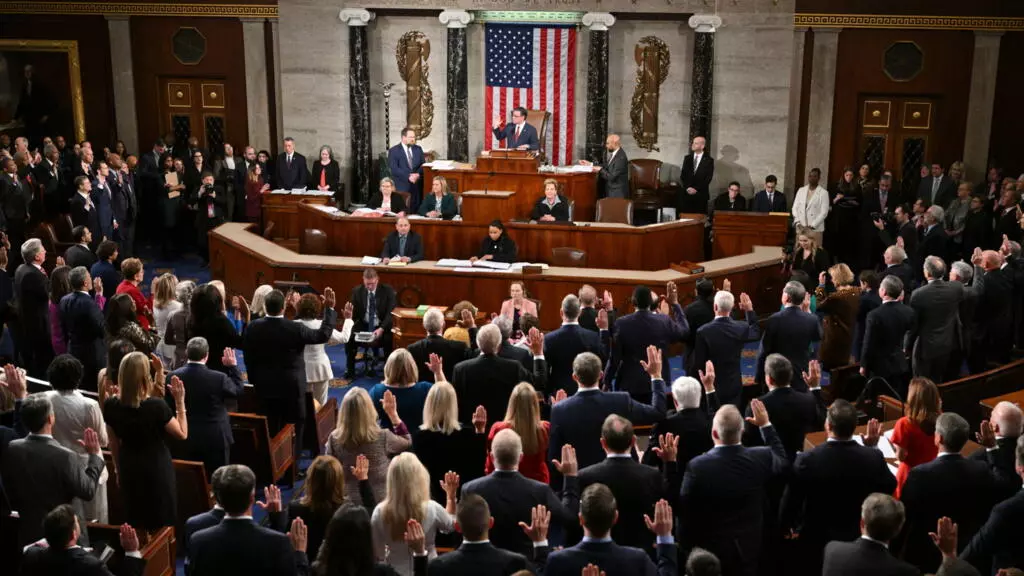
(ZENIT News / Washington, 11.11.2026).- A bipartisan initiative is seeking to bring Pope Leo XIV to the floor of the United States Congress, with 91 Republican and Democratic lawmakers asking congressional leaders to invite the first American-born pontiff to address a joint session in 2027. The proposal would give the Pope an opportunity to speak to the country’s political leadership at a time of deep divisions and place his American origins at the centre of a potentially historic visit.
The letter, dated 30 October and addressed to House Speaker Mike Johnson, a Republican from Louisiana, and Democratic Minority Leader Hakeem Jeffries of New York, argues that Leo’s election has given millions of Americans a particular reason for pride. His background, the legislators contend, could make him a unifying presence in a political environment increasingly marked by confrontation.
The initiative was led by Democratic Representative Mike Thompson and Republican Representative Brian Fitzpatrick. Its signatories believe that the Pope’s emphasis on service, compassion for others and human dignity would offer a valuable perspective on the difficult domestic and international questions facing Congress. They specifically recall the historic address delivered by Pope Francis to lawmakers in September 2015, urging congressional leaders to arrange a similar appearance by Leo as early as possible in the opening months of the 120th Congress.
Such an invitation would not be automatic. According to the Congressional Research Service, there is no formal procedure established in law or congressional rules governing invitations to foreign leaders or religious figures to address a joint session. The decision has traditionally rested with congressional leadership, often in coordination with the executive branch. The lawmakers’ letter is therefore an appeal to the House leadership to take the necessary political and institutional steps, rather than confirmation that an address has been arranged.
For Leo, a visit would carry significance beyond the symbolism of returning to his country of birth. Born in Chicago, the Pope has spoken openly about his affection for the United States and his hope of visiting soon. In June, he said that the Vatican had been reviewing the calendar for the following two years, although no decision had yet been made. The 250th anniversary of the Declaration of Independence in 2026 has also provided an opportunity for him to reflect on the country’s founding ideals. In July, he sent a message recalling the Declaration’s enduring language of freedom, equality, the pursuit of happiness, justice and democratic self-government. He also accepted the 2026 Liberty Medal awarded by the National Constitution Center in Philadelphia.
The timing of any American journey remains uncertain. Leo is currently undertaking a visit to South America, with stops in Uruguay, Argentina and Peru, the country where he spent more than two decades of his adult life. The trip is scheduled to conclude on 17 November. No visit to the United States has been formally announced.
A papal address to Congress would place Leo in a distinguished line of predecessors. Benedict XVI spoke to lawmakers during his 2008 visit, while John Paul II travelled to the United States seven times during his 26-year pontificate. Francis’s 2015 appearance, however, remains the most immediate precedent invoked by the lawmakers behind the new appeal.
The significance of the proposed invitation lies partly in the unusual convergence of national identity and religious authority. As the first Pope born in the United States, Leo occupies a position unlike that of any predecessor: he can speak to American society both as its native son and as the head of a worldwide Church whose moral concerns extend far beyond national interests. His message on human dignity, peace, solidarity and the common good could therefore reach an audience well beyond Catholics.
Whether Congress ultimately issues the invitation will depend on its leaders. But the fact that 91 lawmakers from both parties have joined the appeal suggests that, at least for this initiative, the prospect of hearing the Pope has created a measure of common ground in a deeply divided Washington.
Thank you for reading our content. If you would like to receive ZENIT’s daily e-mail news, you can subscribe for free through this link.

Publicaciones relacionadas:
 “The missionary scope of Lent”: Pope Leo XIV’s Ash Wednesday homily, with which he opens his first Lent
 Did Pope Leo XIV speak out against the Spanish party Vox, which is aligned with the Trump administration?
 Pope Leo XIV concludes his annual spiritual exercises with some impromptu words about Christ and Communion
 An Italian: this is the Pope’s new ambassador “to” Donald Trump
