(ZENIT News / Rome, 08.16.2026).- Answered by Legionary of Christ Father Edward McNamara, professor of liturgy and sacramental theology at the Pontifical Regina Apostolorum university.
Q: My question regards blessings such as that of fire, candles, water and oils. In some ceremonies, such as the Chrism Mass, the Easter vigil and the feast of the Presentation (February 2), these objects are blessed at Mass. Do these objects receive the blessing in such a way that they can transmit the blessing by being placed into contact with other similar objects? In other words, so that it does not run out, is it correct to add ordinary water to blessed holy water? So that it does not run out, is it correct to add unblessed oil to the holy oils and the sacred chrism blessed by the bishop in the Chrism Mass? And so that the light from the fire blessed during the Easter vigil be perpetuated, may it be passed along to another candle? — J.P.G., Zipaquirá, Colombia
A: To answer this question, a distinction is in order. Blessings are usually divided into constitutive and invocative blessings.
An invocative blessing is one that implores God’s favor on the person or object blessed but does not change their nature nor reserve them for a sacred function. These are the vast majority of blessings such as when the faithful ask for the blessing on themselves and their families, and on their home, cars and other objects of daily use.
A constitutive blessing is one in which the person or object is separated from normal use and constituted as a sacred person or object. These blessings are reserved to an ordained minister: to a bishop (blessing of an abbot, consecration of a Church, chrism) or to a priest (blessing of a chalice).
The blessing of devotional objects such as rosaries, medals, small crosses, candles and the like can be done by a priest or deacon. The blessing of devotional candles on February 2 would be of this latter kind of devotional blessing.
While a constitutive blessing does separate an object from secular use, not all blessings have the same effect. The blessing of a church and an altar separate the building from profane use entirely and reserves it as the house of God. The blessing of the holy oils means that they become part, in some cases an essential part, of the sacraments.
Rosaries, candles and the like are separated for devotional purposes of the faithful but do not acquire a different nature as such. Nor do they transmit their blessing to similar objects by contact.
The Church will occasionally offer special graces and indulgences to the use of blessed rosaries and the like, but this is a kind of spiritual pedagogy to encourage their use in prayer rather than granting them some special nature.
The fact that the nature of a blessed object is not fundamentally changed can also be seen by the fact that canon law determines that any blessed object, even those subject to constitutive blessings such as chalices and other objects used in the liturgy, lose their blessing the moment someone attempts to sell them.
I think that hence we can answer our reader’s broader question by saying that no, blessed objects cannot transmit the blessing by mere contact with unblessed objects of a similar nature. Hence, a blessed candle cannot transmit its blessing to other candles.
Likewise, while it is perfectly possible to perpetuate the light of the Easter fire by lighting another candle or lamp, the blessing as such is not transmitted. It would also not make much liturgical sense to perpetuate this light when the Church itself withdraws the Easter candle from daily use once Eastertide has ended.
A different question is the possibility of diluting holy water or the sacred oils in cases of severe scarcity.
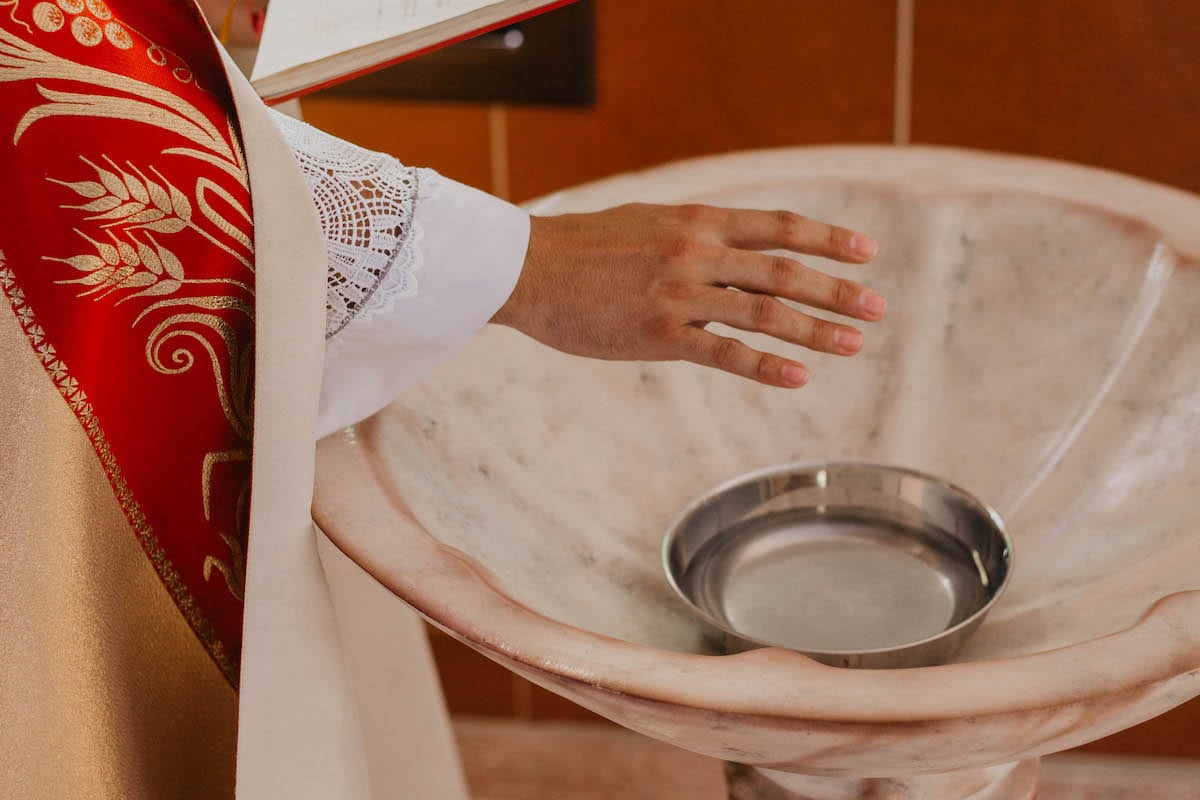
With respect to holy water there is a custom, but not an established law, that ordinary water may be added to holy water provided that the amount added constitutes less than half of the holy water.
This idea is mentioned by St. Thomas Aquinas, who seems to accept the general principle that “water added to holy water becomes holy” (STh., III q.77 a.8 obj. 3; cf. q.66 a4 resp.) but states logically that this would not apply to the case of adding other liquids to the Precious Blood of Christ: “If the liquid of any kind whatsoever added be so much in quantity as to permeate the whole of the consecrated wine, and be mixed with it throughout, the result would be something numerically distinct, and the blood of Christ will remain there no longer.” Conversely, “if the quantity of the liquid added be so slight as not to permeate throughout,” the Precious Blood remains (STh., III q.77 a.8 resp).
Following this logic, and applying it to the case of holy water, it has become the general opinion of theologians over the centuries that a small amount of holy water added to a large vessel of unblessed water, does not transform the water into holy water while a smaller quantity of ordinary water added to holy water does not remove the blessing.
Most commentators about this topic usually refer to blessed baptismal water rather than holy water per se. The practical reason behind this may have been the fact that the blessing of baptismal water was a somewhat long and complicated rite and hence, in an emergency situation in which sufficient baptismal water was lacking, adding a little more ordinary water was seen as a valid solution.
In today’s liturgy, blessing holy water, while slightly longer than most blessings, is no great burden for priests and deacons, and they should be able to assure a sufficient supply of freshly blessed water so as to render the need to add unblessed water unnecessary.
With respect to adding more oil to the holy oils blessed by the bishop, especially regarding the sacrament of the sick, we answered a similar question in 2007 and 2012. Below we offer an updated version of the earlier answers.
The proper matter for the sacrament of the anointing of the sick is olive oil or, if olive oil is unavailable, some other oil made from plants.
The general norm is that the holy oils to be used should be those blessed by the bishop. This oil is blessed for the whole year at the Chrism Mass.
The Roman ritual of anointing (no. 22) encourages the minister of anointing to «make sure that the oil remains fit for use and should replenish it from time to time, either yearly when the bishop blesses the oil on Holy Thursday or more frequently if necessary.»
Canon 847 of the Code of Canon Law further enjoins priests to obtain recently consecrated or blessed oils from his own bishop and not to use old oils except in case of necessity.
If a parish is running short, then the priest could inquire at the cathedral, as many dioceses keep a reserve supply during the year. One may also ask another parish, especially one that has no hospitals, if it can spare some oil.
When a priest has no blessed oil and a grave need occurs for the anointing of the sick, Canon 999 provides him with a solution so that nobody might be deprived of the grace of this sacrament. It states that any priest may bless the oil in a case of necessity but only in the actual celebration of the sacrament.
Although the canon restricts the priest’s blessing of the oil to cases of necessity, it does not determine the degree of the necessity, and the priest may judge it in each case.
If this is done, the ritual explains that any oil blessed by the priest and left over after the celebration of the sacrament, should be absorbed in cotton or cotton wool and burned.
Because of the priest’s faculty of blessing the oil of the sick in case of need, the questions about using or mixing in unblessed oils should no longer be an issue in this case.
Previously, the general opinion was that the use of unblessed oil or oil blessed by an unauthorized priest was of doubtful validity. The Holy See had responded negatively to propositions favoring these opinions, but it did so in terms that did not entirely settle the question from the dogmatic point of view.
The debate remained open among theologians regarding the possibility of using a different holy oil blessed by the bishop (either the chrism or the oil of catechumens) for the sacrament of the sick. Also unsettled was the question of whether mixing blessed and unblessed oil invalidated the sacramental matter.
Many theologians approved of the first opinion: that different holy oils could be used. Fewer theologians, however, proposed the possibility of mixing blessed and unblessed oils. The 1917 Code of Canon Law, however, was open to this possibility as we will see below.
The questions were never definitively resolved and, as we mentioned, have been superseded by the new discipline allowing the priest to bless the oils.
No matter what the theological opinions might have been, all agreed that priests administrating this sacrament should follow exactly the Church’s liturgical norms and not risk any danger of invalidity. This advice remains valid today.
Another matter is the oil of catechumens, which is used for the non-essential complementary rites of baptism.
Although it is obviously preferable to use that blessed by the bishop at the Chrism Mass, the Rite for the Christian Initiation of Adults (RCIA No. 101 in the U.S. English edition or No. 129 in the Latin original) allows for an exception: «The oil used for this rite is to be the oil blessed by the bishop at the chrism Mass, but for pastoral reasons a priest celebrant may bless oil for the rite immediately before the anointing.»
Once more, this provision renders moot any discussion about adding unblessed oil to the oil of catechumens.
Finally, there is chrism, a mixture of olive oil and balsam, which is the essential matter of the sacrament of confirmation and which is also used during the complementary rites of baptism, priestly ordination and some other rites such as the dedication of a Church or altar.
Unlike the case of the other oils, Canon 880 §2 states: «The chrism to be used in the sacrament of confirmation must be consecrated by a bishop even if a presbyter administers the sacrament.»
There is no provision for a priest to make and bless chrism. Should a shortage emerge on a diocesan level, a diocesan bishop could well bless more chrism outside of the Chrism Mass.
As mentioned above, with respect to the possibility of adding unblessed oil to the holy oils the 1917 Code of Canon Law allowed for this possibility in line with the prevalent theological opinion of the times. To wit:
“Canon 734 §1. The holy oils that are used in the administration of certain Sacraments must be blessed by the Bishop on the [Holy Thursday] immediately before; older [oils] shall not be used unless necessity urges.
“§2. In case of an insufficient supply of blessed oil, the non-blessed oil of olives can be added, [and] even [added] again, though in an amount less than [was] the original.”
The present Code of Canon Law, in line with current practice, and according to the opinion of some canonists, suppresses by omission the dispositions found in Canon 734 §2.
The present-day code says:
“Can. 847 §1. In administering the sacraments in which holy oils must be used, the minister must use oils pressed from olives or other plants and, without prejudice to the prescript of can. 999, n. 2, consecrated or blessed recently by a bishop; he is not to use old oils unless it is necessary.
“§2. The pastor is to obtain the holy oils from his own bishop and is to preserve them diligently with proper care.”
As we can see, the possibility of diluting the holy oils is no longer mentioned. This would appear to eliminate the previous practice since it would only be necessary in the case of a lack of chrism, and this would be an exceptional circumstance.
For this reason, some dioceses have explicitly excluded the mixture of oils. For example, in 2021 the Archdiocese of Boston reminded clergy and faithful:
«The Church requires the use of proper oils for the celebration of the Sacraments. In the case of Confirmation, the use of the proper oil, the Sacred Chrism, involves the validity of the Sacrament. Only oils pressed from olive plants or from other plants that have been recently consecrated or blessed by the Bishop may be used in the administration of the Sacraments (Canon 847§1). Old oil can only be used when there is a true necessity (Canon 847§1). The Holy Oils can never be diluted under any circumstances with additional oil, even in order to fill an oil stock or container to display the oils in an ambry or a repository. Perfumes or other substances can never be added to the consecrated and blessed oils. Also, the Holy Oils may never be employed for non-sacramental use.»
There are, however, some writers who hold the opinion that, in spite of being no longer mentioned in canon law, the underlying theological argument is still valid and could be used in a case of authentic emergency.
In my view, from what we have seen for the oils of the sick and of catechumens, the faculties granted to the priests to bless fresh oil would make the need to dilute the older oils practically nonexistent.
One might envisage an emergency for the chrism albeit in highly unlikely situations. It could only be justified in dramatic circumstances such as a priest having to confirm someone in a situation of imminent danger of death. But even in such a case so little chrism would be required that it would be hard to imagine a need to dilute it.
* * *
Readers may send questions to zenit.liturgy@gmail.com. Please put the word «Liturgy» in the subject field. The text should include your initials, your city and your state, province or country. Father McNamara can only answer a small selection of the great number of questions that arrive.
Thank you for reading our content. If you would like to receive ZENIT’s daily e-mail news, you can subscribe for free through this link.