

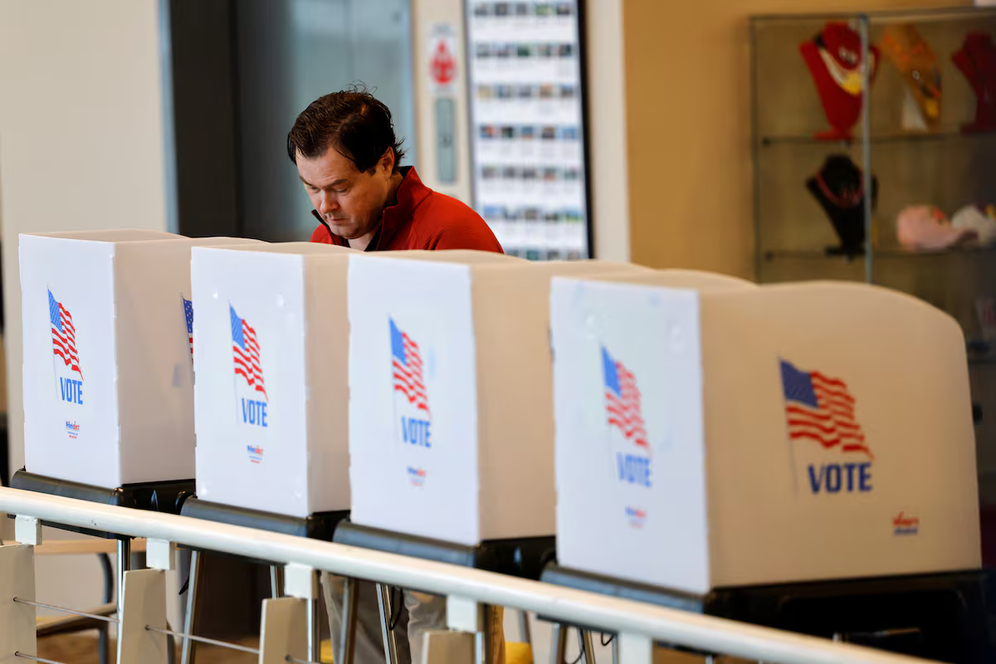
(ZENIT News / Rome, 11.08.2026).- The American Catholic vote, once a decisive source of support for Donald Trump, has become one of the clearest indicators of the political discontent confronting his presidency. In the November 3 midterm elections, Catholics divided almost evenly between Democrats and Republicans, marking a dramatic reversal from the 2024 presidential contest.
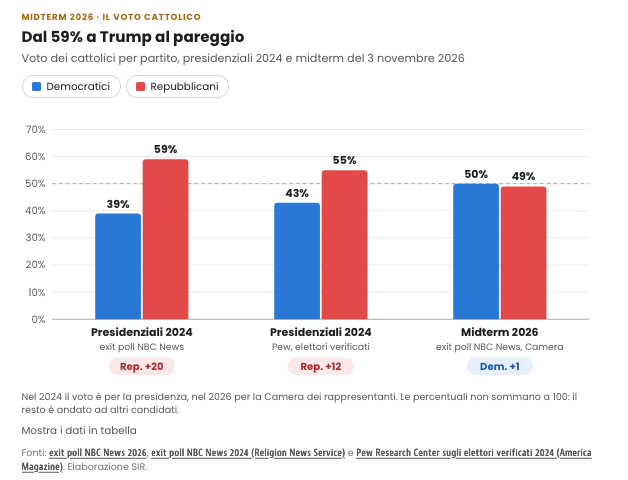
According to NBC News exit polls conducted with other media organizations across 45 states, 50% of Catholic voters supported Democratic candidates and 49% backed Republicans. The result is particularly striking because Catholics account for approximately one in five American voters. Just two years earlier, Trump had won their support by a commanding margin: 59% voted for him, compared with 39% for Kamala Harris. This time, Democrats not only recovered ground among Catholic voters but secured control of both chambers of Congress, with significant Senate victories in states including Ohio, Maine and Texas.
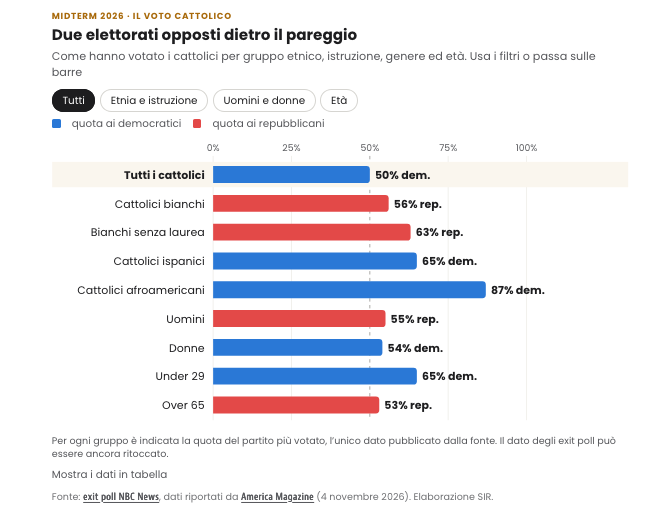
The shift reflects broader national dissatisfaction, but the Catholic electorate is far from politically uniform. White Catholics remained firmly Republican, with 56% supporting the party’s candidates. Among white Catholics without a university degree, that figure rose to 63%. Hispanic Catholics, by contrast, voted Democratic by 65%, while African American voters did so by 87%. The wider Hispanic electorate also moved towards the Democrats, whose share of the Latino vote rose from 51% in 2024 to 64% in these midterms.
The divisions suggest that Catholic political allegiance is increasingly shaped by competing social and economic experiences rather than by a common religious identity. Ryan Burge, a political scientist at Washington University in St. Louis, has described Catholics as relatively soft Republican supporters, whose loyalty can weaken when economic conditions deteriorate. Economic discontent appears to have been an important factor in the Democratic gains, although the election results cannot be attributed to a single issue.
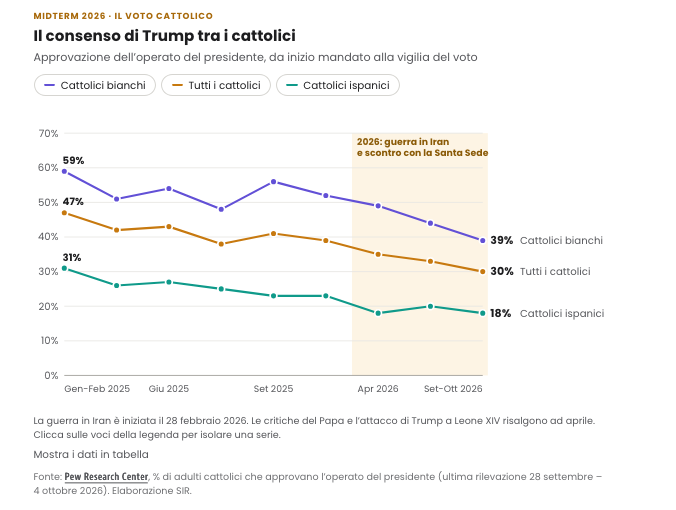
Trump’s declining standing among Catholics had already become apparent before election day. Pew Research Center data showed his approval rating among Catholic adults falling from 47% at the beginning of 2025 to 30% in early October 2026. Among white Catholics, approval declined from 52% in January 2026 to 39%. The deterioration unfolded during a year marked by an increasingly public confrontation between the White House and Pope Leo XIV, particularly over the war in Iran.
The dispute became especially visible in April, following the outbreak of the conflict on February 28. On April 10, addressing the Chaldean bishops, Leo XIV urged Christians to proclaim that disciples of Christ, the Prince of Peace, cannot stand with those who launch bombs. Trump’s response was sharply critical: he described the Pope as weak on crime, while Vice President JD Vance, a Catholic convert, cautioned Leo to be very careful when discussing theology. The remarks provoked criticism even from CatholicVote, a prominent conservative Catholic organization that had previously supported Trump. Its reaction was notable given that its former president, Brian Burch, is now the US ambassador to the Holy See.
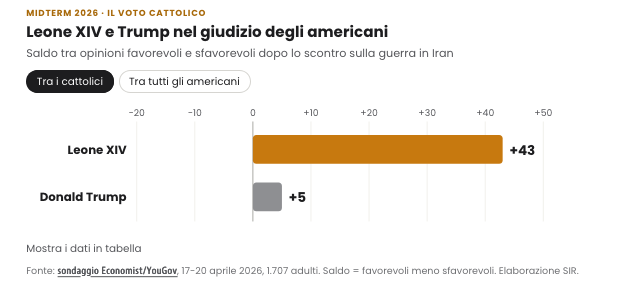
The contrast between the Pope’s and the president’s public standing among Catholics was already evident in an April Economist/YouGov survey, which gave Leo a net approval rating of 43 points among Catholic respondents, compared with five points for Trump. That gap, together with the subsequent decline in presidential approval, suggests that the administration’s confrontation with the pontiff may have further weakened Trump’s appeal. It would nevertheless be premature to conclude that the dispute itself determined how Catholics voted: economic concerns, immigration, abortion and other political issues also shaped the outcome.
The election also exposed tensions within the American Catholic relationship with the Republican administration over the presentation of religious support. On October 22, the White House released footage of twelve bishops praying with Trump in the Oval Office. The video was subsequently circulated through the president’s campaign channels, accompanied by a claim from White House spokeswoman Taylor Rogers that no president had been better for American Catholics. Archbishop Jeffrey Grob of Milwaukee later apologized, saying that the moment of prayer had been manipulated. The episode raised an important question about the boundary between pastoral engagement with political leaders and the use of religious authority to endorse a political administration.
For the US bishops, the election brought another difficult result: defeats for pro-life initiatives in three of the four states holding abortion-related referendums. Voters in Virginia and Nevada approved constitutional protections for abortion rights. Missouri rejected an attempt to repeal the abortion rights measure adopted in 2024, while Idaho rejected a proposal that would have introduced such protections. The outcome represents a serious setback for the pro-life movement, particularly in Virginia, where Bishops Barry Knestout of Richmond and Michael Burbidge of Arlington warned that the constitutional amendment would permit abortion in circumstances they described as practically unlimited.
These defeats also reopen a debate about the effectiveness of the Church’s political strategy. Daniel Rober, a professor at Sacred Heart University, has argued that the election exposes a dead end in the culture-war approach pursued by some bishops since the late 1990s. That criticism deserves consideration, especially when electoral defeats reveal the limits of relying on party alliances or ballot campaigns alone. But the result does not diminish the moral questions at stake. The protection of unborn life remains a central concern of Catholic teaching, alongside the defence of mothers, families and the social conditions that allow both women and children to flourish. A coherent pro-life commitment cannot be reduced to election results or partisan identification.
The broader challenge for the Church is therefore twofold: to defend its moral convictions without becoming identified with a political party, and to speak with independence when the actions of any administration conflict with human dignity and the demands of peace. The bishops’ own public interventions reflect that tension. Before the election, Archbishop Paul Coakley of Oklahoma City, president of the US Conference of Catholic Bishops, reminded citizens that participation in democracy is both a right and a responsibility, adding that discouragement is not a Christian virtue.
Leo XIV himself took part in the election by voting by mail, becoming the first pope to vote in a US election. The Holy See Press Office had previously reaffirmed the Pope’s conviction that citizens have both the right and the duty to participate in democratic processes. His involvement was not an endorsement of either party, but a reminder that the Church’s presence in public life cannot be confined to the interests of one political camp.
The near-even split among Catholic voters may thus prove more significant than a simple electoral swing. It reveals a community divided by race, generation, economic concerns and political priorities, while also showing that support for a president cannot be assumed simply because he has cultivated alliances with conservative Christians. For Trump, the loss of the Catholic advantage he enjoyed in 2024 is a warning. For the Church, it is an opportunity—and a test—to recover a public voice grounded not in political loyalty, but in the consistent defence of life, family, religious freedom and peace.
Thank you for reading our content. If you would like to receive ZENIT’s daily e-mail news, you can subscribe for free through this link.

Publicaciones relacionadas:
 Francis: The Pope Who Wept before the Virgin (and Before the Eyes of All)
 Artificial Intelligence and the Mission of the Church. An analytical contribution
 The health (physical, mental, and spiritual) of Australian clergy in 2025: What interesting research reveals
 How do young Catholics stay informed? Here’s how the digital generation consumes (and how often) news
