

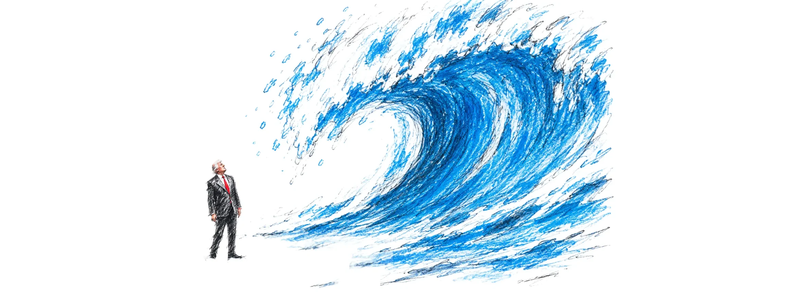
(ZENIT News – Caffe Storia / Rome, 11.07.2026).- The same themes emerge once again: American politics, Christianity (and beyond), and Islam (which must be understood in the plural). Yet, we find ourselves in what are being called the «most important midterm elections in history,” perhaps the least rhetorical hyperbole from the «Great Defeated One” — and the reality is far more complex than it appears.
Adam Hamilton, a Methodist pastor and newly elected senator, cites Matthew 7:12 and Micah 6:8 in Kansas, while also invoking the parable of the Good Samaritan. Byron Donalds, the new Governor of Florida, begins his victory speech by giving thanks to Jesus Christ. Then there is the political standoff between Gina Hinojosa, the new Governor of Texas, and Greg Abbott, a case where religious identity — specifically Catholicism,– is shared by both sides.
Looking back at the words spoken by the candidates following their victories, the presence of religion is both vivid and structural. Particular resonance surrounds the electoral wins of Abdul El-Sayed, the first Muslim state senator in the history of the United States, and James Talarico, a bright-eyed Texan who, in the heart of the land of oil and Westerns, wrested a Senate seat from the Republicans after 38 years.
In Michigan, when addressing his own spiritual framework, Abdul El-Sayed didn’t even pause for a translation — linguistic or otherwise. «Up until this very moment, you may have noticed that I kept saying ‘Inshallah‘, that is, ‘God willing’, whenever the outcome of this race was mentioned. But today, tonight, we can transform that ‘Inshallah‘ into ‘Alhamdulillah.’ And that… for the right-wing agitators, simply means ‘Praise be to God.'»
A subtle irony, used to dismantle xenophobic hysteria and attempt to heal the wounds left by the election campaign. «At first, they pointed at my name and my faith, as if to say: ‘He’s a bit different’ […]. But you all know that my name and my faith are not the reason why you can’t afford to pay for gas […] You have welcomed us into your homes, your churches, your synagogues, your veterans’ halls, and your union halls… You see, they detest the idea of an America that is big enough to include anyone who looks a little different or speaks a little differently.»
Many, and not just among the most conservative Republicans, might take issue with at least one of those «a little different» characterizations; yet, in El-Sayed’s discourse, the Islamic faith is nonetheless directed toward defining the boundaries of the civic compact and the secular responsibilities of politics.
Shifting the focus to Texas, James Talarico invokes one of the most famous pedagogical parables in history to illustrate a dramatic shift in the seat. «I am reminded of that story from the Scriptures about a young shepherd who faces a giant. For forty days, Goliath mocks and provokes him. On the day of the battle, he appears in full armor carrying so many weapons that he needs someone else to hold his shield. In this election campaign, we have faced our own Goliaths: the richest man in the world, the most powerful man in the world, and the entire Washington, D.C. establishment. David was neither as important nor as strong as Goliath… but he had hope. He had faith, and he had a sling… And tonight, we have defeated Goliath.»
Part teacher, part Presbyterian seminarian — Talarico has been both –the new senator concludes by returning to the roots of his philosophy: «The Scriptures have taught me, and my own life has taught me, to always bet on the side of the underdog.» A single stone becomes a lever for social redemption.
It is impossible not to notice that the «grammar of the sacred» employed by the Donald Trump phenomenon does not look to Scripture for ethical guidance or a path toward reconciliation. Instead, the Bible serves as a civic trophy, a symbol of belonging to a «great America.» In the Trumpian lexicon, faith functions through exclusion and polarization, pitting an «us» — the chosen ones –, against a threatening «them». God does not call for social justice or the welcoming of others; rather, He demands loyalty to the leader appointed to protect the nation (and, naturally, one’s own personal interests). He is a king without scruples, yet one chosen by Heaven to carry out a mission of national salvation.
The theological stance of Vice-President JD Vance carries distinct nuances. Having converted to Catholicism as an adult, Vance brings to the MAGA movement a complex doctrinal framework that evokes Augustine and Thomas Aquinas; he adapts the concept of ordo amoris (the order of love) to justify an «America First» agenda, effectively lecturing Pope Leo XIV, prioritizing one’s own children, neighbors, and national community as an exclusionary standard against «foreigners» (whether near or far), while framing the nation’s borders as a divinely ordained boundary.
This contrast reveals a landscape of theological and political divergences. While El-Sayed draws upon progressive Islam to expand the polis, and Talarico revives the evangelical «Social Gospel» to challenge financial oligarchies, Trump champions a civil, nationalist, and protectionist form of Christianity, whereas Vance positions his faith as a bulwark for a traditionalist, identity-focused Catholicism.
The divide becomes irreconcilable when it comes to the question of universalism: for the two progressive figures, faith is a principle that tears down walls and demands openness; for the conservative duo, the sacred serves as a demarcation line, used to determine who deserves protection within the fold and who must remain on the outside.
This unsettling theological fault line finds its seismograph in the Catholic electorate, a true bellwether and a mirror of the contradictions found across the Atlantic. As evidenced by polls from America Magazine and reports from the National Catholic Reporter, the Catholic electorate in these midterm elections shows a significant shift in positioning compared to 2024, though it has not converged into a Democratic majority. Split almost perfectly between the two parties, the Catholic vote remains a mosaic of political orientations and social sensibilities, where religious identity does not automatically align with partisan affiliation.
On one hand, twelve Catholic Bishops did not hesitate to pray in the Oval Office with Donald Trump shortly before the vote — sparking considerable controversy regarding the political use of the event — while, on the other, Catholic identity reveals its inherently polyphonic nature. This spectrum ranges from figures like Gina Hinojosa in Texas, who views her faith as a moral compass, to Troy Jackson in Maine, and includes conservative members of the House such as Tom Emmer and Riley Moore, who have spoken publicly about their practice of the Rosary and their participation in sacramental life.
It is a mosaic that demonstrates how American Catholicism resists simplistic, caricatured portrayals. Caught between the impulses of the Church’s Social Doctrine and the siren song of identity politics, the Catholic electorate embodies the very arena in which the meaning of the sacred continues to shape, and contest, the nature of American democracy.
Against the backdrop of this theological clash, there remains, finally, the extravagant perspective of the White House Office of Faith-Based and Neighborhood Partnerships, directed by senior advisor and televangelist Paula White. Trump’s spiritual counselor embodies the perfect synthesis of faith, power, and profit. In this scenario of a monetized pseudo-gospel and devout sovereignism, the only real doctrinal uncertainty concerns the agenda of the Office itself: it remains to be seen whether the counselor will choose to focus efforts on the realm of divine protectionism, or whether, true to the logic of her creed, she will end up proposing tax breaks for those who can demonstrate that their wealth is an unequivocal sign of grace.
Translation from the original English text, under the responsibility of the Editorial Director of ZENIT.

Publicaciones relacionadas:
 Revealing Report Highlights Growing Marginalization of Christians in the United Kingdom
 What keeps pastors in the pulpit, and why do some leave? The study that sheds light on departures by Catholic priests
 The schism and the ecumenical problems ahead: a woman is the new head of Anglicans worldwide
 The Other Global Shortage: A Hundred Million Christians Still Waiting for a Bible
