

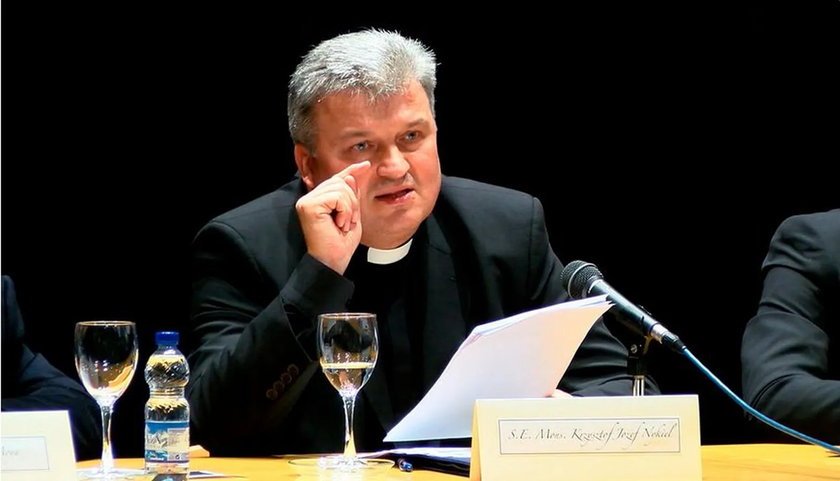
(ZENIT News / Rome, 11.02.2026).- The Regent of the Apostolic Penitentiary, Monsignor Krzysztof Józef Nykiel noted, during a seminar held at the Vatican, that Confession should not be confused with psychotherapy, nor should it be reduced to a paralyzing sense of guilt; rather, it is a moment of interior regeneration.
The Apostolic Penitentiary organized the 5th Seminar on the practice of Sacramental Confession, titled «Celebrating the Sacrament of Reconciliation,» held at the Palazzo della Cancilleria on October 23 and 24. Monsignor Nykiel’s presentation summarized the preceding contributions, which outlined «a comprehensive map — biblical, spiritual, psychological-existential, and pastoral — of the path of conversion.»
By emphasizing that authentic contrition does not consist of dwelling on one’s own errors, but rather in recognizing them in the light of God’s love, it becomes clear that a confessor is «not a judge of the ruins,» but a «servant of mercy.» As Monsignor Nykiel stated, «Contrition is not a price to be paid, but the beginning of a new creation wrought by the Holy Spirit.»
The Regent of the Vatican body explained that «authentic contrition does not arise from self-loathing or from a mere observation of the evil one has committed, but from a gaze directed toward divine mercy. A human being, therefore, dares to look at their own sin because they know, above all else, that they are loved and welcomed.» It should be noted that a «sense of guilt» — when it is «psychological, static, and self-referential» — «overwhelms the person with the illusion of being guilty» and «leads to paralysis or to frenetic confessions [sought] merely for emotional relief.»
On the contrary, Monsignor Nykiel explained, «a person dares to look at their own sin because they know, above all else, that they are loved and welcomed.» He further clarified that this is not «a paralyzing sense of guilt» or «a psychological analysis sterilely confined to itself,» but rather «a liberating encounter between the truth of our own fragility and the superabundance of God’s mercy.» Based on this principle, «confession should not be confused with psychotherapy,» and the confessor does not act as «a judge of ruins,» but rather as «a servant of reconstruction who accompanies the penitent from the state of guilt toward mercy.»
He also recalled the encyclical Dilexit Nos, in which Pope Francis highlighted the «indissoluble link between interior contrition and external reparation.» Reparation, he noted, is «not merely a moralistic duty,» but rather «the fruit of a pierced heart that chooses to build upon the ruins caused by sin.»
The Regent of the Apostolic Penitentiary described the seminar as «a school of prayer and reconciliation» for all participants, intended to «bear concrete fruit» in their «spiritual lives.» To this end, he offered four practical suggestions for engaging with the Sacrament of Reconciliation.
First, «begin with love, not with an internal tribunal.» This is achieved through «a good examination of conscience, which should not start from a list of failures or from self-criticism, but rather from the contemplation of God’s mercy and of the Crucified One.» Furthermore, «only when we recognize how much we are loved do we find the courage to look at the gravity of our sin, without justifying ourselves and without falling into despair.»
Second, «call sin by its name and overcome self-referentiality,” which is attained by «escaping the trap of guilt, which leads us to say ‘I’m worth nothing,’ and instead embracing evangelical contrition, which says: ‘I have wounded Love, but I desire to return to the Father.'»
Next, «extend the Sacrament of Reparation,» because «Confession does not end with the final absolution: while contrition looks toward God, reparation looks toward one’s neighbor and the community.»
Monsignor Nykiel’s final suggestion was to keep one’s heart open to the Word of God, a Word that does not judge others and remains open to hope.

Publicaciones relacionadas:
 Pope’s Address on Pastors and Laity: Exploring Ways of Participation
 The Vatican’s Pontifical Academy for Life Clarifies Its President Position, Following Erroneous Interpretations of His Thought
 Nearly thirty papal appointments to the Dicastery for the Doctrine of the Faith
 The Catholic Church’s Mission Territories Continue to Grow: Here Is the Data
