(ZENIT News / Rome, 08.19.2026).- What if the most powerful way to honor peace were to give its most prestigious prize to those who have never had the power to make war?
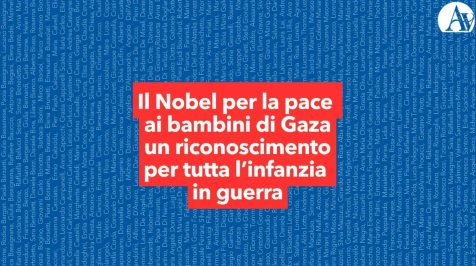
That is the question behind a proposal to nominate the children of Gaza for the Nobel Peace Prize, an initiative embraced by the Italian bishops’ newspaper and strongly defended by Father Ibrahim Faltas, vicar of the Custody of the Holy Land.
The proposal was prompted by a stark figure: 300 children and adolescents reportedly killed during the 300 days following the ceasefire that took effect on October 10, 2025 — effectively one child a day during a period that was supposed to mark an end to the violence.
For Faltas, the symbolism is precisely the point. The children did not negotiate, command armies or decide to fight. They nevertheless became among the most vulnerable casualties of a conflict shaped by decisions made by adults.
“They deserve the Nobel Peace Prize because they themselves embody the very meaning of the word peace,” Faltas argued, stressing the physical and psychological consequences suffered by children as a result of adult decisions.
The initiative was first proposed by a philosophy professor at the University of Naples Federico II and subsequently adopted by Avvenire, the newspaper established at the initiative of Pope Paul VI and published by the Italian bishops’ conference. Thousands of readers have reportedly expressed support, although the proposal has also attracted criticism.
Faltas sees the award not merely as an honor but as a moral statement.
Recognizing Gaza’s children, he argues, would acknowledge what war takes away from childhood itself: parents, education, play, security and the ordinary experiences through which children grow into adulthood.
It would also make the suffering of children impossible to reduce to a statistic.
Yet the proposal becomes more significant when Avvenire deliberately widens its scope beyond Gaza.
The newspaper has emphasized that children killed in war are not divided into categories of greater or lesser innocence according to their nationality. Israeli children were among those murdered in Hamas’ October 7, 2023 attack, while other children have suffered after being held in terrorist captivity. Ukrainian and Russian children have been caught in the consequences of the war in Ukraine; young people have also suffered amid violence in Iran and Sudan.
This broader framing is essential to the proposal’s credibility.
A Nobel nomination centered exclusively on one population could easily become another instrument in the political arguments surrounding the Middle East conflict. Avvenire instead presents the children of Gaza as a symbol of a universal reality: children do not lose their right to protection because of the identity of their parents, their nationality or the side of a conflict in which they happen to live.
The principle is elementary, but wars repeatedly violate it.
Children are not responsible for the decisions of governments, armed groups or military commanders. They cannot be treated as legitimate targets because of the political identity of their communities. And protecting them does not require denying the suffering of children on the other side of a conflict.
That is why the proposal can be understood as something larger than a statement about Gaza.
Faltas describes recognition of the children’s sacrifice as an act of truth and justice. Avvenire similarly argues that the nomination should honor childhood in wartime across generations and continents.
Thank you for reading our content. If you would like to receive ZENIT’s daily e-mail news, you can subscribe for free through this link.