

(ZENIT News / Rome, 08.22.2026).- Answered by Legionary of Christ Father Edward McNamara, professor of liturgy and sacramental theology at the Pontifical Regina Apostolorum university.
Q: Is it correct to celebrate the sacraments without any lit candles, for example, a wedding, with or without Mass? What about other celebrations? — E.D.S., Brasilia, Brazil
A: The use of candles would depend on which sacrament is being celebrated and the particular circumstances of the celebration.
An exception would be the first form of the sacrament of reconciliation in which the penitent confesses privately to the priest. Here no candles are foreseen.
When any sacrament is celebrated within Mass, the corresponding number of candles should always be used. This is specified in several documents. Principally in the General Instruction of the Roman Missal:
“307. The candles, which are required at every liturgical service out of reverence and on account of the festiveness of the celebration (cf. no. 117), are to be appropriately placed either on or around the altar in a way suited to the design of the altar and the sanctuary so that the whole may be well balanced and not interfere with the faithful’s clear view of what takes place at the altar or what is placed on it.”
This norm is further corroborated in the Introduction to the Lectionary:
“92. Candles, which are signs of reverence and festivity, are to be used at every liturgical service. The living flame of the candle, symbolic of the risen Christ, reminds people that in baptism they are brought out of darkness into God’s marvelous light. For the celebration of the Eucharist, it is appropriate to carry candles in the entrance procession and during the procession with the Book of the Gospels. At least two candles are placed near the altar in the sanctuary area. If there is a lack of space, they may be placed on the altar. Four or six candles may be used for the celebration of Mass and for the exposition of the Blessed Sacrament. If the bishop of the diocese celebrates, seven candles may be used. Candles placed in floor-standing bases or on the altar should be arranged so they do not obscure the view of the ritual action in the sanctuary, especially the action at the altar.”
Since the celebration of a sacrament, such as baptism, confirmation or a wedding during Mass, is practically always a festive occasion it would usually require the use of six candles.
This goes for ordinations, which are always within Mass except in very dire circumstances. Even the occasional celebration of the anointing of the sick within Mass should be considered a festive celebration, increasing the suffering person’s union with Christ.
Outside of Mass, the use or not of candles would depend on the rubrics of each ritual and particular circumstance.
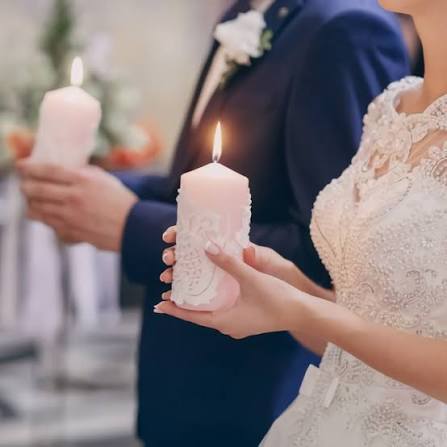
For baptism, the only candle foreseen is the Easter candle. Shortly after the baptism the priest hands over the white garment and then an unlighted candle saying, “Receive the light of Christ.” Then either the adult baptized person, or in the case of an infant, a parent or godparent, lights the candle from the Easter candle.
Therefore, for baptism outside of Mass it is clear that the Easter candle is intrinsic to the rite.
For the Rite of Confirmation Outside of Mass, while there is no specific mention of lighted candles, the fact that the rubrics foresee that the bishop celebrates the sacrament in the sanctuary of a church, and the aforementioned principle that candles are “required at every liturgical service,” would indicate that they should be lit as for a Mass.
The same principle would also apply to a wedding celebrated in Church but outside of Mass, especially if Communion is to be administered.
Likewise, the principle would apply to the anointing of the sick whenever it is celebrated in a church.
Outside of a church the rubrics for the anointing of the sick foresee the use of candles, above all when the sacrament is united to the reception of Communion:
“Those who are with the sick should be asked to prepare a table covered with a linen cloth upon which the Blessed Sacrament will be placed. Lighted candles are prepared and, where it is customary, a vessel of holy water.”
Although we have mentioned that candles are not foreseen during the sacrament of reconciliation, lighted altar candles, and other candles, might accompany the second communal form of the sacrament when it is celebrated in a church. This celebration often happens during Lent, Advent, or parish missions.
The celebration begins with a hymn, a priestly greeting, a prayer expressing forgiveness, Scripture readings from the Old and New Testaments, a brief homily and time for personal reflection. After this each penitent confesses to a priest individually and receives absolution. There are usually several priests available on such occasions. During this time, other prayers may be recited. When the foreseen time has concluded the priest blesses the congregation and ends with “Go in peace.”
Other non-sacramental liturgical rites also foresee the use of candles. For example, the Rite of Holy Communion and Eucharistic Worship Outside of Mass foresees candles on practically all occasions when Communion is distributed in a church or in homes. It also has important indications for adoration:
“54. For exposition of the blessed sacrament in the monstrance, four to six candles are lighted, as at Mass, and incense is used. For exposition of the blessed sacrament in the ciborium, at least two candles should be lighted, and incense may be used.”
The altar candles are also lit for every solemn celebration of the Liturgy of the Hours and may be lit even on less solemn celebrations.
In conclusion, we can say that, generally speaking, candles must be used for all sacraments celebrated in a church, except for the first form of the sacrament of reconciliation. The use of candles should not be omitted on these occasions.
In some cases, such as a sacrament celebrated in imminent danger of death, these elements can be omitted.
There may be some other exceptional circumstances in which the bishop can grant reasonable exceptions to the general rule. This could include Masses and other rites celebrated in hospitals where the presence of highly volatile oxygen and other gases exclude any living flame whatsoever.
* * *
Readers may send questions to zenit.liturgy@gmail.com. Please put the word «Liturgy» in the subject field. The text should include your initials, your city and your state, province or country. Father McNamara can only answer a small selection of the great number of questions that arrive.
Thank you for reading our content. If you would like to receive ZENIT’s daily e-mail news, you can subscribe for free through this link.

Publicaciones relacionadas:
 Vatican Limits Traditional Latin Mass in Texas Diocese Following Bishop’s Removal
 Questions about liturgy: Multiple Crucifixes in a Church
 From Oxford to the Catholic Liturgical Calendar: Vatican gives St. John Henry Newman a place in the Catholic Church’s daily prayer
 Questions about liturgy: The Sanctuary in Lent
