

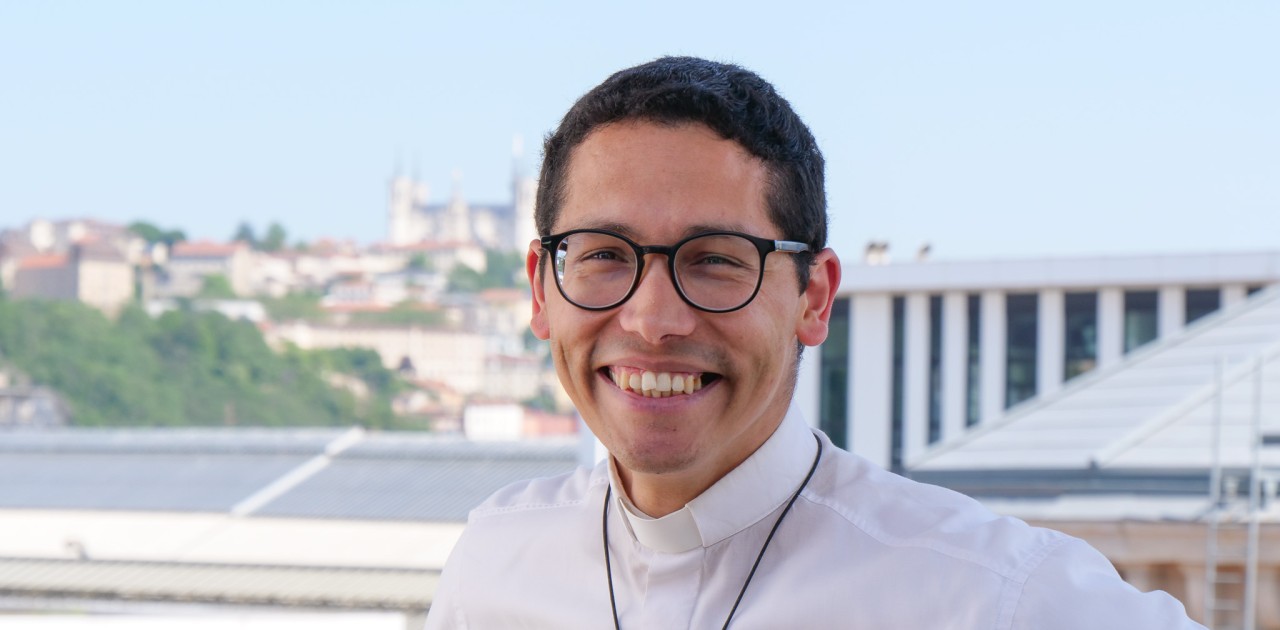
(ZENIT News / Guadalajara, 11.12.2026).- During his youth, the man who is now Father Amari began to experience religious questions that led him to re-examine his own beliefs.
While pursuing university studies in Strasbourg, he began studying philosophy. An intellectual encounter proved decisive: reading Blaise Pascal, who spoke not of the «God of the philosophers and scholars,» but of the God who touches the heart, the God of Revelation. It was then that he thought: «Perhaps I have missed what is essential by seeking only through reason.»
He was particularly struck by the distinction between the «God of the philosophers» and the «God of Revelation,» the God who makes Himself present in human life.
Later, a Protestant friend gave him a New Testament. Reading the Gospels transformed his understanding of God and human existence.
One of his most significant reflections was: «The Gospels restored my vision of the deeper meaning of existence and helped me understand that God is love, that we were created to be loved.» He added a phrase that encapsulates his experience: «Thanks to Jesus, all the pieces of the puzzle fell into place.»
Rejected by his family after converting from Islam, Father Mustapha Amari found a new family within the Chemin Neuf (New Path) Catholic community, where, in 2027, he will mark 10 years in the priesthood.
He initially encountered some difficulties within the Church itself. When he requested baptism at a parish in Strasbourg, he was asked to wait and consult with the Bishop, as it was not a typical situation.
Amari understood that his conversion entailed much more than simply changing religions; it meant assuming a new identity and being prepared to face the resulting familial and social consequences.
Although his relationship with his parents has not yet been fully restored, a process of reconciliation has begun. He affirms that God has given him a family a hundred times better: his religious community and his brothers and sisters in the faith.
Conversions from Islam to Christianity have steadily increased in Europe in recent years, prompting the emergence of specialized local missions. However, few converts go on to embrace religious or priestly life.
For these converts, the decision to renounce their former religion entails significant risks and sacrifices, ranging from the severing of family ties and social rejection to physical violence. Furthermore, they do not always receive support from the Catholic Church hierarchy, which often seeks to avoid religious tensions on a continent marked by intense debates over immigration and local identities. The story of Father Mustapha Amari is emblematic in this regard.
The Appeal of the Universality of the Gospel
While many converts from Islam claim to have encountered Christ through profound mystical experiences, the path taken by Father Amari, now 40 years old, was more gradual and internal.
Surrounded by practicing Muslims, as well as Christians and atheists, he began to question his own beliefs and study philosophy. «My faith blossomed first from a philosophical foundation, rather than an existential one,» he stated.
Until then, he had often wondered why his life had unfolded so well. After a difficult first year upon arriving in France, his family had settled in a town in the Alsace region, where the local residents welcomed them and cared for them with great warmth. He felt that he was finally receiving the answer his heart had longed for all that time.
He had tried to return to Islam, but could find no reason to do so other than his roots. He felt that his parents’ religion was too heavily influenced by culture and did not allow him to reach God, as its conception of transcendence precludes the search for tangible signs of the divine presence.
«The Gospels restored my vision of the deeper meaning of existence and helped me understand that God is love, that we were created to be loved,» he affirmed. «Thanks to Jesus, all the pieces of the puzzle fell into place.»
«In Jesus, God follows a unique path for every person.» This is universal; it can take the right path for each individual, whether through illness, a missionary calling, or any number of other things.
All or Nothing
At that time, however, he was not yet fully aware that choosing Jesus would demand significant sacrifices, starting with his own family. He had not even been baptized yet when his father disowned him and his mother stopped answering his phone calls.
For its part, the Church did not exactly welcome him with open arms at first. When he inquired about baptism at a parish in Strasbourg, he recounts that he was told to return after the summer and that, subsequently, the Bishop would have to be consulted because it was considered a «special case.»
«It felt like they were taking a vacation,» he remarked. «It bothered me a bit, but in a way, I understood it.»
The painful loss of his family made his commitment even more urgent. «I told myself that I could not have lost my family only for my Christian faith to consist merely of attending Mass on Sundays,» he stated. «Your life with Jesus has to be 100%; otherwise, it’s not worth it.»
The decision to enter the priesthood became clear to him after a year of volunteer work and a month-long Ignatian silent retreat. The sense of having received countless graces throughout his journey of conversion outweighed his initial fear of solitude and celibacy.
«The Bible verse that says, ‘To whom much is given, much will be required,’ sums up my whole life,» he added.
«There are so many people who do not have the grace to encounter Jesus — why me?» he would constantly ask himself. He feared that if he kept receiving without giving of himself, he would become like a «rotten fruit on a tree.»
Discovering the lifestyle promoted by the Chemin Neuf community, based on communal living and shared responsibility between laypeople and clergy, provided him with the balance he needed. He was ordained a priest in 2017 as a member of that community and is currently attached to a parish on the outskirts of Paris.
The difficulties stemming from his status as a convert did not disappear with his religious vocation. Although he never faced direct retaliation for leaving Islam, he had to limit his online testimonies to platforms within Catholic communities. «When I opened my TikTok account, around 2018 or 2019, I received very violent comments and had to stop; I wasn’t prepared for that.»
He credits the community of believers with giving him the strength he needed to face adversity and loneliness over the years. He illustrates this through what he considers a parable: an evening in Portimão, in southern Portugal, where he and his community were hosting a festival for 4,000 young people during the week leading up to World Youth Day of 2023.
It also happened to be his mother’s birthday, and he tried to call her just five minutes before going up on stage. «As usual, she refused to answer,» he recounted. A few minutes later, with great determination, he invited the young people to commit their lives to Jesus. «I saw thousands of them come forward, moved by his fervor. It is one of the most beautiful images of my life,» he affirmed.
He insisted that he holds no resentment toward his parents. He acknowledges that, by becoming a Christian and later a Catholic priest, he asked a great deal of them. Although he has recently begun a process of reconciliation with his parents, thanks to the power of prayer, he also notes that this rift has borne fruit within his own family.
As a child, his academic excellence had earned him his father’s special favor — at times to the detriment of his siblings.
«I lost my place in the family,» said Father Amari, «but that place was given to my brothers and sisters in a different way. And that is wonderful.»
For his part, God gave him «a family a hundred times better»: a religious community, brothers and sisters, and homes all over the world.
His story shows that evangelization in Europe does not consist solely of reaching out to those who have abandoned religious practice; it also involves accompanying people from other traditions who are seeking to join the Church.
Other Highly Significant Testimonies
Born in Bosnia and Herzegovina, Senad Mrkkaljevic arrived in Germany as a refugee. At the age of 23, he began reading the Bible and attending Mass in secret. Following his Catholic baptism, he pursued a priestly vocation. In 2016, he was ordained a priest in Berlin. His story is particularly significant because he transitioned from being a religious seeker to serving pastorally in a neighborhood with a large Muslim population.
Born in Bavaria, Germany, to Turkish parents, Antuan Ilgit grew up in Turkey. He converted to Christianity as an adult, joined the Society of Jesus (Jesuits), and was appointed Auxiliary Bishop of Anatolia by Pope Francis in 2023. His case is especially notable due to his journey from a Muslim family to the Catholic episcopate.
Conversions from Islam to Catholicism in Europe represent much more than individual stories of religious change; they are a testament to a search for God that remains present in the heart of contemporary man. Whether people come to Christ through philosophy and the study of the Gospels, or discover Him through the witness of other Christians, each story serves as a reminder that faith is, above all, a personal encounter that transforms one’s life. The evangelizing significance of these conversions does not lie in counting how many people leave one religion to embrace another, but rather in recognizing the power of witness, the act of welcoming, and the accompaniment offered by the Church. In a Europe marked by secularization and religious diversity, these new Catholics remind us that the proclamation of the Gospel remains meaningful, and that the Church’s mission always begins by revealing, through both words and deeds, the face of Christ. As their lives demonstrate, the search for truth can become a path toward encountering Love.

Publicaciones relacionadas:
 Italian Cardinal Comes Out in Defense of Cardinal Joseph Zen, Archbishop Emeritus of Hong Kong
 Peter Seewald, Benedict XVI’s Biographer, Says the Pope Emeritus “Is Suffering Very Much Because of the Situation of the Church
 Cardinal Joseph Zen Ze-kiun, Bishop Emeritus of Hong Kong, Receives Sentence from the Chinese Communist Government
 Caring for poor and forgotten communities: these are Guatemalan nuns
