

Marie-Armelle Beaulieu
(ZENIT News – Terra Santa Net / Jerusalem, 11.26.2026).- «Now my daughters go out at night, and no one cares.» This is how a man interviewed by Mada al-Carmel researchers describes his life abroad. He also recounts the fate of a man who had invited him to his wedding. The man had spent almost his entire life outside the country before returning at his family’s request. He was murdered shortly after coming home, while on his way back from work. «If a homeland cannot provide security, it ceases to be a homeland,» the witness observed.
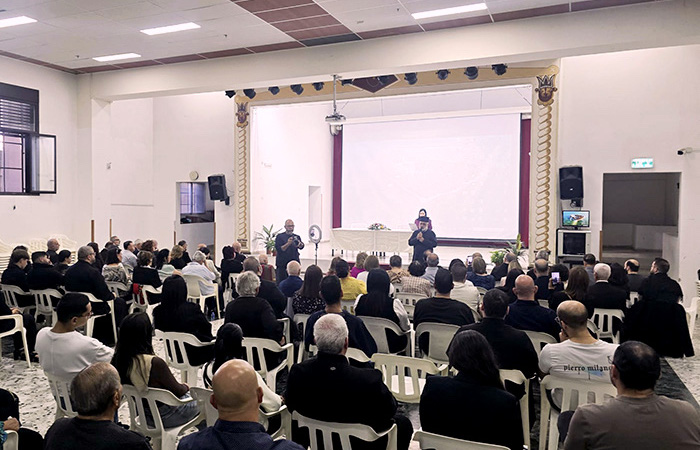
This account appears in a study conducted by Ameed Saabneh and Habib Makhoul for Mada al-Carmel, the Arab Center for Applied Social Research, based in Haifa. The findings were presented on November 14 in the parish hall of the Latin Church of Saint Joseph, during an event organized by the Christian Forum in the Holy Land. Its Coordinator, Wadie Abunassar, called on churches, parishes, and associations to collaborate more effectively to understand the reasons why people emigrate and to address the underlying causes.
Increase in Departures, Decrease in Returns
In 2019, Israel’s Central Bureau of Statistics recorded 417 departures abroad among Arab Christians residing in Israel. This figure rose to 694 in 2022, 707 in 2023, 880 in 2024, and 1,023 in 2025. The progressive increase, therefore, was already underway before October 7, 2023, and has continued ever since. At the same time, the number of people returning increased from 345 in 2019 to 295 in 2025. Net migration, which accounts for these returns, shifted from -72 to -728 individuals. When considering the size of each community, the comparison presented by the researchers shows that the migration deficit in 2025 was more pronounced among Christians than among Muslims or Druze.
The surveys cited in the study show a different trend. According to the Israel Democracy Institute, 28% of Christians surveyed in 2024 expressed an intention to emigrate, compared to 27% in 2019. A survey conducted in 2009 among young Christians in Galilee had already yielded a similar proportion. The groups surveyed vary from one study to another. Nevertheless, a sharp increase in emigration has been observed in recent years, while the percentage of those considering leaving has remained largely unchanged. The presence of family members abroad, as highlighted in several interviews, can facilitate the decision to emigrate, as individuals know whom to turn to for advice, where to find accommodation, and who might offer hospitality upon arrival.
More Vulnerable
The researchers conducted 23 interviews, eleven of which were with Christians. Thirteen of these individuals had already emigrated, while ten were considering doing so. In this exploratory study, religious affiliation rarely emerges as the sole determining factor. Christian participants, like others, cite wars, political uncertainty, and rising crime within Israel’s Arab society. Some young people add that they have experienced workplace pressure or various forms of marginalization — issues that have intensified since the October 7th massacre three years ago. Some view a foreign passport as a last resort. «I am afraid of becoming a refugee,» one survey participant confessed.
Some of the Christians interviewed believe that the small size of their families makes them more vulnerable to extortion, as they have less support to rely on when faced with threats. The interviews document this perception and indicate that extortion affects various sectors of Arab society.
Conditions for Remaining
On November 14 in Haifa, the Latin Patriarch Emeritus of Jerusalem, Archbishop Michel Sabbah, recalled the words of Jesus: «You are the salt of the earth,» and added: «We may be few in this land, but we will continue to fulfill our mission and preserve our values.» The Custos of the Holy Land, Friar Francesco Ielpo, emphasized the Church’s responsibility to «create the conditions that allow for the experience of true fraternity.» He expressed his hope that young people might «envision their future here and dream of building it in this land.»
These conditions are also addressed in very concrete terms. The Pontifical Mission in Jerusalem highlighted its collaboration with the Baladna Association to prevent school dropouts, a situation that can leave young people more vulnerable to recruitment by gangs. Other initiatives focused on family debt and cooperation between laypeople and Church leaders. For their part, researchers intend to continue their work with young people. In both Haifa and Nazareth, it is to them that one must turn to hear what might still inspire someone to build their life here.
Leo XIV: Let Us Remain Close to the Christians of the East!
On the morning of November 20, 2026, Pope Leo XIV received a delegation from the Catholic Near East Welfare Association (CNEWA) in an audience, marking the centenary of its founding by his predecessor, Pius XI.
The Pope described CNEWA as the Holy See’s primary agency in North America for pastoral and humanitarian assistance to the Churches of the East. Based in New York, the Association supports Bishops and clergy, and contributes to the formation of new leaders, Catholic education, and aid for those in need, including in emergency situations. It also oversees the Pontifical Mission for Palestine, established in 1949 to assist Palestinian refugees.
In his brief address, the Pope also touched upon the issue of Christian emigration from the Middle East. He stated: «Throughout the Middle East and other regions, Christians continue to suffer the consequences of war, persecution, instability, and poverty. Many have been forced to leave the lands where their ancestors lived and where their Churches have proclaimed the Gospel since the earliest centuries of Christianity. When a Christian family is compelled to leave its homeland, it loses much more than just a place to live: a community is weakened, a living tradition is threatened, and the presence of the Church diminishes.» «For this reason,» added Leo XIV, «supporting Eastern Christians in their lands of origin is a fundamental work of hope. At a time when many of them are tempted by discouragement, your presence reminds them that they are not alone and that suffering and uncertainty do not have the last word.»

Publicaciones relacionadas:
 A besieged Easter: Lebanon’s Christians between bombardment, blocked aid, and a fragile hope
 Haiti: Second kidnapped priest released
 Situation in Israel and Gaza raises fears of migration wave also in Iraq
 Holy Land: Catholic Church denounces Jewish settlers’ encroachment on church-owned properties. Israeli government seeks to mend relations
