

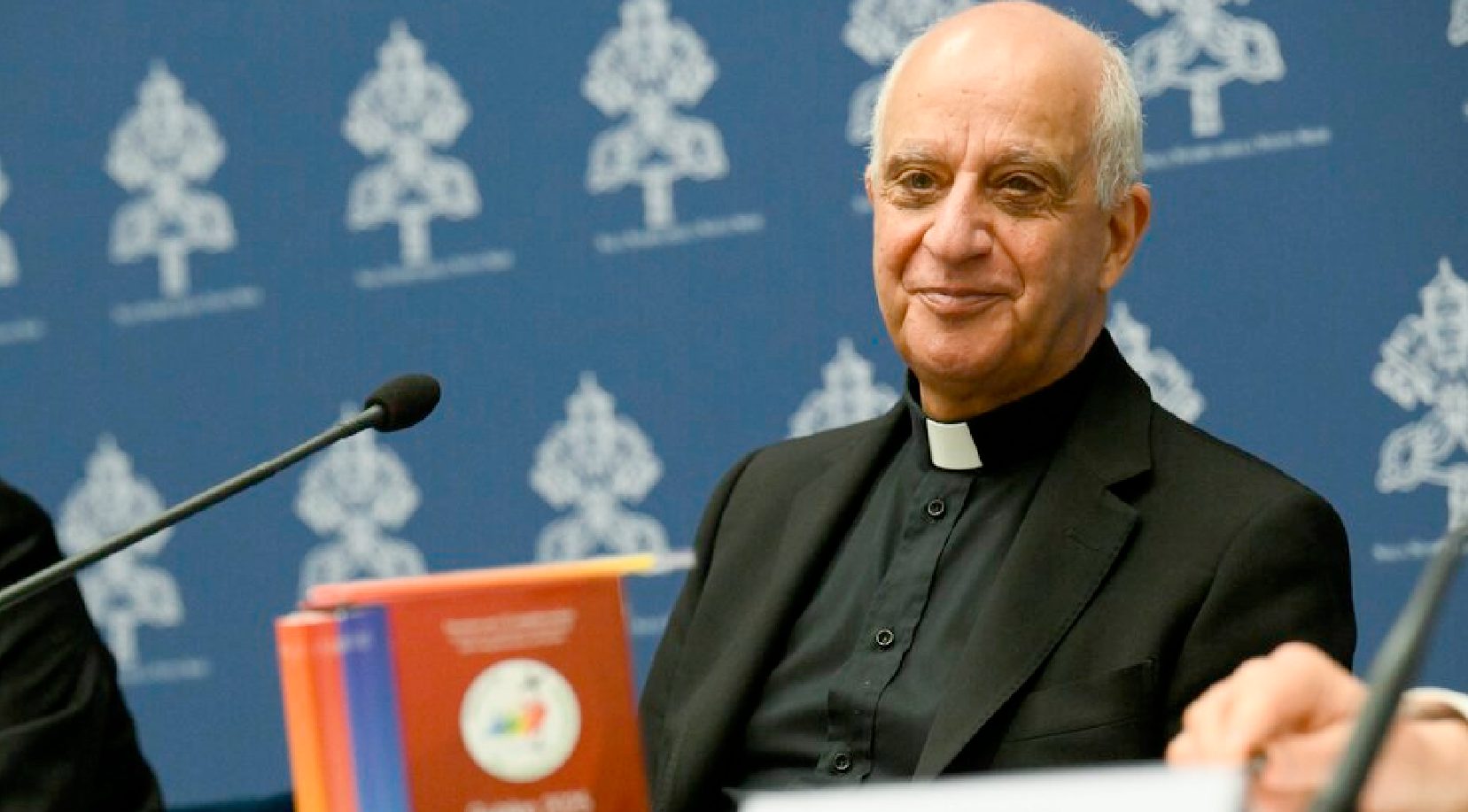
(ZENIT News / Rome, 09.07.2025) – Since the opening of the Holy Door last December 2024, the Vatican has already welcomed millions of pilgrims from all walks of life.
Since January 2025, numerous events have been held, attracting an ever-increasing number of people from all over the world to make a pilgrimage and pray during this Jubilee Year. ZENIT interviewed Archbishop Rino Fisichella, Italian Pro-Prefect of the Dicastery for the New Evangelization and organizer of the 2025 Jubilee.
Q: Your Excellency, in this Jubilee Year, what strong impressions do you have of the opening of the Holy Door and the passage through Rome of so many pilgrims?
Archbishop Fisiclella: Every day I leave home to go to the Dicastery for Evangelization and I have to cross the Via della Conciliazione, near St. Peter’s Square. I always see many pilgrims walking, praying, and crossing the Holy Door. Tourists, locals, anyone who is there can see the Jubilee Cross and the pilgrims asking for the grace of the Plenary Indulgence. I must say it impresses me greatly.
Those who pray give a powerful witness to others, and questions may arise: What is the meaning of this world when we pray in the heart of the city? Who are these people, and why do they bear this witness? This becomes a source of evangelization, a question that affects above all the meaning of life.
It is no coincidence that the Dicastery for Evangelization was entrusted with the task of organizing and celebrating the Jubilees. Evangelization is not a theory: it is a testimony, a living experience of the transmission of the faith. To date, approximately 11 million pilgrims have come to Rome to celebrate the Jubilee Year.
I must say that this is a very significant figure. It is true that we also had two important events: the funeral of Pope Francis and the election of the new Pope, Leo XIV.
Q: What can you tell us about the importance of the Jubilee process and how pilgrims are reacting?
Archbishop Fisichella: The experience of joy is essential. We see pilgrims walking and praying with joy, very happy to be in the city of Saints Peter and Paul to experience the Jubilee. We give them a piece of paper, a prayer aid: this is very useful because their journey then becomes a path of prayer. And once inside St. Peter’s Basilica or other Papal Basilicas, such as Saint Paul Outside-the-Walls, Saint Mary Major, or Saint John Lateran, we make our profession of faith.
Professing faith at the tomb of Peter means bearing witness, living a unique experience where the Apostle Peter bore witness to his faith in the crucified and Risen Lord. Everyone also prays for the Holy Father, Peter’s Successor, who has the task of unifying the Church, bearing witness to Christ’s Resurrection and of hope.
Let’s not forget that the Jubilee must be lived in light of the motto «Being Pilgrims of Hope.» I would say even more, if we wish to maintain the original motto: «Pilgrims in Hope.» Confirming our faith at this place will be a concrete source of charity and hope for believers.
Q: What have been the most significant jubilee events so far?
Archbishop Fisichella: I must say there have been some very significant events. I think of the Jubilee for Adolescents, where we welcomed more than 200,000 young people who gathered to experience joy, including on the day of Pope Francis’s funeral.
We also cannot forget the Jubilee celebrated for Families, where there was a truly considerable turnout of pilgrims, or the Jubilee of Movements, Associations and New Communities, here, once again, St. Peter’s Square was no sufficiently large to receive all the participants. Other events were not as well attended, but were significant moments. I’m thinking of the Jubilee of Popular Music Bands and Shows, or the Jubilee of the Sick and Disabled.
I must also say that during the Jubilee of Families, we had a very important experience called «Dialogue with the City»: we were present in several well-known squares in Rome to present the meaning of the Jubilee and give testimonies.
Q: And what other important events do you expect between now and the end of the year?
Archbishop Fisichella: What I expect as a continuation, without a doubt, is the Jubilee of Young People at Tor Vergata, which will commemorate the Great Jubilee of the Year 2000. Almost a million people are expected to attend, and it will be an event that will touch the very life of the Church, thanks to the enthusiasm young people will experience together.
We will also have the Jubilee of Catechists, which is very important because catechesis continues to be an essential moment in the transmission of the faith in our Catholic community. During the Jubilee Year we will also experience other important events, such as the canonization on September 7 of two young men, Carlo Acutis and Pier Giorgio Frassati, who lived an experience of holiness and who encourage young people today to follow their example.
Let’s not forget that in all the Jubilees of the last century there have always been symbolic Canonizations. In 1950, Pius XII canonized Saint Maria Goretti, a young girl, martyr. Saint John Paul II canonized Saint Faustina as a sign of mercy, and Pope Francis canonized Mother Teresa, another concrete sign of God’s mercy.
Q: How did you experience the death of Pope Francis and the election of Pope Leo XIV?
Archbishop Fisichella: The death of Pope Francis affected the entire Church. We were saddened to see this Pope, so close to the People of God, leave us unexpectedly. But, of course, the Jubilee continued, and this event allowed us to experience it differently. Sadness was transformed into joy: a joy born of Christian hope.
I met with Pope Leo XIV several times. During the first audience with him, we were to confirm or make changes to the organization of the Jubilee. The Holy Father listened attentively and decided to confirm almost all the events. He also wanted to continue as Pope Francis had decided.
I must also say that the enthusiasm generated by the election of Pope Leo XIV has seen an increase in the number of pilgrims. And we can see how many pilgrims will attend the Jubilee and how many more are expected, as they want to hear and see the new Pope.
Q: What is your vision for the future of the Church after the Jubilee Year and how it will continue to accompany these millions of pilgrims in hope?
Archbishop Fisichella: I must say that, for the moment, we will be really busy over the next six months, with the numerous events and commitments we must address. But I’m sure that afterward there will be more intense reflection on the subject of hope.
In our pastoral experience, we will have the opportunity to emphasize even more the need for hope. And we cannot forget what is necessary in the life of hope: to move from the «hopes» we live daily to «hope.» We will experience many disappointments because the «hopes» promised by today’s culture are far from being fulfilled. And we will have to regard Christian «hope» with greater force and depth.
Translation of the French original published by ZENIT’s French edition.

Publicaciones relacionadas:
 How Did Cardinal Prevost React To Being Elected and What Did He Feel About Being a «Papabili»? Cardinal Tagle Responds
 Pope Leo XIV indicates to bishops 4 theological cores and 4 indispensable virtues for a pastor
 ZENIT’s Interview with Cardinal François Bustillo: «Being A Cardinal Is Above All A Responsibility of Communion»
 The Consistory, The Situation of Christians in Iraq, and Their Return to Baghdad After a Brief Exile: An Interview with Cardinal Sako
