

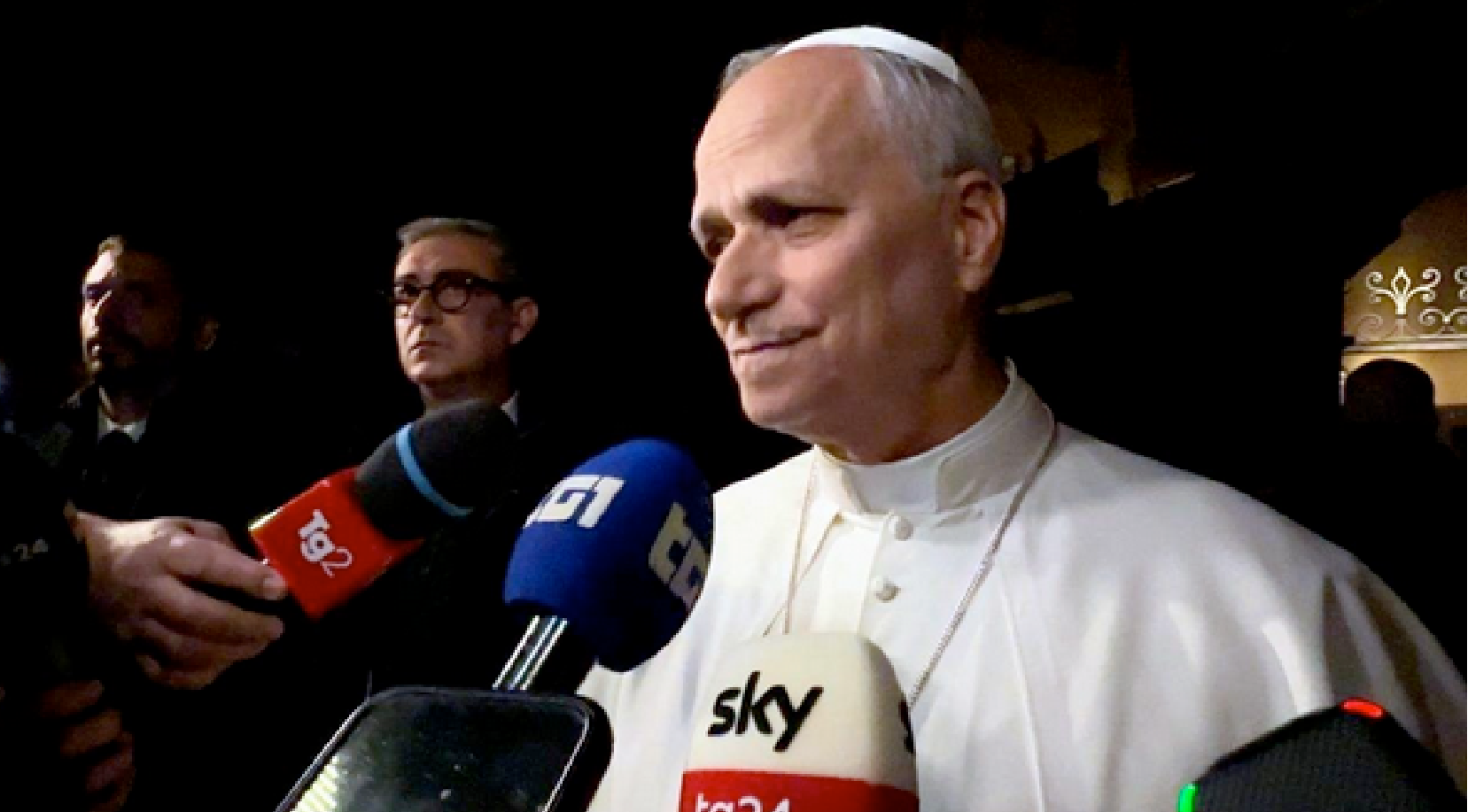
(ZENIT News / Castelgandolfo, 12.24.2025).- The final days before Christmas offered Pope Leo XIV an unusual public moment of synthesis: a brief, improvised exchange with journalists that wove together global conflict, fragile ceasefires, and a deeply personal moral disappointment rooted in his own homeland. The setting was Castel Gandolfo, as the Pope emerged from Villa Barberini amid carols, applause, and the quiet rituals of a papal visit now familiar to the lakeside town.
Speaking on the evening of December 23, Leo XIV returned repeatedly to a single theme that framed his reflections: the meaning of life, human dignity, and the possibility of peace—even if only for a day.
The Pope’s first words turned outward, toward the world’s active war zones. He expressed sorrow over Russia’s reported refusal to accept a proposed Christmas truce in Ukraine, calling the news one of the greatest personal burdens he carries during the holiday season. Christmas, he insisted, should not pass without at least a symbolic interruption of violence. His appeal was deliberately modest: not a comprehensive settlement, but 24 hours of restraint, a single day in which weapons fall silent.
The same hope surfaced when he spoke of the Middle East. Leo XIV referred to the recent visit of Cardinal Pierbattista Pizzaballa, Latin Patriarch of Jerusalem, to Gaza, describing it as a sign of pastoral closeness amid devastation. Only hours earlier, the Pope said, he had been in contact with the parish priest of Gaza’s Holy Family church, where Christians were attempting to celebrate Christmas under conditions that remain precarious. The pontiff voiced cautious optimism that negotiations over the next phase of a ceasefire might hold, even as daily realities on the ground remain unstable.
Yet the most pointed remarks of the evening were reserved not for distant battlefields, but for a decision taken in Illinois, the state where Leo XIV was born and raised. Responding to questions, the Pope confirmed that during a private Vatican meeting in November he had urged Governor JB Pritzker to veto legislation legalizing medically assisted suicide for terminally ill adults. That appeal, he said, was made clearly and directly, and was echoed by Cardinal Blase Cupich of Chicago during the same encounter.
The law was nevertheless signed on December 12, a decision that Leo XIV described without hesitation as deeply disappointing. For the Pope, the issue is not abstract policy but a fundamental question of how societies respond to suffering. He reiterated the Church’s conviction that life retains its dignity from conception to natural death, and warned against framing assisted suicide as an act of compassion while deeper failures in care, accompaniment, and solidarity remain unresolved.
Rather than lingering on political confrontation, however, Leo XIV used the moment to redirect attention to Christmas itself. The Incarnation, he said, reveals what human life truly means: not autonomy at any cost, but relationship, vulnerability, and hope. His invitation was broad, extending beyond Catholics to “all people,” asking them to reflect during the holiday on the goodness of life in every stage and condition.
The Pope’s comments resonated with concerns already voiced by the bishops of Illinois, who argue that the new law risks exposing the elderly, the disabled, and the poor to subtle forms of pressure, while diverting attention from the expansion of palliative care. Cardinal Cupich, in recent days, has also warned that state policies increasingly place Catholic healthcare ministries in direct conflict with their moral convictions, particularly on life issues.
In Castel Gandolfo, the Pope did not enumerate those battles in detail. Instead, he framed them within a wider horizon. From Ukraine to Gaza, from legislative chambers to hospital wards, Leo XIV suggested that the same moral question persists: whether human life is treated as inviolable, even when it is fragile, inconvenient, or marked by suffering.
The Pope’s appeal was neither diplomatic nor legislative in tone, but pastoral and symbolic. In a world marked by war and ethical fracture, he asked for something deceptively simple: one day of peace, and a renewed reverence for life that does not end when hope becomes difficult.
Thank you for reading our content. If you would like to receive ZENIT’s daily e-mail news, you can subscribe for free through this link.

Publicaciones relacionadas:
 3 key words of the missionary action of the Church and of the work of the Holy See’s diplomacy, according to Leo XIV
 Israeli Prime Minister Calls Pope After Military Attack on Catholic Parish in Gaza
 13 new ambassadors are presented to the Pope, who tells them that the Holy See will not be a spectator in human rights violations
 Pope Leo speaks with Israeli president and reiterates condemnation of anti-Semitism
