

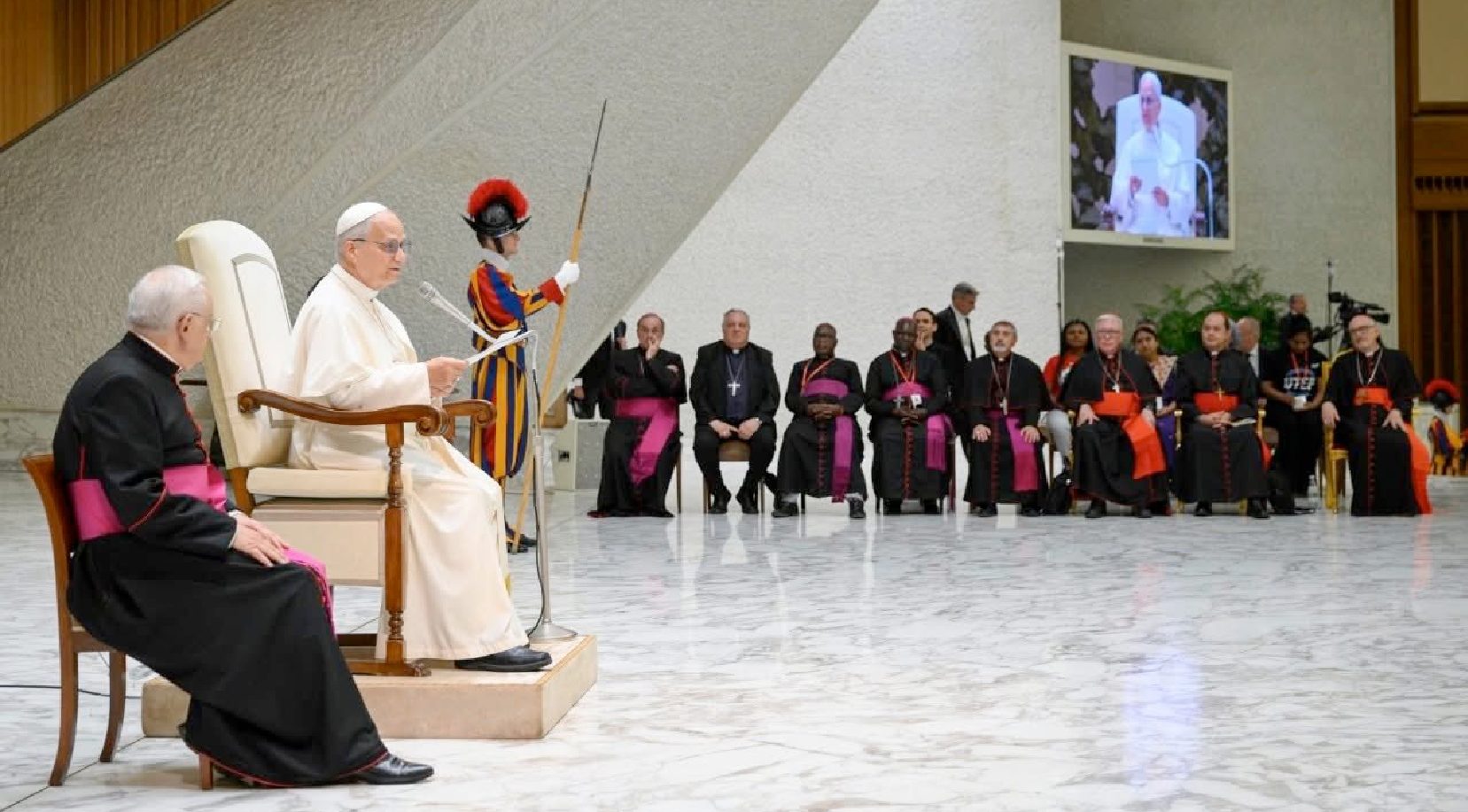
(ZENIT News / Vatican City, 24.10.2025) – On Thursday, October 23, Pope Leo XIV met with the participants in the World Meeting of Popular Movements, in Paul VI Hall in Vatican City. Starting with his explanation for choosing the name he bears, Leo XIV explained what the «new things» are in the situation of the people present there, that is, from the peripheries. We offer the English translation of the Pope’s address below.
* * *
Dear Brothers and Sisters:
This is the first time I have had the pleasure of meeting with you, continuing the path begun by Pope Francis, who, over the years, frequently engaged with your reality, highlighting your prophetic importance in the context of a world marked by problems of a diverse nature.
One of the reasons I chose the name «Leo XIV» is the Encyclical Rerum Novarum, written by Leo XIII during the Industrial Revolution. The title Rerum Novarum means «new things.» Certainly there are «new things» in the world, but when we talk about them, we generally adopt a view «from the center» and refer to things such as artificial intelligence or robotics. However, today I want to look at those «new things» with you, starting from the periphery.
See the «New Things» from the Periphery

More than ten years ago, here in the Vatican, Pope Francis told you that you had come to plant a flag. What was written on it? «Land, Housing, and Work» [1], as Guadalupe reminded us a moment ago. It was a «new thing» for the Church, and it was something good! Echoing Francis’s pleas, I say to you today: land, housing, and work are sacred rights; they are worth fighting for, and I want you to hear me, to listen to me say: «Me too!» «I am with you!»
Is asking for land, housing, and work for the excluded a «new thing»? Seen from the centers of global power, certainly not. Those who have economic security and a comfortable home may consider these demands as something outdated. The truly «new» things seem to be autonomous vehicles, the latest fashions or items, high-end cell phones, cryptocurrencies, and other similar inventions.
However, from the peripheries, things look different; the banner you raise is so relevant that it deserves an entire chapter in Christian social thought on the excluded in today’s world.
This is the perspective I wish to convey to you: to see new things from the periphery and to value your commitment, which does not limit itself to protesting, but seeks solutions. The peripheries cry out for justice, and you cry not «out of desperation,» but «out of desire»: your cry is a cry that seeks solutions in a society dominated by unjust systems. And you do not do this with microprocessors or biotechnology, but from the most elemental, with the beauty of craftsmanship. And that is poetry: you are «social poets»! [2]

Today, you once again raise the banner of land, housing, and work, walking together from a social center — Spin Time — to the Vatican. This journey together bears witness to the vitality of popular movements as constructs of solidarity in diversity. The Church must be with you: a poor Church for the poor, a Church that reaches out, that takes risks, that is courageous, prophetic, and joyful.
What I consider most important is that your service be animated by love. I know of similar realities and experiences in other countries, true community spaces filled with faith, hope, and, above all, love, which is the greatest virtue of all (cf. 1 Corinthians 13:13). In fact, when cooperatives and work groups are created to feed the hungry, provide shelter for the homeless, rescue the shipwrecked, care for children, create jobs, access land, or build homes, we must remember that we are not materializing an ideology, but truly living the Gospel.
At the heart of the Gospel, indeed, is the commandment of love, and Jesus told us that His own face is hidden in the faces and wounds of the poor (cf. Matthew 25:34-40). It is beautiful to see that popular movements, even before demanding justice, are driven by a desire for love, against all individualism and prejudice.
As Bishop in Peru, I had the good fortune to experience a Church that accompanies people in their sorrows, their joys, their struggles, and their hopes. This is an antidote to a widespread structural indifference that fails to take seriously the plight of peoples dispossessed, plundered, and reduced to poverty. We often feel powerless in the face of all this; however, in the face of what I have called the «globalization of powerlessness,» we must begin to oppose a «culture of reconciliation and commitment.» [3] Popular movements fill this void, born of a lack of love with the great miracle of solidarity, founded on caring for one’s neighbour and on reconciliation.

As I was saying, the normal discourse about «new things,» with its potential and risks, overlooks what happens in the peripheries. From the center, there is little awareness of the problems affecting the excluded, and when they are mentioned in political or economic debates, it gives the impression that the issue is treated as «an issue that is added almost out of obligation or as a peripheral matter, if not considered mere collateral damage. In fact, when it comes to concrete action, they are often left in the last place.» [4] On the contrary, the poor are at the center of the Gospel. Therefore, marginalized communities must be an active part of a collective and supportive commitment that reverses the dehumanizing tendency of social injustices and promotes integral human development.
Because, «as long as the problems of the poor are not radically resolved, renouncing the absolute autonomy of markets and financial speculation and attacking the structural causes of inequality, the world’s problems and, ultimately, no problem will be resolved. Inequality is the root of social evils.» [5]
Old Injustices in the New World
Your commitment is even more necessary in a world that, as we know, is increasingly globalized. As Benedict XVI stated, «The process of globalization, properly understood and managed, offers the possibility of a vast redistribution of wealth on a global scale, such as has never been seen before; but if it is poorly managed, it can increase poverty and inequality, and also spread a crisis to the whole world.» [6]
This means that the dynamics of progress must be managed from an ethic of responsibility, overcoming the idolatry of profit and always placing the human being and his integral development at the center. The «human» is at the heart of St. Augustine’s vision of the ethics of responsibility. He teaches us that responsibility, especially toward the poor and those in material need, is born from having a human attitude toward our fellow human beings and, therefore, from recognizing our «common humanity.» [7]

Because we all share the same humanity, we must ensure that «new things» are adequately addressed. This issue should not be left to political, scientific, or academic elites, but should concern us all. The creativity with which God has endowed human beings, which has generated great advances in many areas, has not yet been able to optimally address the challenges of poverty and, therefore, has not been able to reverse the trend of dramatic exclusion of millions of people who remain on the margins. This is a central point in the debate on «new things.»
When my Predecessor Leo XIII wrote Rerum Novarum at the end of the 19th century, he did not focus on industrial technology or new sources of energy, but rather on the plight of the working people. Therein lies the evangelical power of his message: the focus was primarily on the plight of the poor and oppressed of that time. And for the first time, and with absolute clarity, a Pope said that the daily struggles for survival and social justice were of fundamental importance to the Church. Leo XIII denounced the subservience of the majority to the power «of the few, so that a small number of very rich men have been able to impose on the masses of the working poor a yoke little better than slavery itself.» [8] Such was the great inequality of the time.
In Leo XIII’s Encyclical, we do not find the words «unemployment» or «exclusion,» because at that time the problems referred more to the improvement of workers’ conditions, exploitation, the need for a new social harmony and a new political balance, objectives that have been gradually achieved thanks to numerous labour laws and social security institutions. Today, however, exclusion is the new face of social injustice. The gap between a «small minority» — 1% of the population — and the vast majority has expanded dramatically. This exclusion is a «novelty» that Pope Francis denounced as a «throwaway culture,» vehemently stating: «The excluded are not ‘exploited,’ but marginalized, ‘discarded.'» [9]

When we talk about exclusion, we also face a paradox. The lack of land, food, housing, and work also exists alongside access to new technologies that are spreading everywhere through globalized markets. Cell phones, social media, and even artificial intelligence are within reach of millions of people, including the poor. However, although more and more people have access to the Internet, basic needs remain unmet. Let us ensure that, when the most sophisticated needs are met, the fundamental ones are not neglected.
This systematic arbitrariness deprives people of the necessary and submerges them in unnecessary things. In short, mismanagement generates and increases inequalities under the pretext of progress. And by not having human dignity as its central axis, the system also fails in terms of justice.
The Impact of «New Developments» on the Excluded
Today I will not exhaustively describe the «new novelties» produced by technological development centers in particular, but we know that they have an impact on all the fundamental areas of social life: health, education, work, transportation, urbanization, communication, security, defense, etc. Many of these impacts are ambivalent: they are positive for some countries and social sectors, but others, on the other hand, suffer «collateral damage.» Once again, this is the result of poor management of technological progress.
The climate crisis is perhaps the most obvious example. We see it in every extreme meteorological phenomenon, be it floods, droughts, tsunamis, or earthquakes: who suffers the most? It’s simply the poorest. They lose the little they have when water sweeps away their homes and are often forced to abandon them without a suitable alternative to restart their lives. The same happens when, for example, peasants, farmers, and indigenous populations lose their lands, their cultural identity, and sustainable local production due to the desertification of their land.
Another aspect of the «novelties» that particularly affect the marginalized has to do with the anxieties and hopes of the poorest regarding the lifestyles that are constantly promoted today. For example, how can a poor young person live with hope and without anxiety when social media constantly extols unbridled consumption and completely unattainable economic success?
And, furthermore, another significant problem is the spread of digital gambling addiction. The platforms are designed to create a compulsive need and generate habits that create dependency.
I don’t want to fail to mention the «novelty» of the pharmaceutical industry, which undoubtedly represents a major advance in some respects, but is not without ambiguity. In today’s culture, not without the help of certain advertising campaigns, a kind of cult of physical well-being is propagated, almost an idolatry of the body. In this vision, the mystery of pain is interpreted in a reductionist way. This can even lead to a dependence on painkillers, whose sale obviously increases the profits of the producing companies themselves. This has also led to opioid addiction, which is particularly devastating in the United States. Consider, for example, fentanyl, the drug of death, the second leading cause of death among the poor in that country. The proliferation of new, increasingly lethal synthetic drugs is not just a crime committed by drug traffickers, but a reality linked to the production of medicines and their profits, lacking a global ethic.

I would also like to emphasize that the development of new information and telecommunications technologies depends on minerals that are often found underground in poor countries. Without coltan from the Democratic Republic of the Congo, for example, many of the technological devices we use today would not exist. However, its extraction depends on paramilitary violence, child labour, and population displacement. Lithium is another example: competition between major powers and large corporations for its extraction represents a serious threat to the sovereignty and stability of poor States, to the point that some businessmen and politicians boast of instigating coups d’état and other forms of political destabilization, specifically to seize the «white gold» of lithium.
And finally, I would like to mention the issue of security. States have the right and duty to protect their borders, but this must be balanced with the moral obligation to provide refuge. With the abuse of vulnerable migrants, we are not witnessing the legitimate exercise of national sovereignty, but rather serious crimes committed or tolerated by the State. Increasingly inhumane measures — even politically celebrated — are being adopted to treat these «undesirables» as if they were trash and not human beings. Christianity, on the other hand, refers to the God of love, who makes us all brothers and sisters and asks us to live as brothers and sisters.
At the same time, I am heartened to see how popular movements, civil society organizations, and the Church are confronting these new forms of dehumanization, constantly bearing witness that those in need are our neighbours, our brothers and sisters. This makes them defenders of humanity, witnesses of justice, poets of solidarity.

The Just Struggle of Popular Movements
In Rerum Novarum, Leo XIII observed that «the old workers’ corporations were abolished in the last century, and no other protective organization has taken their place.»[10] The poor have become more vulnerable and less protected. Something similar is currently happening, because the unions typical of the 20th century now represent an ever-smaller percentage of workers, and social security systems are in crisis in many countries; therefore, neither unions nor employers’ associations, neither states nor international organizations, seem capable of addressing these problems. But «a State without justice is not a State,» St. Augustine reminds us.[11] Justice demands that the institutions of each State serve all social classes and all residents, harmonizing their different needs and interests.
Once again, we find ourselves faced with an ethical vacuum into which evil easily creeps. A parable comes to mind: that of the unclean spirit who is cast out, but upon returning, finds his former dwelling clean and orderly, and then mounts an even worse struggle (cf. Matthew 12:43-45). In the ordered vacuum, the evil spirit is free to act. The social institutions of the past were not perfect, but by eliminating many of them and embellishing what remains with ineffective laws and unenforced treaties, the system leaves human beings more vulnerable than before.
For this reason, popular movements, together with people of good will, Christians, believers and governments, are urgently called to fill this void, setting in motion processes of justice and solidarity that extend throughout society, because, as I have had occasion to say, «illusions distract us, preparations guide us. Illusions seek a result, preparations make an encounter possible.» [12]
In the Apostolic Exhortation Dilexi Te, I wished to remind you that «various popular movements, made up of lay people and led by popular leaders, […] have often been regarded with suspicion and even persecuted.»[13] However, their struggles for a better world, under the banner of land, housing and work, deserve to be encouraged. And just as the Church accompanied the formation of trade unions in the past, today we must accompany popular movements. This means accompanying humanity, walking together in shared respect for human dignity and in the common desire for justice, love and peace.
The Church supports your just struggles for land, housing, and work. Like my Predecessor, Francis, I believe that right paths begin at the bottom and from the periphery to the center. Your numerous creative initiatives can be transformed into new public policies and social rights. Yours is a legitimate and necessary quest. Who knows if the seeds of love you sow, as small as mustard seeds (cf. Matthew 13:31-32; Mark 4:30-32; Luke 13:18-19), might grow into a more humane world for all and help to better manage the «new things.»

The Church and I wish to be close to you at this moment. We continue to raise our prayers to Almighty God. Together with you, in prayer, we implore the Father of all mercy to protect you and fill you with His inexhaustible love. May He, in His infinite goodness, give you the courage of evangelical prophecy, perseverance in the struggle, hope in your hearts, and poetic creativity. I commend you to the maternal guidance of the Most Blessed Virgin Mary. And from the depths of my heart, I bless you.
Thank you, thank you all! And continue on the path, with joy and hope! Thank you. Then let us pray together as Jesus taught us. (He prayed the Our Father in Spanish and imparted the Blessing).
Notes:
[1] “Land, Housing and Work.” [2] Francis, Video-Message, October 16, 2021. [3] Video-Message on the occasion of the presentation in Lampedusa of the candidature of the “Welcome Gestures” to the List of the Immaterial Cultural Patrimony of UNESCO, September 12, 2025.[4] Francis, Encyclical Letter Laudato Si’, 49.
[5] Id., Apostolic Exhortation Evangelii Gaudium, 202. [6] Benedict XVI, Encyclical Letter Caritas in Veritate, 42. [7] Cf. St. Agustin, Sermon 259, 3. [8] Lo XIII, Encyclical Letter Rerum Novarum, 3. [9] Francis, Apostolic Exhortation Evangelii Gaudium, 53. [10] Leo XIII, Encyclical Letter Rerum Novarum, 3. [11] St. Agustin, The City of God, XIX, 21, 1. [12] Leo XIV, General Audience, August 6, 2025. [13] Id., Apostolic Exhortation Dilexi Te, 80.

Publicaciones relacionadas:
 Pope Leo XIV Speaks Out on the Situation in Iran: No Armed Victory Outweighs the Pain of Mothers and the Fear of Children
 Pope Leo XIV publicly notes deterioration of international and humanitarian law
 Hunger as a weapon of war: this is what Pope Leo XIV’s letter to the President of FAO says
 Pope calls for day of fasting and prayer on August 22: this is what he said and this is why
