

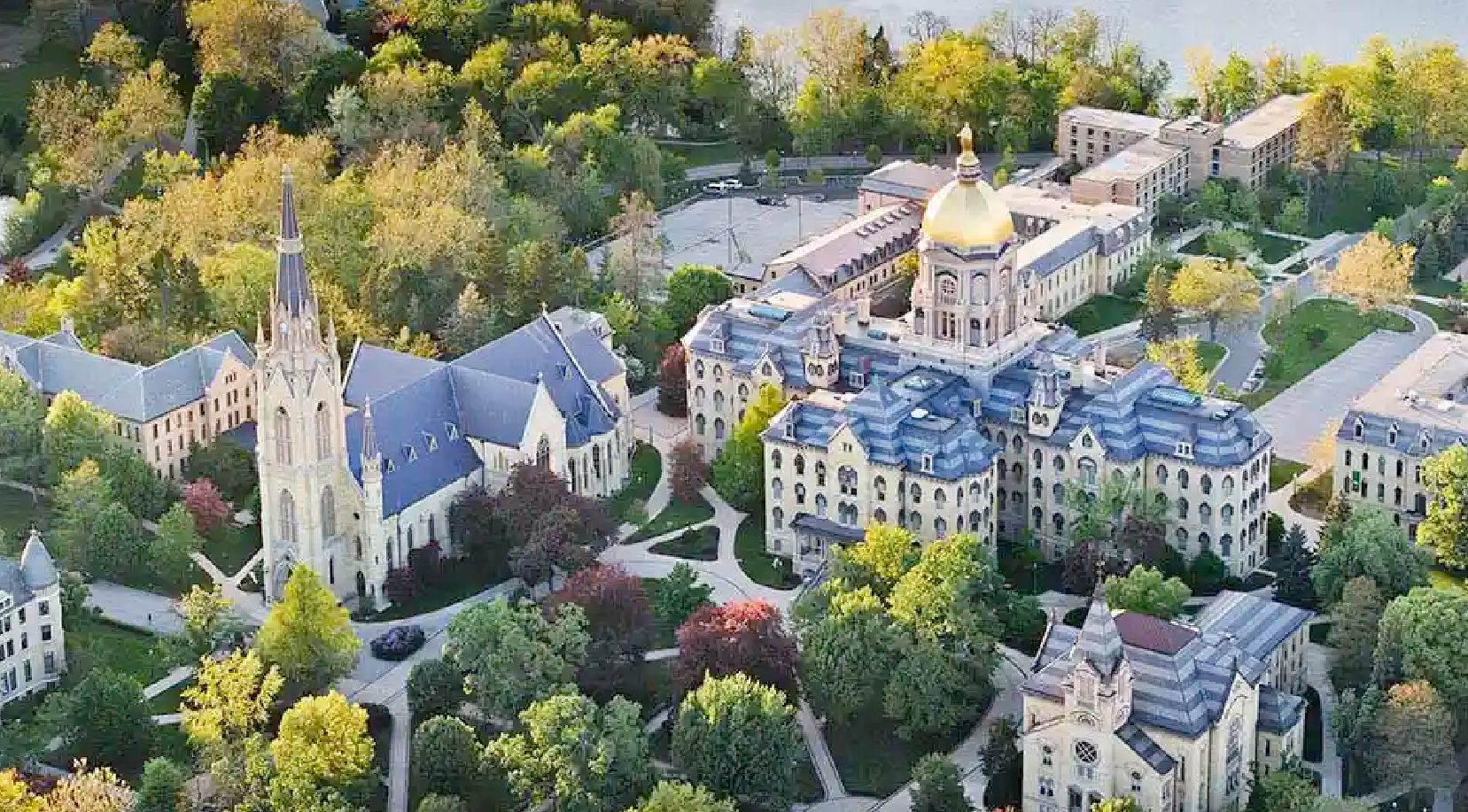
(ZENIT News / Washington, 02.27.2026).- A senior leadership appointment at one of the United States’ most emblematic Catholic universities has ended not with a formal dismissal, but with a retreat after weeks of mounting pressure that exposed unresolved tensions between academic freedom, institutional identity, and episcopal oversight.
On February 26, the administration of University of Notre Dame confirmed that Professor Susan Ostermann will not assume the directorship of the Liu Institute for Asia and Asian Studies, a post she had been scheduled to take up in July 2026. The decision, communicated by the dean of the Keough School of Global Affairs, Mary Gallagher, framed the outcome as Ostermann’s own choice “not to move forward,” rather than an institutional reversal.
Yet the context leaves little doubt that the withdrawal followed an unusually intense backlash, both on and off campus, centered on whether a university that explicitly defines itself as Catholic can entrust a leadership role to a public advocate of legal abortion.
A controversy that escalated quickly
Notre Dame, founded in the 19th century by the Congregation of Holy Cross, occupies a distinctive place in American Catholic life. Its global academic ambitions coexist—often uneasily—with a mission statement that affirms fidelity to Catholic teaching. That balance came under sharp scrutiny when Ostermann’s appointment was announced on January 8.
Ostermann, an associate professor at the Keough School since 2017 and a specialist in regulatory governance in South Asia, has an extensive record of public commentary defending abortion as essential to women’s freedom and well-being. In opinion pieces and essays published in recent years, she criticized pro-life legislation, described pregnancy resource centers as misleading, and argued that abortion restrictions are rooted in racism and white supremacy. She also sought to frame abortion within the language of “integral human development,” a core concept of Catholic social doctrine.
For critics, this went far beyond a disagreement within a classroom setting. They argued that placing such a figure at the helm of an academic institute amounted to institutional endorsement, or at least normalization, of positions fundamentally at odds with Catholic moral teaching.
Episcopal intervention and donor pressure
The turning point came with the intervention of Kevin Rhoades, the local bishop whose diocese includes Notre Dame. In a public statement, he described the appointment as a “scandal” and stressed that the issue was not Ostermann’s right to research or teach, but her suitability for an administrative leadership role within a Catholic university.
Rhoades went further, leading a rosary and prayer service on campus attended by roughly 50 people, and calling on the university to reconsider. More than a dozen other bishops, including some Notre Dame alumni, echoed his concerns, some publicly and others privately. Among them was Paul Coakley, president of the U.S. Conference of Catholic Bishops, who publicly backed Rhoades’ stance.
Behind the scenes, the reaction was reportedly even stronger. According to multiple accounts, major donors and trustees expressed deep anger, and two faculty members affiliated with the Liu Institute resigned in protest. Sources close to the administration suggested that the scale of the backlash took university leadership by surprise.
Academic freedom versus institutional witness
Notre Dame initially defended the appointment by appealing to academic freedom, noting that Ostermann had stated she would respect the university’s position on the sanctity of life and would not use the directorship to promote a personal political agenda.
Critics countered that this argument misunderstood the nature of the role. Academic freedom, they argued, protects scholarly inquiry; it does not oblige a Catholic institution to appoint leaders whose public advocacy directly contradicts its moral framework. Bishop Rhoades articulated this distinction clearly, warning that senior appointments shape the public witness of a Catholic university in ways that go beyond individual research agendas.
The debate also unfolded against a broader cultural backdrop. Surveys by the Pew Research Center indicate that 64 percent of U.S. Catholics say abortion should be legal in most or all cases, a figure that drops to 36 percent among those who attend Mass weekly. The divide between institutional teaching and lived belief continues to complicate governance decisions at Catholic universities.
A decision framed as voluntary
In the end, the administration opted for de-escalation. Gallagher praised Ostermann’s scholarly credentials and thanked her for her willingness to serve, while Ostermann herself said that the controversy risked overshadowing the institute’s work. She expressed hope that Notre Dame could become a place where “diverse voices” flourish and said she looked forward to continued collaboration as a faculty member.
Notably, Ostermann will remain within the leadership structure of the Keough School, underscoring that the dispute was narrowly focused on her suitability for this specific directorship rather than on her continued presence at the university.
An unresolved question
The episode leaves Notre Dame at a familiar crossroads. For decades, the university has defended faculty whose views diverge sharply from Catholic doctrine, even as it has reaffirmed its Catholic identity. This time, sustained pressure from bishops, donors, and parts of the campus community altered the outcome.
Whether this marks a genuine shift toward tighter alignment between leadership appointments and Catholic teaching, or remains an isolated case driven by exceptional circumstances, remains to be seen. What is clear is that the question of who may lead, not just teach, at Catholic universities has once again moved from internal deliberations into the public square.
Thank you for reading our content. If you would like to receive ZENIT’s daily e-mail news, you can subscribe for free through this link.

Publicaciones relacionadas:
 Pope Leo XIV comments on Trump’s peace plan for Gaza (and other current topics of general interest)
 USA: FDA Approval of Generic Abortion Drug “Jarring and Contradictory,” Says Bishop Thomas
 Leo XIV, a pro-life Pope, sends a message to participants in the March for Life in the USA
 The most important Catholic university in the United States openly challenges Pope Leo XIV and the Church
