(ZENIT News / Rome, 10.11.25) – With an unconventional yet surprisingly effective approach, Father Richard A. Miserendino has taken on the chaplaincy of the Catholic Campus Ministry at the University of Mary Washington in Fredericksburg, Virginia. From the start, he noticed that young people were not responding to the usual invitations to youth groups and catechesis. As he puts it, “If I’m going fishing and I keep casting in this one spot and there´s no fish, try moving the boat.”
In a university environment marked by screens, headphones, and students that are online but not necessarily connected, Father Miserendino decided to bring the Church’s presence to where students already are: cafés, social spaces, and even the edges of the campus bar.
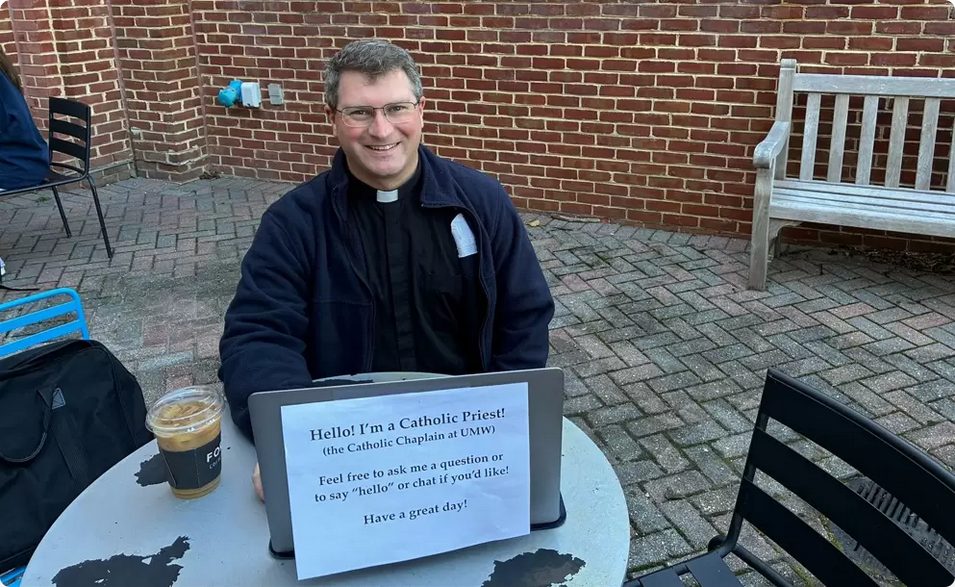
About a year ago, he began setting up his “portable office” at an outdoor table next to the campus coffee shop, with a sign that read: “Hello! I’m a Catholic priest! Feel free to ask me a question, say hello, or chat if you’d like!”
The idea came to him when he realized that the official campus ministry building, with its chapel, student lounge, and resources, wasn’t enough to capture students’ attention. “We do a lot of things on campus… but it’s amazing how, in the cell phone era, they are going to walk right by” he says. So, he decided to “fish” where the young people already were, rather than wait for them to come. That meant moving the “boat”—being in the café, out in the courtyard, talking casually, inviting without a rigid program.
The results, Father Miserendino says, have been far more encouraging than he expected. Although he was warned that a secular campus might react with hostility, his experience has been the opposite. “I was given the impression coming in that … they would, you know, break my bones to make their bread … And it would just be adversarial around the clock” he recalls. “But the reality was different: students come up, ask questions, chat—and that supposedly hostile atmosphere just isn’t there.”
“I was like, ‘Wow, this is really working! People are coming up and asking me questions!’” he adds with a smile.
The conversations vary widely: “Sometimes they’re more theological. Sometimes they’re more heart—you know, things that people are working through… Sometimes people are just lonely and want to talk.”
These encounters have led to tangible fruits: higher attendance at Sunday Mass, more students beginning the catechumenate to enter the Catholic Church, and greater openness in sharing personal experiences. One conversation, he recalls, “lasted two and a half hours—it was about God, gender, and everything in between.”
From Father Miserendino’s perspective, this “coffee-table ministry” doesn’t require any special gift: ““It’s not some special charism that I’ve been given … We just have to kind of bring the faith to where the people are. You can do it too.” His hope is that other priests and laypeople adopt this “go-to-them” mentality instead of waiting for young people to show up on their own.
This model offers several important lessons for university evangelization: the value of informal presence, the understanding that conversions often begin as conversations rather than events, and the recognition that many young people today are “starved for community.” As he puts it, “One of the things our culture is starved for right now is community.”
Father Miserendino’s example invites the Church to rethink how to approach contemporary university life—with patience, closeness, and creativity.