

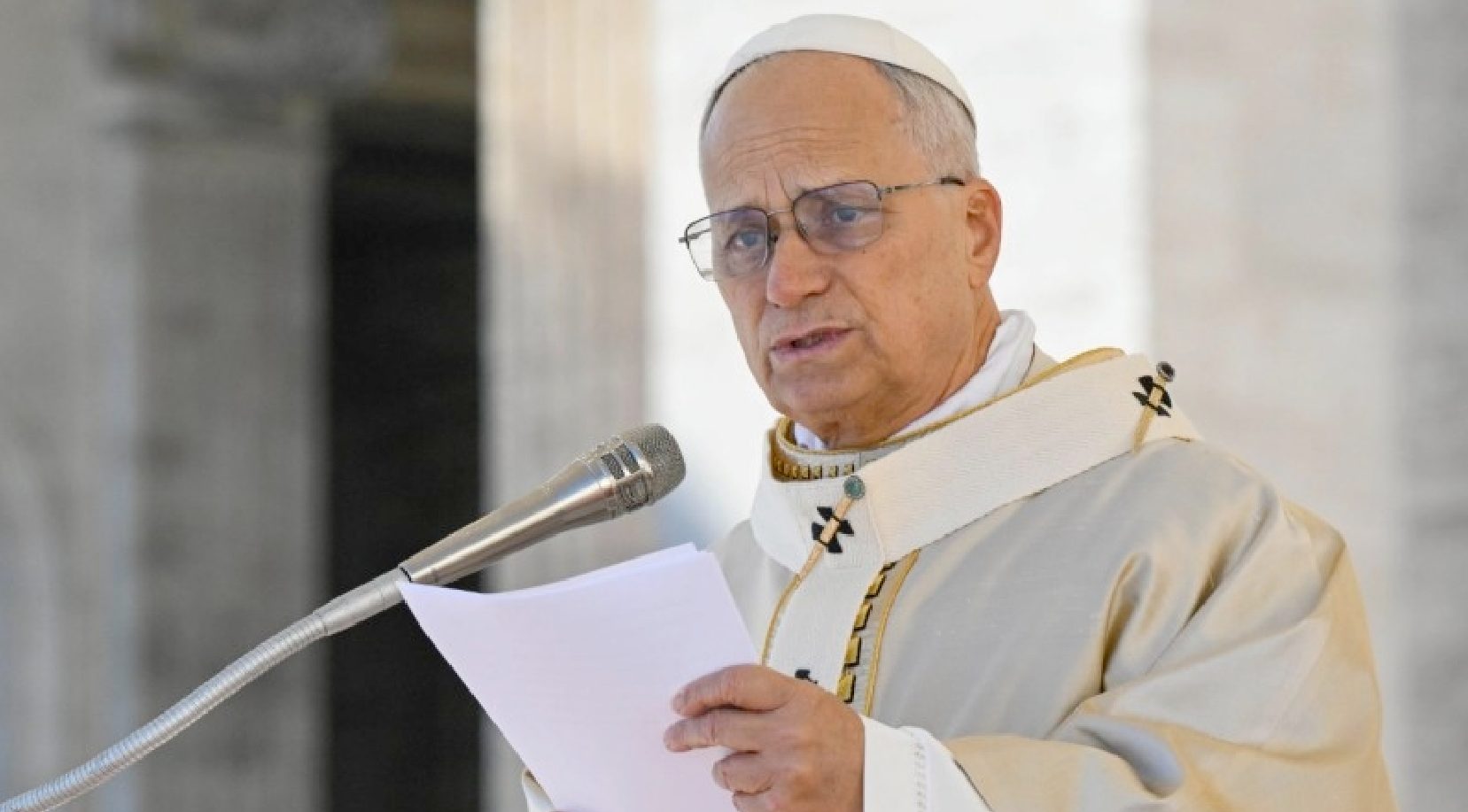
(ZENIT News / Vatican City, 11.24.2025).- In the long arc of Christian history, few moments have shaped the faith as decisively as the gathering of bishops in the small Anatolian town of Nicaea in the year 325. Seventeen centuries later, that assembly has returned to center stage—not as a museum piece, but as a compass. With his new apostolic letter In unitate fidei, published on 23 November, Pope Leo XIV invites the global Church to rediscover the power of the Nicene Creed at a time when the world is again pulled apart by suspicion, upheaval and division.
The document appears just days before the Pope’s journey to Turkey and Lebanon, a pilgrimage that will bring him to Iznik—ancient Nicaea—where the first ecumenical council forged the profession of faith still spoken every Sunday in Christian communities worldwide. The Pope’s intention is clear: to draw on that ancient memory not for nostalgia, but for guidance.
Leo XIV situates the anniversary of Nicaea within the Holy Year dedicated to “Christ, our hope,” calling the coincidence “providential.” For him, the Creed formulated in 325 is no relic but a living wellspring from which believers should drink anew. It is, he writes, the heart of Christian faith—a confession that “deserves to be professed and explored in ways that remain fresh and meaningful.”
From the outset, the Pope reframes the Nicene story. He does not dwell primarily on the political backdrop of Constantine’s empire or the ferocity of the Arian controversy, though he recalls how the bishops gathered in a moment of profound doctrinal crisis. Instead, he highlights the Council’s enduring achievement: the common declaration that Jesus Christ is “the only-begotten Son of God,” fully divine, fully human, the one who “came down from heaven for our salvation.”
For Leo XIV, this confession is neither an abstract theory nor a philosophical construction. The conciliar language—terms such as ousia and homoousios, which once sparked so many debates—was never meant to supplant Scripture but to safeguard the truth that God has drawn near. The Creed, he insists, portrays a God who descends into the world’s shadows, who abandons none of the vulnerable, who chooses proximity over power. Its theological precision protects a profoundly pastoral proclamation: God is not distant.
This pastoral horizon runs through the entire letter. Leo XIV points to the contrast between the Council’s clarity about Christ and the confusions of the present age. In a world where the very question of God is often muted, ignored, or overshadowed by new idols—whether economic, technological or ideological—the Pope asks believers to examine their own fidelity. What place does God truly hold? What stewardship do we exercise toward creation? How do our actions reveal or obscure the divine face?
The letter also carries a distinct ecumenical charge. If Nicaea once united bishops from across a fractured empire, Leo XIV envisions its profession of faith as a bridge across today’s Christian divisions. The Pope acknowledges that full visible unity with the Orthodox world and with communities born of the Reformation remains incomplete, yet he emphasizes the real progress achieved. On the foundation of one baptism and a shared Creed, Christians increasingly recognize one another as disciples of the same Lord.
But Leo XIV is not content with polite coexistence. He urges a renewed movement—“ecumenism oriented toward the future”—that abandons polemics whose purpose has long since evaporated. True reconciliation, he argues, will come not by returning to some idealized past, nor by settling comfortably into present differences, but by walking together through honest dialogue, mutual generosity and humble listening. Unity, he says, enriches rather than diminishes; it demands conversion of hearts as much as precision of ideas.
Strikingly, the Pope connects this ecumenical call with the witness of Christian martyrs from every tradition, whose blood, he notes, has already woven a bond stronger than many theological agreements. Their memory, he suggests, is a summons to embody the peace the world so desperately seeks.
Throughout the letter, the Pope’s reflections return to a theme that appears deceptively simple: what Christians profess must shape how they live. The ancient words spoken aloud at every Eucharist, he warns, risk becoming hollow unless they are rooted in the heart and translated into action. Faith must be visible in mercy, solidarity, humility, and the embrace of those whom society discards.
Seventeen centuries after the bishops of Nicaea crafted their formula of faith, Leo XIV presents it again as a gift—one that calls the Church to unity, challenges it to integrity, and leads it back to the God whose love redefines all power.
Thank you for reading our content. If you would like to receive ZENIT’s daily e-mail news, you can subscribe for free through this link.

Publicaciones relacionadas:
 Faith, synodality and common date of Easter: 3 topics discussed by the Pope in meeting with Catholics and Orthodox
 “We cannot and do not want to forget”: Pope Leo XIV at ecumenical celebration for martyrs and witnesses of the faith
 [Pope in Turkey: Day 3] What does it mean to “be the Church”? Pope Leo XIV’s twofold answer
 The Pope’s ecumenical and interfaith message in Lebanon
