

(ZENIT News / Rome, 11.10.2026).- The results of the November 2026 midterm elections have revealed a striking change in the religious profile of American political leadership. Muslim candidates reached an unprecedented level of representation in Congress, a Hindu immigrant is set to become mayor of Los Angeles, and a group of Democratic candidates with backgrounds in Christian ministry secured significant victories. Taken together, these results suggest that religious identity in American public life is becoming more diverse.
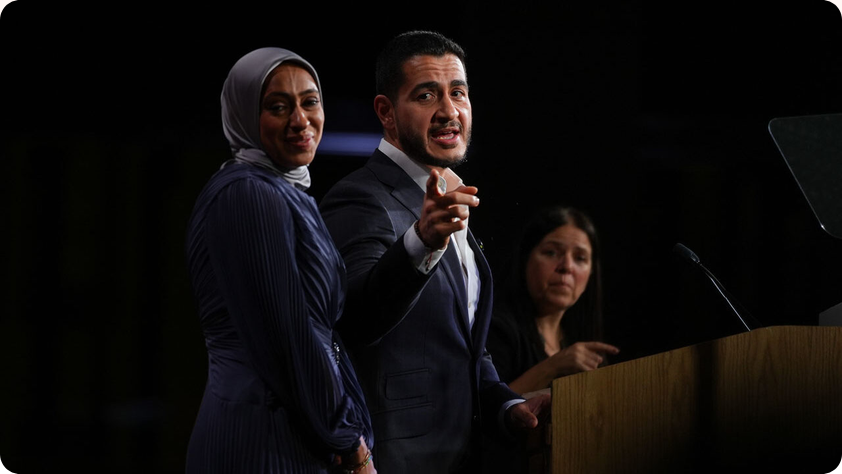
The most historic breakthrough came in Michigan, where Democrat Abdul El-Sayed, a 42-year-old physician and former public health official, became the first Muslim elected to the US Senate. The son of Egyptian immigrants, he faced repeated attacks over his religion during the campaign. President Donald Trump called him a “jihadist” and made claims about his alleged support for Muslim terrorist groups. Yet the rhetoric did not prevent his victory. For supporters, it instead became a rallying point against religious discrimination.
El-Sayed’s election formed part of a wider advance. Six Muslim candidates won seats in the House of Representatives, bringing the number of Muslims elected to Congress to a record seven. Four incumbents — André Carson of Indiana, Ilhan Omar of Minnesota, Rashida Tlaib of Michigan and Lateefah Simon of California — retained their seats, while Adam Hamawy of New Jersey and Darializa Avila Chevalier of New York entered Congress for the first time. Chevalier, 33, is the first Latina Muslim elected to the House. Aisha Wahab, who had already entered Congress through a special election in August, was leading the contest for a full term in California, although the Associated Press had not declared a winner at the time of the report. Her victory would raise the total to eight.
The scale of Muslim political participation extended well beyond Washington. More than 160 Muslim Americans ran for federal, state and local office, compared with 145 in 2022, according to the Council on American-Islamic Relations. Among the notable victories was Letitia Plummer’s election as county judge in Harris County, Texas, making her the highest-ranking elected Muslim woman in the state. Muslim candidates also won legislative seats in Michigan, Illinois, Ohio and several other states. The previous record for Muslims serving simultaneously in Congress was five; the first Muslim elected to the House was Keith Ellison, in 2006.
Another landmark came on the Pacific coast. Nithya Raman, a 45-year-old Democratic Socialist and practising Hindu, is set to become Los Angeles’s next mayor after defeating incumbent Karen Bass with just over 52% of the vote. Born in the Indian state of Kerala, Raman moved to the United States at the age of six. An urban planner educated at Harvard and the Massachusetts Institute of Technology, she campaigned on homelessness, immigration protections and the city’s infrastructure. She is the first Hindu and Indian American elected mayor of Los Angeles, as well as only the second woman to hold the office.
Her election also gives the country’s two largest cities mayors with Indian immigrant backgrounds. New York is led by Zohran Mamdani, a Muslim born in Uganda, while Los Angeles will soon be governed by Raman. Their different religious and political identities underline the growing visibility of immigrant communities in American urban leadership. Raman’s victory, however, should not be mistaken for a consensus within the Hindu community: she faced criticism from some activists over her positions on Israel and her associations with Hindu organisations in Los Angeles, reflecting wider disagreements about caste, nationalism and political representation.
The elections also challenged the assumption that Christian political influence belongs primarily to conservative evangelical movements. Several Democratic candidates with backgrounds in Protestant ministry won important races, presenting a public understanding of Christianity centred on neighbourly love, social responsibility and cooperation across religious differences.
In Texas, 37-year-old James Talarico, a Presbyterian seminarian and state legislator, defeated Republican Ken Paxton in a Senate race that marked the first Democratic victory in a statewide election there in more than three decades. Talarico invoked the example of Jesus as a teacher who called people to love not only those who shared their beliefs or political loyalties, but also those who did not. His language offered a direct challenge to Christian nationalism and to attempts to identify Christianity with one political camp. The defeat of Republican lieutenant governor Dan Patrick, who had argued that there was no separation between Church and state, added another dimension to the result.
In Kansas, Methodist megachurch pastor Adam Hamilton won a Senate seat, appealing to voters through a message of decency and the Golden Rule. In Iowa, Presbyterian minister Lindsay James and Lutheran pastor Sarah Trone Garriott also secured congressional victories. Their campaigns drew on experience in pastoral care, community work and coalition-building. Other Christian figures, including Baptist pastor Frederick Haynes III and Methodist minister Emanuel Cleaver II, also won or retained seats as Democrats. Republican candidates with clerical backgrounds, among them Baptist pastor Mark Harris of North Carolina and former pastor Tim Walberg of Michigan, demonstrated that religiously motivated political participation remains present across party lines.
The electoral figures point to a divided religious landscape rather than a wholesale realignment. An Associated Press survey of approximately 100,000 voters found that around seven in ten Protestants identifying as liberal or moderate supported Democratic candidates. A similar proportion of voters without religious affiliation backed Democrats in several of the Senate and House contests in Texas, Kansas and Iowa. By contrast, white evangelical Protestants continued to support Republicans overwhelmingly, although they represented 17% of the electorate, down from 21% in the 2024 presidential election. That comparison does not, by itself, establish a decline in evangelical participation, since the two elections had different political contexts and turnout patterns.
Nor should the success of candidates who openly discussed their faith be interpreted as proof that religious identity determined the outcome. Political analyst Ryan Burge argued that economic concerns, dissatisfaction with the Trump administration and the cost of living were more decisive than the candidates’ ministerial backgrounds. Their victories, he suggested, reflected the favourable political climate as much as a renewed appetite for progressive religious leadership.
What the results do demonstrate is that the relationship between religion and American politics is more complex than the familiar division between conservative Christians and secular Democrats. Muslim and Hindu candidates have made historic advances, while Christians from different traditions have sought to give their faith a public voice without demanding that the state privilege one religious worldview. That distinction matters in a country whose constitutional tradition protects both the free exercise of religion and the separation of religious institutions from government.
The challenge ahead will be to ensure that this growing diversity translates into genuine religious freedom for everyone, rather than simply a change in which communities enjoy political influence. The right to participate in public life should not depend on whether a candidate is Muslim, Hindu, Christian or non-religious. The 2026 elections have offered a powerful reminder that American democracy is strongest when no citizen has to conceal or apologise for their faith in order to serve the public.
Thank you for reading our content. If you would like to receive ZENIT’s daily e-mail news, you can subscribe for free through this link.

Publicaciones relacionadas:
 How many Catholics are there in the world? Catholic Church Statistics 2023
 Leo XIV: a digital phenomenon and the first Pope influencer. Almost 13 million followers in 72 hours
 Jesus Christ AI: This Is the God “Transformed” Into Artificial Intelligence That Already Exists and Aims to Redefine the Religious Experience
 What happens when technology no longer assists religious life but begins to replace it?
