

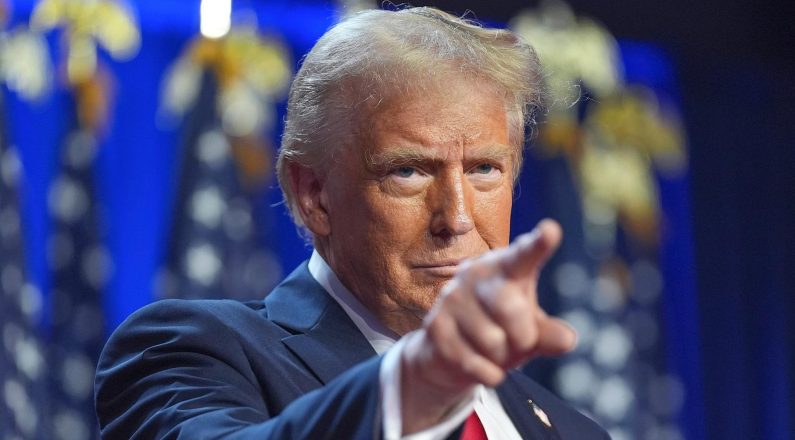
(ZENIT News / Washington, 11.03.2025).- The international spotlight has returned to Nigeria with renewed intensity after former U.S. President Donald Trump’s recent declaration that his administration would place the West African giant back on the list of “Countries of Particular Concern” for violations of religious freedom—accompanied, this time, by the threat of military intervention.
Trump’s statement on October 31, posted on his social media platform Truth Social, ignited a global debate about faith, politics, and foreign policy. “Christianity faces an existential threat in Nigeria,” he wrote. “Thousands of Christians are being slaughtered by radical Islamists.” The following day, his rhetoric hardened. “If the Nigerian government continues to allow the killing of Christians,” he warned, “the United States may enter that disgraced country, armed and ready, to annihilate the terrorists.”
His words, echoed by U.S. Defense Secretary Pete Hegseth, mark the most aggressive foreign policy posture yet on Nigeria’s long and bloody crisis. “Either the government of Nigeria protects Christians,” Hegseth said, “or we will destroy the terrorists committing these atrocities.”
The proposed designation—“Country of Particular Concern,” or CPC—is not new. The Trump administration first placed Nigeria on the list in 2020, citing systematic persecution and targeted violence. But President Joe Biden’s administration removed it in 2021, a move heavily criticized by religious freedom advocates who viewed it as appeasement toward a government widely accused of negligence in the face of rising extremism.
The numbers are staggering. Reports from Intersociety, a Nigerian Catholic human rights organization, estimate that over 7,000 Christians were killed in the first eight months of 2024 alone. More than 8,000 abductions were reported in the same period. The violence, which has ravaged parts of central and northern Nigeria, is driven by a volatile mix of extremist ideology, ethnic tension, and criminal impunity. Yet, as the Vatican’s Secretary of State Cardinal Pietro Parolin recently observed, “not all of it can be reduced to religion.” He described the conflict as “largely social,” pointing to disputes between nomadic herders and farming communities.
That nuance, however, has not satisfied many on the ground. Father Moses Iorapuu, communications director of the Diocese of Makurdi, compared Trump to “a new Moses” sent to deliver Nigeria’s Christians. “We have been praying for this,” he told Crux. “The Lord has used President Trump as an instrument to awaken the world to our suffering.”
Reactions within Nigeria’s Church hierarchy are mixed. Bishop Matthew Hassan Kukah of Sokoto, long regarded as one of the most articulate Catholic voices in the country, cautioned against simplifying the violence into a “religious war.” “Nigeria’s tragedy,” he said, “is the weakness of its institutions, not the theology of its people.” Kukah’s reluctance to frame the crisis purely in religious terms has provoked sharp criticism from activists who accuse him of downplaying persecution to maintain political dialogue.
Father Augustine Anwuchie, a Nigerian missionary serving in Niger, went further. “Bishop Kukah has fallen into what I call the ‘elite trap,’” he said, “defending Nigeria’s image rather than defending her victims.” Anwuchie argued that the coexistence of Islamic law with Nigeria’s secular constitution in northern states constitutes “official terrorism,” exposing Christians to systemic discrimination.
Meanwhile, American domestic reactions have ranged from the predictable to the surreal. Rapper Nicki Minaj, with her massive global following, publicly praised Trump’s stance, writing that “no one should be persecuted for their faith.” U.S. Ambassador to the United Nations Mike Waltz even invited her to the U.N. mission in New York to discuss religious persecution—an invitation she said she was “honored” to accept.
For religious freedom monitors, the drama underscores a deeper truth: Nigeria has become the most dangerous place in the world to be Christian. Global Christian Relief’s 2025 “Red List” report ranks Nigeria at the top, describing widespread killings, kidnappings, and church burnings—particularly in the Muslim-majority northern states governed by Islamic law since 1999.
Beyond politics, the violence has hollowed out communities and upended lives. Entire villages have vanished, priests have been kidnapped or murdered, and seminarians targeted in nighttime raids. In one particularly brutal attack last July, gunmen stormed the Minor Seminary of the Immaculate Conception in Edo State, killing a security guard and abducting three seminarians. A year earlier, the seminary’s rector, Father Thomas Oyode, had offered himself in exchange for kidnapped students, spending eleven days in captivity.
Even moderate Muslims have become casualties of Nigeria’s unraveling. Both Boko Haram and the Islamic State West Africa Province (ISWAP) target anyone—Muslim or Christian—who refuses their radical creed. Over 60,000 Muslims are believed to have been killed since 2009 for opposing extremism.
Still, amid the despair, there is a flicker of hope that international pressure could spur real change. Emeka Umeagbalasi, director of Intersociety, said the Trump administration’s renewed focus “has lifted morale among victims.” “Inside and outside Nigeria,” he said, “it felt like defenders of religious freedom had just won a world championship.”
Whether that sense of victory lasts remains uncertain. Analysts warn that U.S. threats of military action, however well-intentioned, risk deepening Nigeria’s instability. Yet for many of the faithful—those who have buried loved ones, rebuilt razed churches, and prayed in the shadow of fear—any sign that the world is finally paying attention feels like grace after years of silence.
Thank you for reading our content. If you would like to receive ZENIT’s daily e-mail news, you can subscribe for free through this link.

Publicaciones relacionadas:
 Police intentionally kill two girls at Catholic school in Pakistan. Bishops raise their voices
 Killings of Nigeriani Christians on the rise
 USA: After Supreme Court’s landmark free speech ruling, photographers in KY, NY seek to also create freely
 After one month of Nicolás Maduro’s imprisonment, the Venezuelan government restores Cardinal Porras’ passport
