

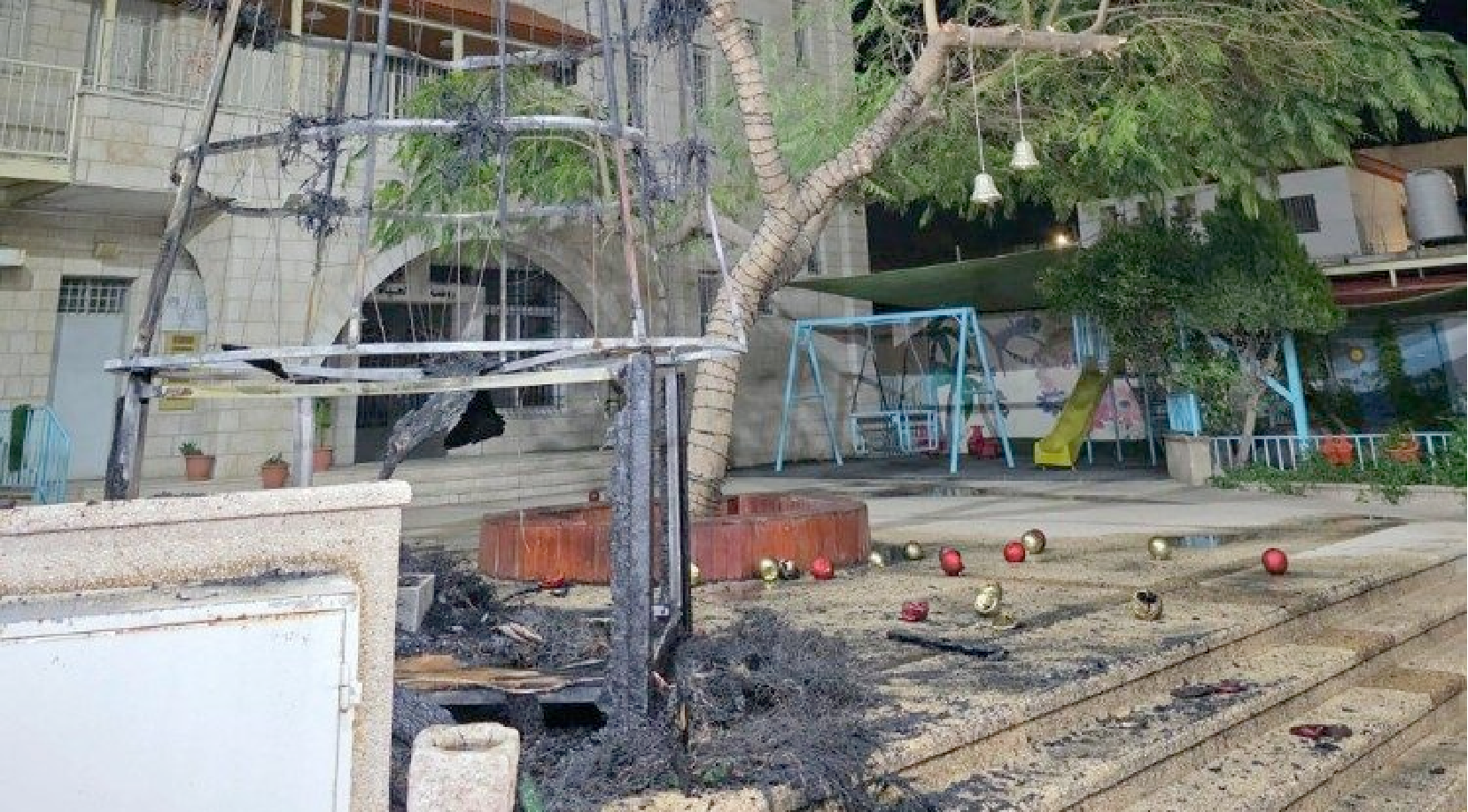
(ZENIT News / West Bank, 12.24.2025).- The flames that consumed a Christmas tree in Jenin were meant as an act of intimidation. Instead, they became an unintended testimony to endurance. In the early hours of December 22, radicalized youths deliberately set fire to the tree erected outside the parish of the Most Holy Redeemer in this West Bank city. By the following evening, a new tree was already standing, lit and blessed, surrounded by a community determined not to retreat into silence.
For Archbishop Adolfo Tito Yllana, the Holy See’s representative to Israel and apostolic delegate for Jerusalem and Palestine, the attack crossed a clear line. He described it as a reprehensible act that undermines coexistence and targets a visible sign of Christian presence. A Christmas tree, he stressed, is not a provocation but a declaration: a public affirmation that Christians exist here and that they celebrate their faith openly.
Yet the most striking response did not come in diplomatic language, but from the local faithful themselves. “Do not burn the soul,” they repeated as they gathered to inaugurate the replacement tree on December 23. The phrase captured a collective conviction: symbols can be destroyed, but identity cannot. Bishop William Shomali, vicar general of the Latin Patriarchate of Jerusalem, traveled to Jenin to bless the new tree, calling it a sign of new life and light capable of illuminating wounded hearts. Local authorities were present, underscoring that the incident was not representative of broader communal relations.
The message from the Christian community was unequivocal. Even if the tree were burned a hundred times, they said, it would be rebuilt a thousand times more. This is not bravado, but survival shaped by decades of marginalization, restrictions, and uncertainty. As Archbishop Yllana observed, the perpetrators should be understood as individuals, not as spokesmen for entire communities. Acts like these, he insisted, do nothing to foster peaceful coexistence in a land already burdened by fear and suspicion.
In nearby Ramallah, Christmas celebrations offered a contrasting image. Catholics, Orthodox Christians, members of other Christian traditions, and Muslims gathered together in a shared expression of joy. After two years marked by war and escalating tension, the celebrations carried a sense of relief mixed with exhaustion. The joy was real, but hard-won. Restrictions on movement, economic hardship, and persistent insecurity remain daily realities for Christians across the region.
The situation is even more severe in Gaza, where the scale of destruction defies abstraction. According to Bishop Shomali, roughly 80 percent of buildings have been damaged or destroyed. Hunger, unemployment, and fear shape daily life. Yet the Church has not withdrawn. Clergy and church structures continue to provide basic assistance and pastoral care, even as resources dwindle. Many residents, rather than abandoning their land, have chosen to remain beside the ruins of their homes, living in makeshift tents as an act of attachment and defiance.
This steadfastness, Shomali suggested, is sustained by a hope that goes beyond optimism. It is rooted in faith in a Savior who enters history not through power, but vulnerability. Archbishop Yllana echoed this perspective by recalling Pope Leo XIV’s call for a peace that disarms hearts before it disarms weapons. Reconciliation, the Pope has insisted, must include even those who act unjustly, because they too are children of the same Father.
In that light, the rebuilt tree in Jenin takes on a deeper meaning. It is not merely seasonal decoration, but a quiet proclamation that Christian life in the Holy Land is neither accidental nor temporary. After two years of war in Gaza and repeated tensions in the West Bank, Archbishop Yllana summarized the paradox with disarming simplicity: hope here is not a slogan. It is lived, day by day, amid ruins and renewal alike.
Thank you for reading our content. If you would like to receive ZENIT’s daily e-mail news, you can subscribe for free through this link.

Publicaciones relacionadas:
 How Does the Conflict Between Israel and Palestine Affect Christians?
 Israel targets Catholic Church school in Gaza
 Jewish settlers vandalize the only completely Christian city in the Holy Land once again
 The last historic Christian village in the Holy Land, threatened with annexation by the Jewish state of Israel
