

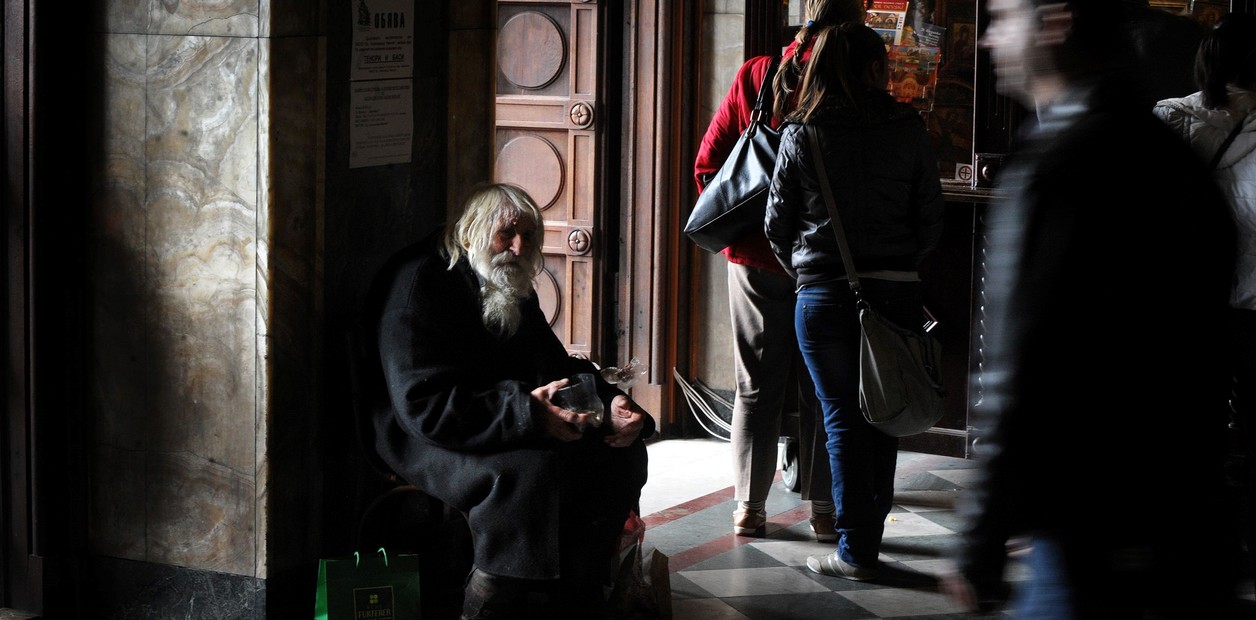
(ZENIT News / Sofia, 11.10.2026).- An elderly man, deeply cherished by the faithful in Sofia, the capital of Bulgaria, died in 2018 at the age of 103. He left a legacy of US$5 million to the Church — funds he had gathered through begging.
Every day, Dobri Dobrev would walk 20 kilometers from his native village of Baylovo to the Cathedral in Sofia. He would ask for money near the Cathedral entrance. Known for his long white beard and black cloak, he would sit by the wall near the main door. Over the decades, he donated the money he collected to the Church and to the poor.
Many Bulgarians regard him as a saint for dedicating his life to raising funds for the restoration of churches. Several monasteries and religious sites across the country have confirmed receiving sums ranging from US$3,000 to US$12,000 each. It is estimated that, over the years, he contributed approximately US$5 million in donations.
His father, Dimitar, died in World War I, and he was raised by his mother, Katerina. During a World War II bombing, a projectile landed near him, causing him to lose almost all of his hearing. He married in 1940 and had four children, two of whom survived him. He lived on a pension of US$95 a month. Around the year 2000, he donated all his possessions to the Church and dedicated himself entirely to the spiritual realm and to begging, a choice driven by his faith rather than by misfortune, as many had believed. His mission was to raise funds for the restoration of orphanages, churches, and monasteries.
He became an inseparable fixture at the St. Alexander Nevsky Cathedral, part of the Bulgarian Orthodox Church in Sofia, to which he donated more than US$25,000. He would spend long hours there, receiving small coins. In 2013, he was named «Personality of the Year» by the Sofia News Agency, which, in presenting the award, stated: «There is still room for charity and good deeds.»
Children loved him, and animals would approach him with trust. Those who gave him alms would also ask for his blessing. After his death, his few belongings — a bed, a table, and a meager supply of food consisting of a piece of bread and half a tomato — were found in the room where he lived, next to a church in Baylovo.
Years after his death, a massive, ten-story-high mural in Sofia commemorates his virtuous life. Meanwhile, the call for his canonization continues. For many Bulgarians, this old man, who appeared to have nothing, possessed a spiritual wealth inherited from his family and from those who inspired him to dedicate his life to kindness.

Publicaciones relacionadas:
 Impressive Via Crucis and the Crucifixion of Jesus Returns to the Center of London and Is Seen by 20,000 People
 Sister Clare: the young Irish actress who became a nun goes to the altars
 The Moving Story of a Religious Congregation with Sisters Who Have Down Syndrome
 16 Children, Sometimes Not Perfect, but United and Faithful: The Story of an Influencer Marriage
