

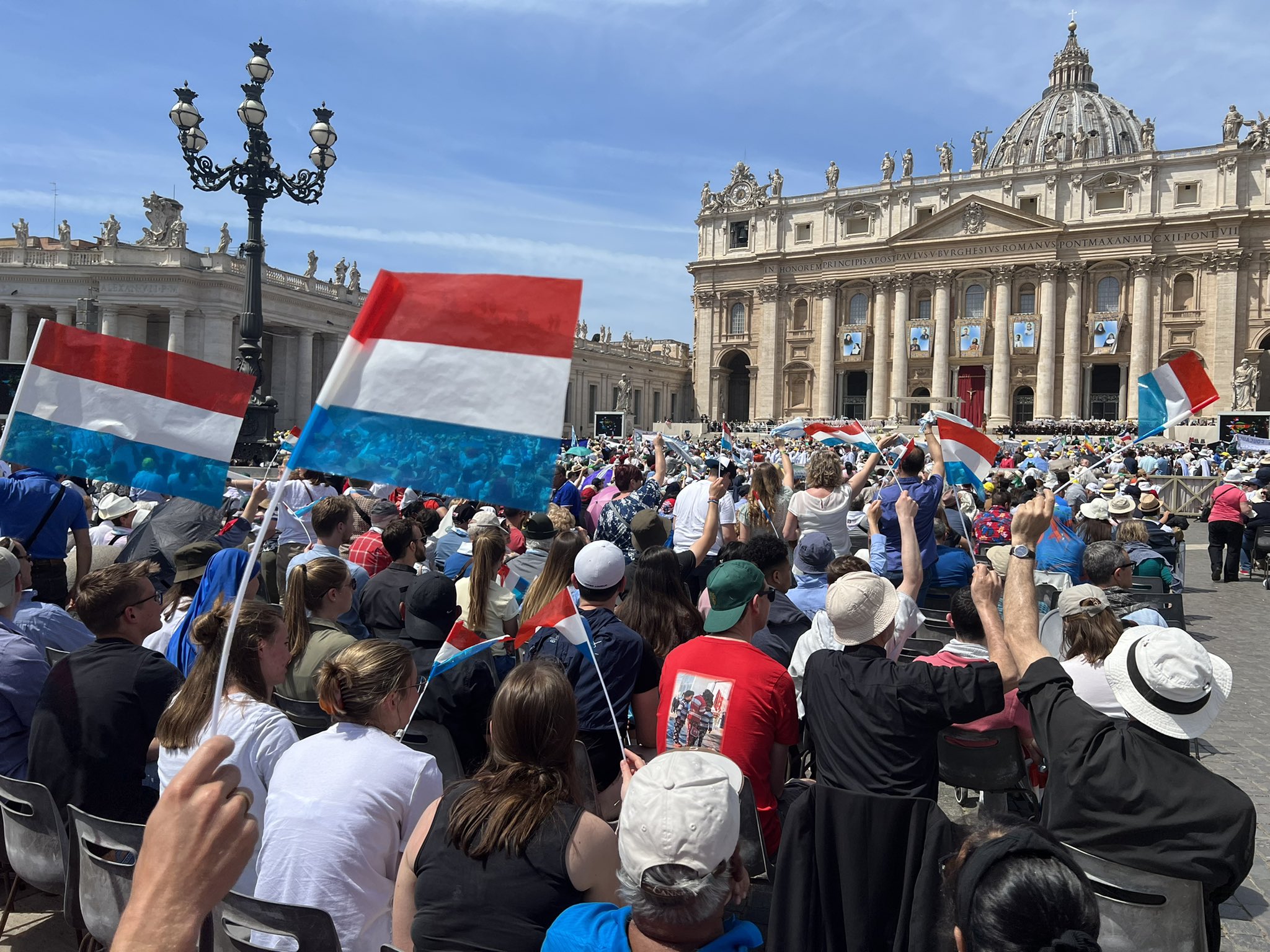
(ZENIT News / Rome, 02.10.2026).- In a country long held up as a laboratory of advanced secularization, something unexpected has been happening beneath the statistical radar. The Netherlands, often cited for the rapid decline of institutional religion and the repurposing of churches into gyms, supermarkets, or cultural venues, recorded a striking increase in adult conversions to Catholicism in 2024. According to official ecclesial statistics, the number of adults entering the Catholic Church rose by 40 percent in a single year.
The figures, published by Kaski, the Catholic Institute for Ecclesiastical Statistics, show that adult entrants increased from 455 in 2023 to 630 in 2024, the most recent year for which data are available. These numbers include both adults baptized as Catholics and Christians from other denominations who were formally received into the Church. In absolute terms, the totals remain modest. In symbolic terms, however, they carry weight far beyond their size.
The Dutch case is not an isolated anomaly. It fits into a broader pattern emerging across Western Europe, a region often described as post-Christian and religiously exhausted. France, frequently labeled the most aggressively secular country on the continent, has seen an even sharper rise: a 45 percent increase in adult baptisms compared with the previous year. For a nation that once styled itself the “eldest daughter of the Church,” the return of adult seekers has taken on a resonance that goes beyond parish registers.
Belgium, another society deeply shaped by secular culture, offers a more restrained but still telling sign. Bishops there report a 4 percent increase in Mass attendance, a figure they interpret cautiously but without dismissing its significance. More revealing is the longer trajectory: the number of adult baptisms has nearly doubled over the past decade, from 186 in 2014 to 362 in 2024. It is a slow, incremental process, but one that suggests a shift in direction rather than a statistical fluctuation.
Northern Europe, too, is showing signs of change. In Sweden, one of the most secularized societies in the world, Bishop Erik Varden, president of the Nordic Bishops’ Conference, has suggested that secularization may have reached its limits. In his view, the cultural momentum that once pushed religious belief to the margins has largely spent itself, creating space for faith to re-emerge not as a social inheritance, but as a personal choice.
The phenomenon is not confined to Europe. Other parts of the Western world are witnessing similar developments, often with greater intensity. Australia recorded a 30 percent increase in adult converts, a surge that reportedly surprised even those responsible for catechetical programs. In the United States, the growth is particularly visible in urban centers and among young adults. Los Angeles alone registered a 45 percent increase in baptisms, reaching 5,500 new Catholics — the most significant rise in a decade.
Universities appear to be a key environment for this renewal. Catholic centers on American campuses are reporting unprecedented numbers of students preparing for baptism. At Kansas State University, for example, the Catholic Center expects 110 baptisms at Easter 2026, an extraordinary figure in a setting more commonly associated with religious indifference than sacramental commitment.
None of this amounts to a demographic reversal of the Church’s long-term decline in the West. These scattered signs point to something worth closer attention. The growth is driven almost entirely by adults — men and women who were not raised Catholic, or sometimes not raised religious at all, and who arrive through deliberate, often intellectually demanding journeys.
For readers less familiar with Catholic practice, it is worth noting that adult conversion typically involves a lengthy process known as the Rite of Christian Initiation of Adults (RCIA), which includes months or even years of catechesis, spiritual formation, and public rites. These are not casual or impulsive decisions. They suggest a search for meaning, structure, and transcendence that persists even in societies saturated with material comfort and personal autonomy.
The numbers remain small, but their consistency across countries as different as the Netherlands, France, Sweden, Australia, and the United States suggests a shared undercurrent. In places where Christianity once functioned as a cultural default and then collapsed, faith now reappears in a different register: less inherited, less socially reinforced, but arguably more intentional.
Thank you for reading our content. If you would like to receive ZENIT’s daily e-mail news, you can subscribe for free through this link.

Publicaciones relacionadas:
 This is the largest statue of the Virgin Mary in the world, which is in Argentina
 Indonesia Unveils the World’s Tallest Statue of Jesus, A New Symbol of Faith
 This is the 197-inch sculpture dedicated to Pope Leo XIV in his former Peruvian diocese
 Brazil: Christ the Redeemer in Rio de Janeiro sees increase in number of sacraments celebrated
