

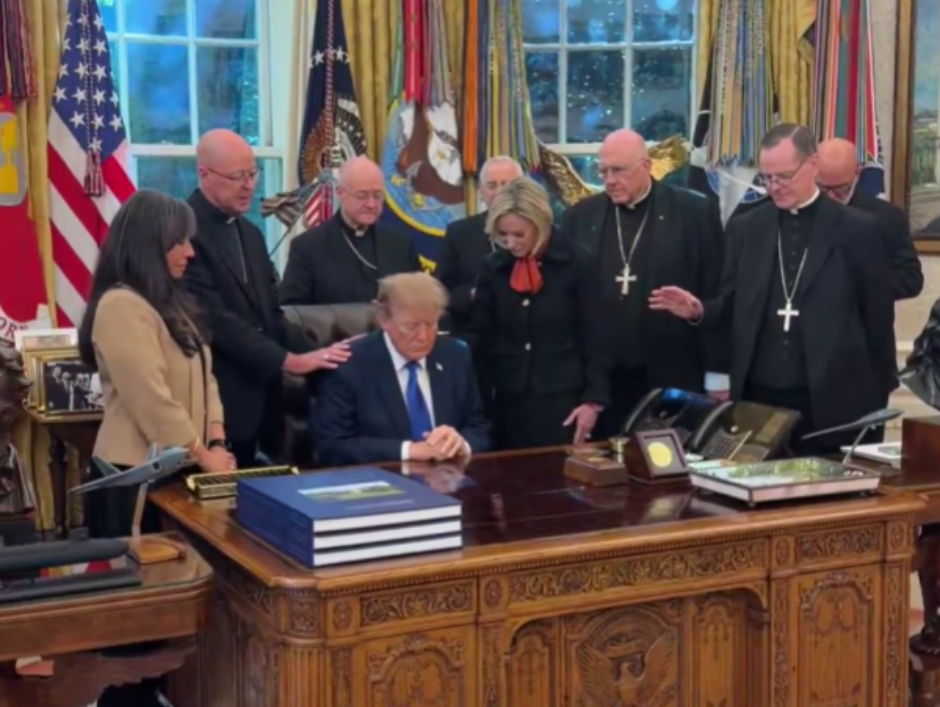
(ZENIT News / Vatican City, 10.23.2026).- The image was striking: President Donald Trump seated in the Oval Office, his head bowed as Catholic bishops gathered around him in prayer. Yet the significance of the October 22 encounter extended well beyond its faith symbolism. With the November 3 midterm elections approaching, the meeting has reopened a delicate question for the American Church: how can bishops defend the principles they consider essential to public life without allowing their pastoral mission to be drawn into partisan politics?
Archbishop James Golka of Denver led the prayer, thanking God for the United States, its government and the presidency before invoking the blessings of Jesus Christ and the protection of the Holy Spirit upon the nation. More than half a dozen other Catholic prelates attended, including Archbishop Jeffrey Grob of Milwaukee, Bishop Edward Burns of Dallas, Bishop William Joensen of Des Moines and Bishop Michael Barber of Oakland, California. Bishop Elias Zaidan, head of the Maronite Eparchy of Our Lady of Lebanon in Los Angeles, also took part, alongside other bishops and Archbishop Emeritus Joseph Naumann of Kansas City, Kansas.
The White House Office of Faith, led by Jenny Korn, presented the encounter as an opportunity for substantive engagement between religious leaders and the administration. According to Korn, the discussions addressed religious freedom, school choice, religious visas, tax credits for families and life-related policies. The meeting concluded with a collective prayer for the president.
Prayer for public officials is firmly rooted in Christian tradition, and the Denver archdiocese was careful to distinguish the spiritual act from political endorsement. Respect for the presidency, it said, did not imply support for any particular candidate or party. Golka subsequently expressed hope that the encounter would encourage further dialogue on the sanctity of human life and the God-given dignity of every person. Nevertheless, the circumstances surrounding the meeting have raised questions about its organization and political implications.
An encounter outside the bishops’ usual channels
The United States Conference of Catholic Bishops (USCCB) stressed that it had neither organized the meeting nor participated in arranging it. Its spokeswoman, Chieko Noguchi, explicitly distanced the conference from the event. This was significant because relations between the American episcopate and the federal government are ordinarily handled through established institutional channels.
According to reporting by The Pillar, Mario Enzler, a Heritage Foundation official serving as a senior adviser to its president, had spent several weeks inviting bishops to the White House. Some reportedly declined because of concerns about the political optics of meeting Trump so close to the elections. Other sources suggested that some participants regarded the encounter primarily as an opportunity for direct dialogue and may not have anticipated how the resulting photographs and video would be used publicly.
Reports that senior USCCB officials were surprised by the gathering, together with accounts of Archbishop Paul Coakley’s frustration over its circumstances, have added to the controversy. The available information does not establish that the bishops knowingly participated in an electoral publicity exercise. Nor does the timing alone prove that the meeting was conceived as a campaign event. It does, however, explain why the images attracted scrutiny.
Korn rejected the suggestion that the gathering was political, describing it instead as public policy engagement that culminated in a meaningful prayer with and for the president. The distinction matters. In an intensely polarized election season, a White House photograph featuring prominent religious leaders can communicate a political message regardless of the participants’ intentions.
Catholic Archbishops and Bishops gather in the Oval Office to pray with President @realDonaldTrump. ✝️ https://t.co/O6SQgR76wH
— Trump War Room (@TrumpWarRoom) October 22, 2026
Shared principles, unresolved disagreements
The meeting also took place against the background of a complicated relationship between Trump and the Catholic hierarchy. The administration and the bishops have found common ground on religious liberty, school choice and certain pro-life initiatives. For Catholics who regard the protection of unborn children, the freedom of religious institutions and the rights of parents as central public concerns, engagement with government officials on these matters is both legitimate and necessary.
Yet Catholic social teaching cannot be reduced to a single issue or political alliance. The bishops have also challenged aspects of the administration’s immigration policies, particularly its mass deportation efforts. Other points of disagreement include the administration’s failure to reverse Biden-era policies facilitating the mailing of abortion medication and Trump’s support for in vitro fertilization (IVF).
These differences illustrate why an independent episcopal voice remains essential. A commitment to protecting unborn life must be accompanied by serious consideration of human dignity throughout life, including the treatment of migrants and the responsibilities owed to vulnerable people. Likewise, defending religious liberty requires more than securing access to political power: it demands a consistent principle that protects the conscience and legitimate freedoms of religious communities, including those whose positions conflict with the preferences of the government of the day.
The bishops therefore face a dual responsibility. They must be willing to engage authorities when fundamental moral questions are at stake, while retaining the freedom to criticize policies that conflict with Catholic teaching. Neither automatic opposition nor uncritical alignment would adequately serve that mission.
Catholic voters and the approaching elections
The timing has made the encounter especially sensitive. The November 3 midterms are expected to be fiercely contested, with control of Congress at stake. A Pew Research Center survey conducted in October found that 42% of registered Catholic voters favored Democratic candidates for the House of Representatives, compared with 39% who favored Republicans; 19% were undecided or supported another candidate.
Those figures suggest that Catholic voters cannot simply be treated as a unified constituency aligned with either party. Immigration, economic pressures and social welfare compete with abortion, religious freedom and other moral questions in shaping their political judgments.
On October 14, Archbishop Coakley urged Catholics to place their faith above partisan loyalties and evaluate candidates according to their actions and commitment to the common good. His appeal offers an important framework for interpreting the Oval Office meeting: political access is not itself a measure of moral success, and a photograph with the president should not substitute for a serious assessment of public policy.
The controversy also unfolds amid tensions between Trump and the Vatican. The president has publicly criticized Pope Leo XIV over the pontiff’s positions on Iran and US military action in Venezuela. Leo, for his part, has maintained that he is not afraid to proclaim the Gospel while expressing reluctance to turn the disagreement into a personal debate with Trump.
Thank you for reading our content. If you would like to receive ZENIT’s daily e-mail news, you can subscribe for free through this link.

Publicaciones relacionadas:
 [PHOTOS] St. Teresa of Jesus’ tomb is opened and her body is still incorrupt
 American Catholic Publishing Housed Is Listed Among The Ten Best Places to Work, According to Fortune Magazine
 Bishops Against Proliferation of Priests’ “Private Ministries” and Misuse of Social Networks
 Polish bishops speak out against attacks on the legacy and figure of Saint John Paul II
