

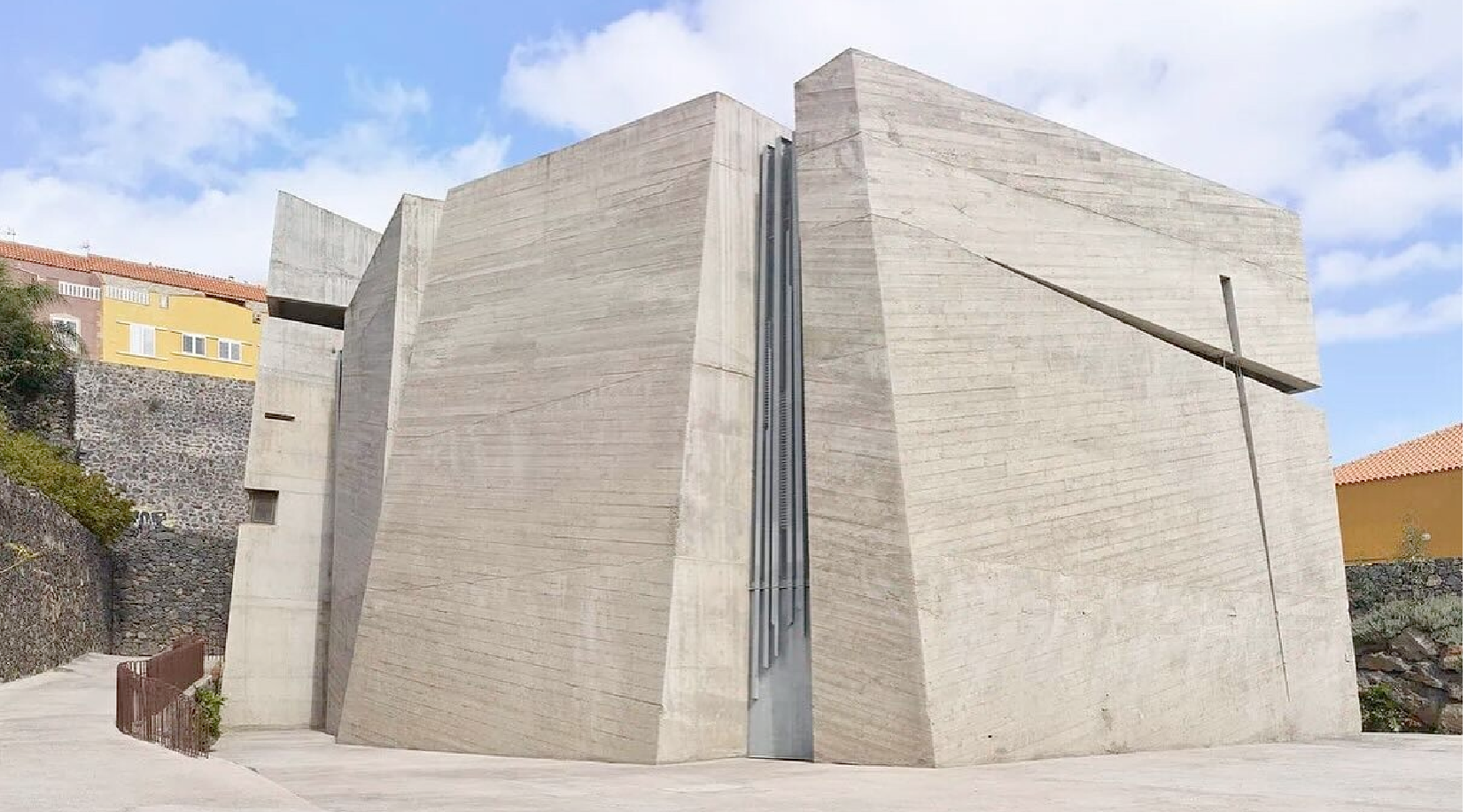
(ZENIT News / Santa Cruz de Tenerife, 11.21.2025).- For decades, Las Chumberas was the sort of neighborhood that rarely appeared in architectural magazines or international travel guides. A quiet corner of San Cristóbal de La Laguna, carved into Tenerife’s volcanic terrain, it was known more for its aging housing blocks than for any hint of design ambition. And yet, the global spotlight has unexpectedly swung toward this modest district, thanks to a building that seems to defy both its surroundings and the expectations of what a parish church can be.
The Church and Community Center of the Most Holy Redeemer, a project conceived by the Canary Islands architect Fernando Menis, has been named World Building 2025 at the World Architecture Festival—an accolade that even seasoned architects treat as a rare crowning moment. The announcement has sent ripples through both the architectural world and the wider public, partly because the structure looks nothing like the conventional image of a church. From afar, it resembles a cluster of fractured volcanic boulders, as if a fragment of Tenerife’s ancient geology had pushed its way up through the pavement.
The resemblance is intentional. Menis designed the complex as if the island’s landscape itself were rising to reclaim a long-neglected urban zone. The four monumental volumes, each carved out of rough concrete, appear to have broken apart naturally, creating narrow fissures through which light pours into the interior. What might have been a forbidding mass of grey instead becomes a kind of luminous cavern. Those who enter often speak less of architectural theory and more of an emotional shift: a sensation of leaving behind the dense, urban world and stepping into a space that feels simultaneously raw and contemplative.
Ver esta publicación en Instagram
This surprising serenity is the product of a story that unfolded over nearly two decades. Unlike the usual parade of well-funded civic projects, this church grew slowly, almost organically, as parishioners and neighbors donated what they could. The social center was completed first in 2008, becoming an anchor for local families. The main church followed in 2022, and the surrounding plaza—now an unexpectedly lively public square—was finished only last year. The result is a place where liturgy, community gatherings and everyday conversations coexist naturally, reflecting a vision that transcends the boundaries between sacred and civic life.
While the awards jury praised the building’s sculptural power, visitors often find the interior even more captivating. Light seeps between the concrete masses in angled shafts, tracing the surfaces with shifting lines that change throughout the day. The effect is neither theatrical nor cold. Instead, it feels instinctive, like sunlight filtering through the cracks of a cave. Against this backdrop, the cross at the altar becomes a focal point: a vertical fracture through which daylight floods in, a gesture Menis developed after delving into theological texts and the liturgical symbolism of light. For many, this movement from shadow to radiance evokes the spiritual transition from death to life—expressed in the language not of doctrine, but of space and stone.
The parish website describes this tension between concrete and luminosity as an echo of the struggle at the heart of human experience. Yet the innovation lies not only in symbolism. Menis’ “low-tech” ingenuity—using local volcanic aggregate, passive cooling strategies and acoustic solutions embedded in the textured walls—allows the building to function sustainably in a warm climate without relying on energy-intensive systems. The same rugged concrete that defines the exterior also provides remarkable acoustics inside, making the church suitable for both liturgical celebrations and community concerts.
The international recognition, however, has a significance that reaches beyond aesthetics. Las Chumberas, a neighborhood long marked by urban decline, has found in this project a catalyst for renewal. The plaza has become a daily meeting place. The church and social center host everything from catechesis to civic initiatives. Residents speak of a revived sense of belonging—a change that, they admit, would have sounded like wishful thinking twenty years ago.
This year’s World Architecture Festival highlighted bold designs from across the globe—from the visionary future airport of Gelephu in Bhutan to the intricate interior of the Fractal Chapel in Graz. But it was the unassuming parish complex in Tenerife that claimed the highest honor. Perhaps because, in an era of experimental forms and high-tech façades, this building reminds the world that architecture can still transform places through humility, presence and a deep reading of the land.
Thank you for reading our content. If you would like to receive ZENIT’s daily e-mail news, you can subscribe for free through this link.

Publicaciones relacionadas:
 This is the largest statue of the Virgin Mary in the world, which is in Argentina
 Indonesia Unveils the World’s Tallest Statue of Jesus, A New Symbol of Faith
 This is the 197-inch sculpture dedicated to Pope Leo XIV in his former Peruvian diocese
 Mass Attendance Boom: The Case of the US Diocese of Bridgeport
