

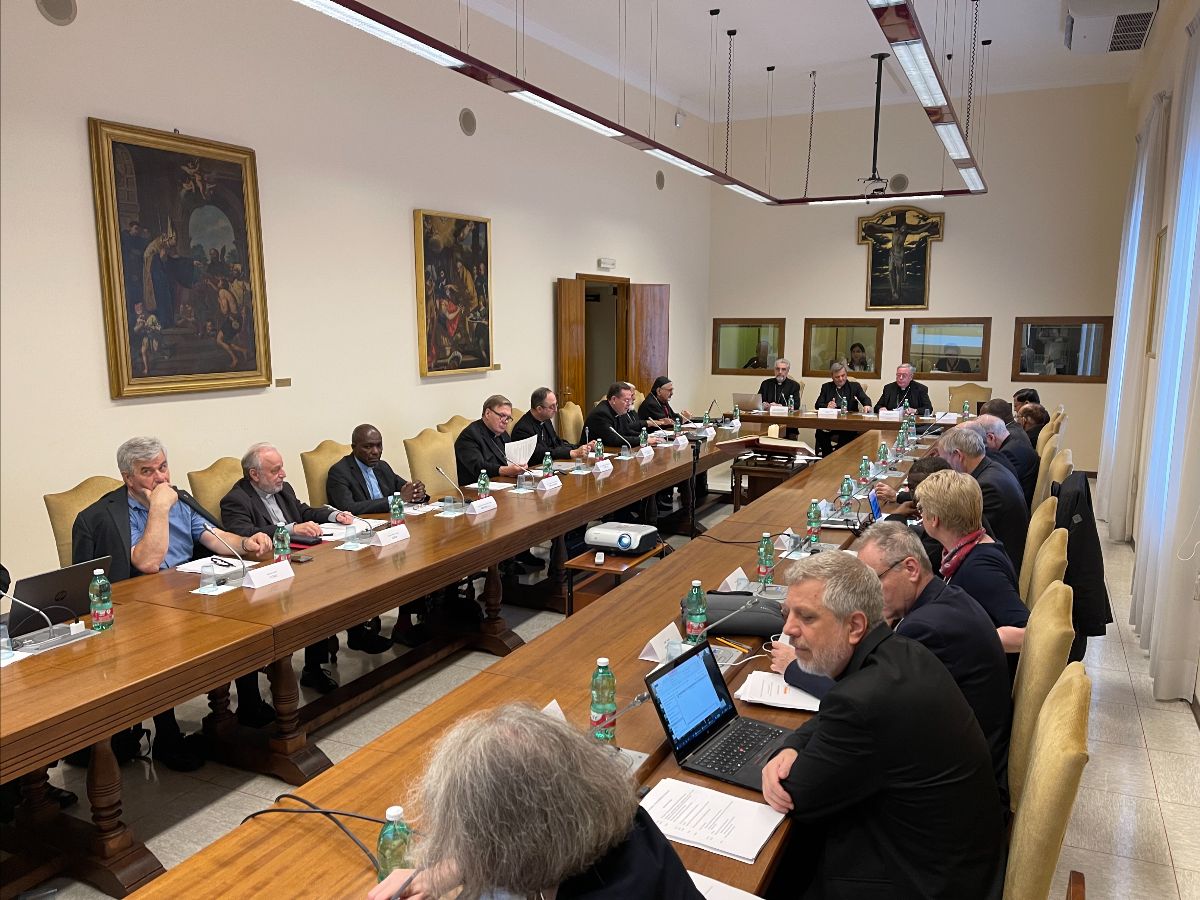
(ZENIT News / Rome, 09.08.2026).- The General Secretariat of the Synod publishes the Final Report of Study Group 6 on The revision in a synodal missionary perspective of the documents touching on the relationship between bishops, consecrated life, and ecclesial associations, together with the second part – concerning ad limina Visits – of the Final Report of Study Group 7 on Some aspects of the person and ministry of the bishop (criteria for selecting candidates to episcopacy, judicial function of the bishops, nature and course of ad limina apostolorum visits) from a missionary synodal perspective. The first part was published on 5 May.
Pope Leo XIV has directed that the Final Reports be made public in order to share with the entire People of God the fruits of the reflection and discernment undertaken, thereby giving concrete expression to one of the essential characteristics of a synodal Church: transparency and accountability (cf. Final Document, no. 97). The two texts set out proposals submitted to the Holy Father at the conclusion of the work of the respective Groups. They are therefore not decisions that have already been taken, but indications which the competent Dicasteries and the General Secretariat of the Synod will be called to translate into operational proposals to be submitted to the Holy Father (cf. Note of the General Secretariat of the Synod, 3 March 2026).
“These two Reports may appear to address different matters, but they say the same thing: there is no mission without converted relationships. Between a bishop and religious communities, between a bishop and the portion of the People of God entrusted to his care, between a local Church, the Churches of the same territory and the Bishop of Rome, the same principle applies: we listen to one another, we give an account, and we exchange gifts. Both texts place at the centre what the Synod has called differentiated co-responsibility,” says Cardinal Mario Grech, Secretary General of the Synod.
The Final Report of Study Group 6
The Final Report of Study Group 6 was drawn up “to offer the Holy Father reflections and practical suggestions” concerning the urgent need to foster a “relational conversion” among bishops, consecrated life and ecclesial associations – associations of the faithful, ecclesial movements and new communities. The aim is to move beyond functional or merely hierarchical approaches towards relationships founded on trust, mutual listening and a generous exchange of gifts. This entails a concrete commitment to transformation, both interior – of hearts and attitudes – and structural – of language, methods and spaces for encounter.
The Group, which met between April 2024 and February 2026 and was organised into three thematic subgroups, based its work on direct listening through questionnaires and interviews with bishops, consecrated persons and moderators of ecclesial associations. The results were progressively compared and reworked, culminating in a final synthesis oriented towards practice.
The proposals are structured around three areas: relations between bishops and consecrated life; collaboration between Episcopal Conferences and Conferences of Major Superiors; and relations between ecclesial associations and local Churches.
In the first area, the Group proposes the development of theological and juridical criteria for discerning the approval of new institutes, societies of apostolic life and emerging forms; the appointment in every diocese of a delegate or vicar for consecrated life, with annual meetings among bishops, consecrated persons and Conferences of Major Superiors; and synodal accompaniment during the more delicate transitions that many institutes are undergoing – declining vocations, the suppression of communities and the allocation of assets – through tailored visits, spaces for dialogue and spiritual support. The Report also calls for mandatory contracts or memoranda of understanding between dioceses and institutes regulating mission, formation, gender equality, remuneration and the administration of assets, accompanied by conciliation committees, deadlines and accountability indicators.
With regard to collaboration between Episcopal Conferences and Conferences of Major Superiors, the Report first suggests that ad limina Visits be prepared jointly by both, so that the dialogue with the Apostolic See may reflect the entire ecclesial reality of a given territory. It also proposes opportunities for fraternity, such as retreats and jubilees, as well as annual meetings of the respective General Secretariats to foster mutual knowledge; joint formation, with modules on synodality, ecclesiology and leadership to be offered together in seminaries, novitiates and formation centres; and annual multidisciplinary initiatives at the service of the peripheries. At the structural level, the Report calls for clear protocols governing pastoral collaboration and available resources, the presence of religious delegates within Episcopal Conferences, and the full representation of consecrated persons and lay people in decision-making bodies.
With regard to relations between ecclesial associations and local Churches, the Report calls for greater terminological clarity (associations of the faithful, movements, new communities), supported by qualitative listening to moderators and bishops capable of identifying concrete challenges and practices. It calls for ecclesial associations to be systematically incorporated into diocesan pastoral plans and participatory bodies – consultative bodies, pastoral councils and synodal assemblies – and proposes the development of networks among associations for common projects, resource-sharing and the promotion of charismatic complementarity. In the area of formation, it proposes programmes for members of associations on leadership, decision-making processes and the relationship between freedom and communion; formation for seminarians on the lay vocation; and formation for bishops on the potential and distinctive characteristics of these ecclesial realities. Above all, the Group stresses the need for a mutual change of mindset, fostered through personal acquaintance and regular visits.
The second part of the Final Report of Study Group 7
The second part of the Final Report of Study Group 7 seeks to offer a renewed understanding and procedural revision of ad limina Visits, in keeping with Pope Francis’ Apostolic Constitution Praedicate Evangelium. The Report emphasises that the Visit should not deal exclusively with matters concerning the internal administration of the local Church, but should also support the mission that the Christian community is called to carry out in the world, thereby becoming an instrument at the service of the missionary conversion of ordinary pastoral life.
The proposed criterion for evaluation is the conversion achieved in diocesan structures, decision-making processes and relationships among ecclesial subjects, with a view to the fruitfulness of the mission. The proposals situate the ad limina Visit within the framework of the ordinary dialogue between the local Churches and the Apostolic See, and concern its preparation, conduct and follow-up.
In preparation for the Visit, the Report invites the diocesan bishop to convoke his people so that, through ecclesial discernment, they may participate co-responsibly in drafting the Preliminary Report on the state of the diocese, which is sent to the Holy See prior to the Visit. The results of the diocesan processes would then be presented to the assembly of bishops of the Ecclesiastical Province or Episcopal Conference. The bishops would collegially assess the state of their dioceses, with the aim of strengthening pastoral collaboration and shared planning, and of offering the Pope and his collaborators an overview of the potential and needs of their territory that is, as far as possible, the fruit of common discernment.
With regard to the stay in Rome, priority is given to care for the spiritual dimension. The Report recommends that the bishops be divided into smaller groups and that sufficient time be allowed for the Visit. The dialogue, understood as an “exchange of gifts” and conducted in a collegial spirit, should be frank, cordial and not one-directional, enabling both the riches and the needs of the local Churches to emerge and fostering the circulation of good practices. The Report also considers it desirable that a diocesan delegation accompany the bishop during the ad limina Visit, in whatever manner may be deemed most appropriate, giving preference to those who were involved in its preparation at the local level.
Particular attention is devoted to follow-up. The institutions of the Roman Curia would provide the Episcopal Conferences and Eastern Hierarchical Structures with a report on the Visit; each diocesan bishop, together with any faithful who accompanied him to Rome, would in turn give an account of its outcomes to the local Church. The participatory bodies and competent diocesan offices would then discern the steps to be taken. Where the Visit has highlighted issues requiring further dialogue, online meetings or visits in loco by representatives of the Curia could be arranged. Finally, an independent ecclesial commission would periodically be established to evaluate the entire process.
Thank you for reading our content. If you would like to receive ZENIT’s daily e-mail news, you can subscribe for free through this link.

Publicaciones relacionadas:
 Relevant Data on the Contribution of the Digital World and Catholic Influencers to the Synod
 Nine Scientists Correct the Pontifical Academy for Life (Full Original Text)
 200 representatives of ecclesial movements and communities from all over the world in Rome for annual meeting
 Progress on Instrumentum Laboris for Synod on Synodality in October 2024 reported
