

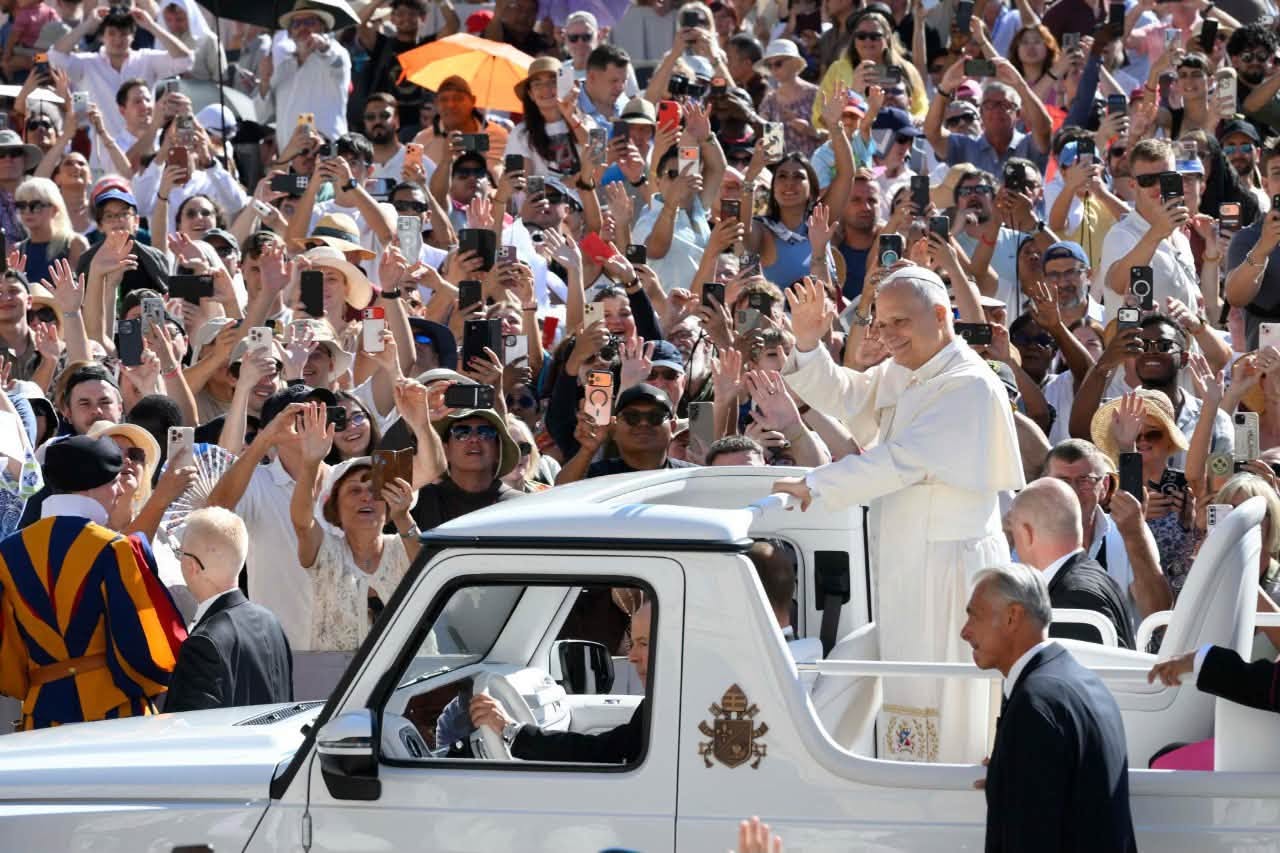
(ZENIT News / Paris, 09.08.2026).- France is preparing for an extraordinary four days when Pope Leo XIV arrives from September 25 to 28, in what is shaping up to be far more than a routine apostolic journey.
The first official papal visit to France since 2008 has generated a level of public enthusiasm that has surprised even those responsible for organizing it. Tickets for the youth vigil at the Stade de France disappeared in less than an hour. More than 400,000 people had already registered for the papal Mass in Paris, while authorities expect crowds of up to 500,000 along the Concorde–Champs-Élysées area. Lourdes, meanwhile, closed registrations a month ahead of schedule after reaching its capacity of 150,000 participants.
Hotels along the Pope’s itinerary have been fully booked for more than a month. The figures alone suggest an event of exceptional proportions. But another development may be even more revealing: the spontaneous financial response it has generated.
A surge of generosity
Since the Archdiocese of Paris launched its fundraising campaign on July 10, donations have continued throughout the French summer, traditionally a period when charitable giving slows dramatically.
According to Sylvie Bretones, who oversees the campaign, the archdiocese was receiving roughly 100 checks and 100 bank transfers every day during the summer. By the end of August, the campaign had reportedly reached €2 million.
The pattern of giving has been particularly striking. The average donation has been around €200—approximately twice the average single donation in France in 2024—and some contributions have exceeded €10,000.
Just as significant is the arrival of donors previously unknown to the Church.
The campaign was deliberately designed to reach beyond regular parish contributors, and organizers have found themselves receiving support from people who may belong to France’s Catholic cultural tradition without being publicly identifiable as practicing Catholics. Some, Bretones believes, may be people returning to faith after years away; others may be searching for meaning or responding to questions that have become increasingly difficult to avoid in modern society.
That phenomenon will be studied more closely after the visit. For the French Church, the donations may offer a window into a broader religious awakening that cannot be measured simply by Sunday attendance.
A Pope who has entered the French conversation
The unusual anticipation surrounding Leo XIV also reflects the impact of his pontificate beyond strictly ecclesiastical circles.
His encyclical Magnifica Humanitas, addressing the challenges posed by artificial intelligence and the protection of human dignity, reportedly became one of the summer’s bestselling books in French bookstores, including outside the traditional Catholic market.
His interventions on peace and on end-of-life issues have likewise ensured that the Pope is being heard in some of the most consequential moral debates facing contemporary Europe.
In a country where secularism has long shaped public life, it does suggest something: the Catholic voice is once again attracting attention from people who may not otherwise look to the Church for answers.
The visit will also arrive amid renewed interest in Christianity among younger generations, a development French dioceses have increasingly sought to understand and accompany.
On September 24, the eve of Leo XIV’s arrival, Catholic figures from markedly different corners of the French religious landscape are scheduled to gather at the Madeleine Church for a joint prayer vigil. The participants are expected to include the Dominican Brother Paul-Adrien, Father Matthieu Raffray and the creators of the popular YouTube channel Two Disciples—an unusual display of unity among personalities who ordinarily reach distinct audiences.
A generation-defining encounter?
The youth vigil at the Stade de France will underline the scale of the Church’s ambitions for the visit.
Around 80,000 people are expected to attend. The program will combine the memory of France’s great saints with a musical production bringing together Gregorian chant and contemporary praise music. Alexis Duffaure, choir director of Bordeaux Cathedral, has spent weeks preparing the event with 2,500 singers, a symphony orchestra and a contemporary music ensemble.
The organizers clearly hope that the evening will be remembered not simply as a spectacular gathering, but as an encounter capable of leaving a lasting spiritual mark on a new generation.
That ambition helps explain why the visit has mobilized so many people in different ways. Some are contributing financially, others are volunteering, and others are preparing through prayer.
Under France’s 1905 law separating Church and State, public authorities do not finance or organize the religious dimensions of the visit. The government’s role is limited primarily to security. The overall budget for the events—now estimated at €20 million—is therefore being borne by the dioceses and Church institutions involved.
An exceptional security operation
The extraordinary crowds expected for the papal journey have also prompted one of the largest security operations associated with a religious event in France in recent years.
Interior Minister Laurent Nuñez has announced that 15,000 members of the security forces will be mobilized at the height of the Paris events on September 25 and 26.
Approximately 14,000 police officers, gendarmes, mobile units and soldiers from Operation Sentinelle are expected to be deployed in Paris, while another 1,000 personnel will be in Lourdes preparing for the Pope’s arrival.
During papal movements in the Popemobile, officers on foot will form what Nuñez described as a protective security bubble, monitoring the enormous crowds for unusual activity.
The challenge is clear: the visit will involve major outdoor events attended by hundreds of thousands of people. Authorities expect approximately 80,000 participants at the Stade de France, up to 500,000 in central Paris, 150,000 at Lourdes and tens of thousands more around Metz Cathedral.
So far, however, French intelligence services have reported no specific terrorist threat against the papal visit. Nuñez also said authorities had not identified plans for violent disruption by extremist movements or organized actions aimed at exploiting the visit to protest against particular positions of the Pope or the Catholic Church.
More than nostalgia
It would be easy to interpret the enormous crowds expected for Leo XIV as a nostalgic reaction to the rare spectacle of a papal visit. The Pope’s arrival will certainly benefit from the novelty of the occasion.
But the signs surrounding the journey point to something potentially deeper.
The queues for registration, the unexpected flow of donations, the involvement of young Catholics and the interest generated by Leo XIV’s teaching all suggest that, beneath the familiar narrative of European secularization, another story may be developing.
France remains a profoundly secular country. A four-day papal visit will not transform that reality. Yet neither should the enthusiastic response be dismissed as mere curiosity.
A Pope arrives in a nation only occasionally. When he does, the event can reveal something about the country receiving him.
Thank you for reading our content. If you would like to receive ZENIT’s daily e-mail news, you can subscribe for free through this link.

Publicaciones relacionadas:
 Pope Leo XIV to bishops of the Amazon: no to the worship of nature
 Pope Leo XIV scores 8 out of 10 in US approval poll: here are the results
 This is the 197-inch sculpture dedicated to Pope Leo XIV in his former Peruvian diocese
 Pope Leo XIV accepts resignation of bishop whom Pope Francis appointed cardinal, but who “did not want” to receive the appointment
