

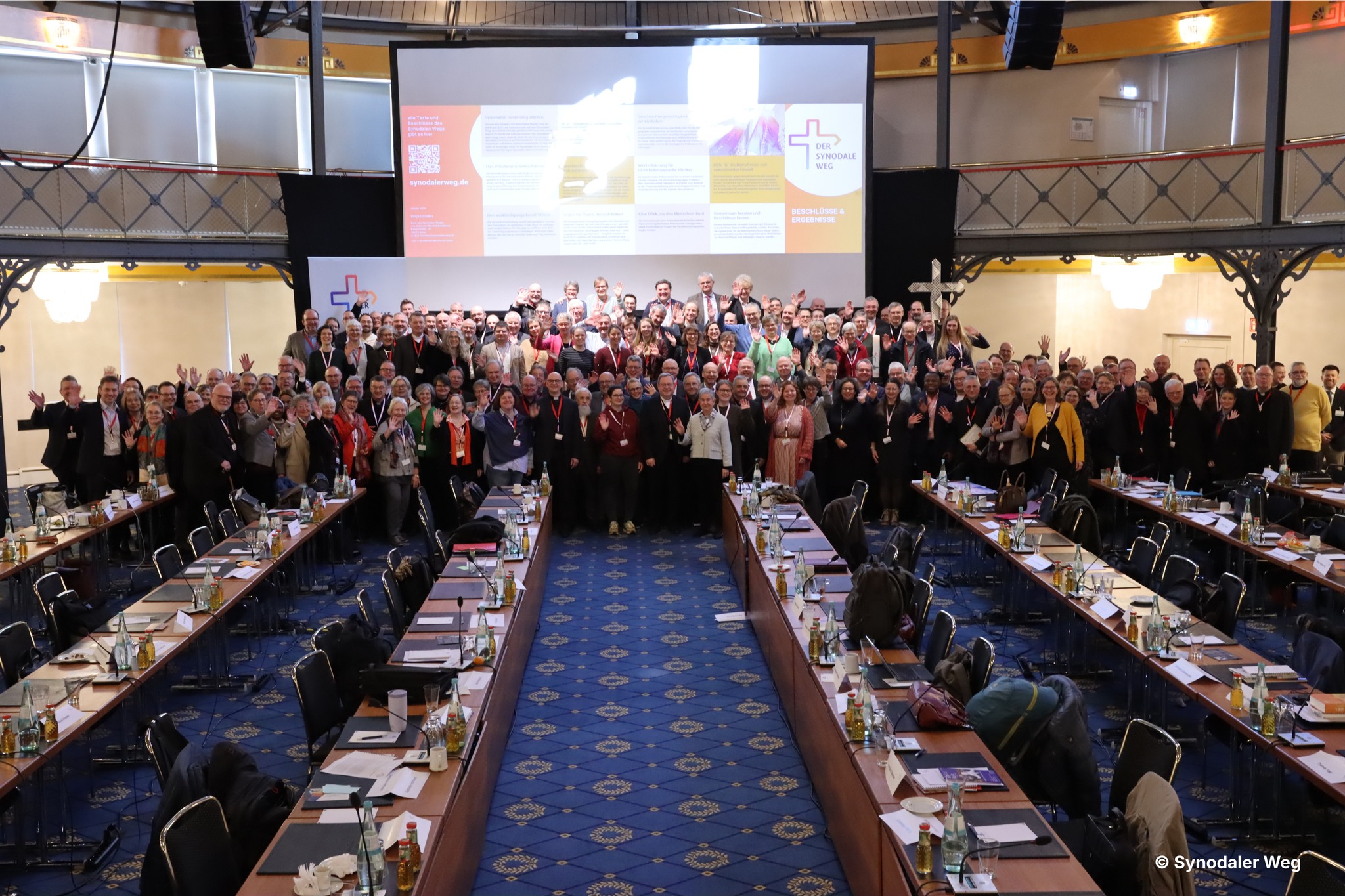
(ZENIT News / Rome, 02.03.2026).- When the final gavel fell in Stuttgart on February 1, 2026, it marked the end of one of the most ambitious—and controversial—reform experiments in modern Catholic history. After more than six years of debate, tension, negotiation, and guarded dialogue with Rome, Germany’s Synodal Way officially closed its first chapter. What follows now is something different: an attempt to institutionalize synodality itself.
From crisis to reform laboratory
The Synodal Way was born in late 2019 amid the shockwaves of Germany’s abuse crisis. What began as a response to systemic failures quickly evolved into a nationwide ecclesial laboratory, bringing together roughly 230 delegates—bishops and lay representatives—tasked with rethinking power structures, sexual morality, priestly life, and the role of women.
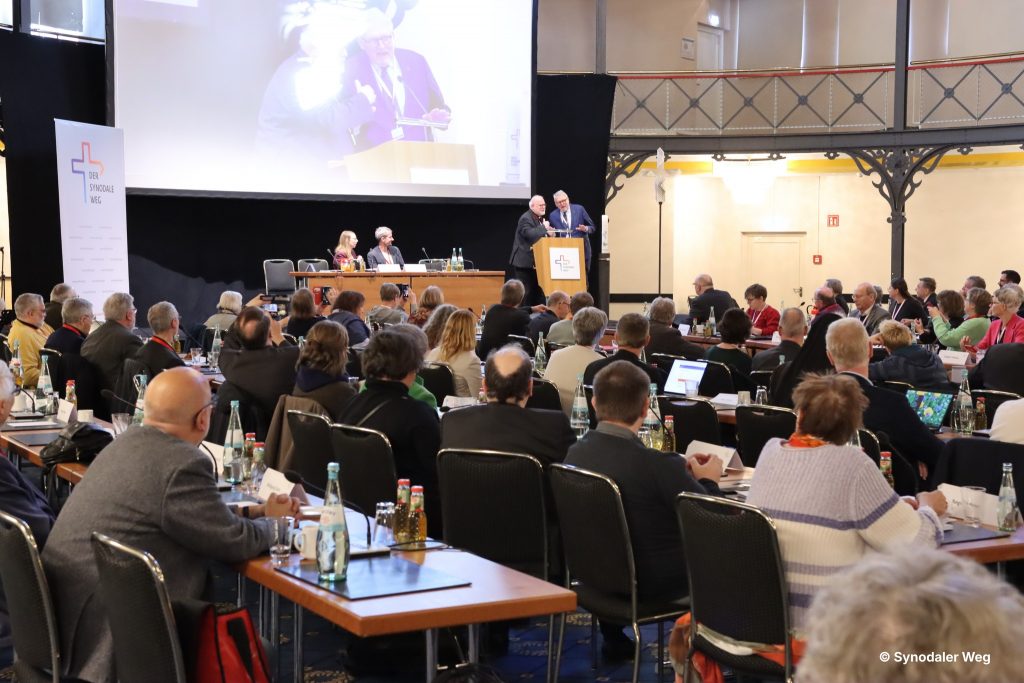
Its sixth and final plenary assembly, held January 31 and February 1 in Stuttgart, gathered 177 participants on site, alongside observers, consultants, and guests. Looking back, Bishop Georg Bätzing, president of the German Bishops’ Conference (DBK), spoke of a “cultural shift” in Church life. Irme Stetter-Karp, president of the Central Committee of German Catholics (ZdK), was even more direct: “We made it.”
What exactly did they achieve?
Fifteen documents were adopted over the course of the process, including ten concrete action texts. Among their most debated proposals: greater lay involvement in the appointment of bishops, opening priestly ordination to married men, advancing gender equality in a Church that still bars women from priesthood, reassessing Catholic teaching on homosexuality, blessing couples outside sacramental marriage, and reforming Church labor law so employees can no longer lose their jobs over private lifestyle choices.
Other resolutions addressed abuse prevention, calling for structural changes to counter clericalism and the concentration of power—factors widely seen as enabling past crimes.
Yet from the start, one limitation was clear: German bishops can only implement reforms locally, and some of the most sensitive questions—celibacy, women’s ordination, doctrinal change—lie squarely in Rome’s hands.
Unfinished business
A final report presented in Stuttgart listed eleven unresolved tasks. These range from creating a model framework for selecting bishops to allowing lay preaching during Eucharistic celebrations. The paper underscored a broader reality: the Synodal Way produced momentum, but not closure.
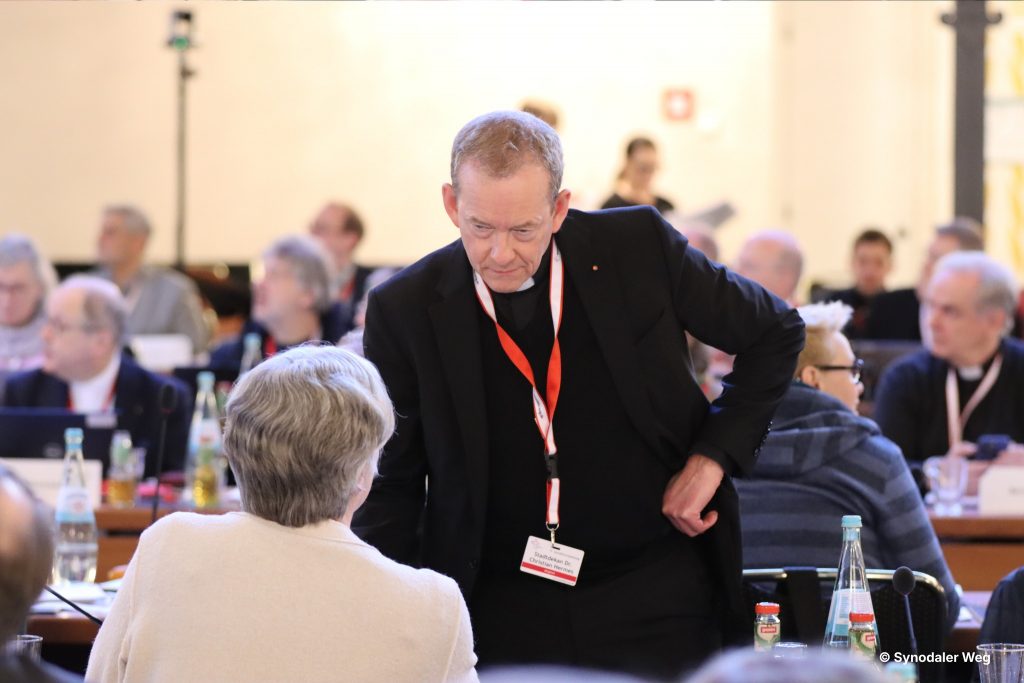
Disagreements also persist within the German Church itself. Some delegates, like Stuttgart dean Christian Hermes, pushed for faster progress. Others, including Bishop Franz Jung of Würzburg, criticized the compressed timelines of earlier assemblies, arguing that key decisions were rushed and insufficiently debated.
Thomas Sternberg, former ZdK president and one of the project’s architects alongside Cardinal Reinhard Marx, recalled how the initiative repeatedly stood on the brink of collapse. Critics predicted failure more than once. Yet in Stuttgart, Marx’s declaration that he was glad to have launched the Synodal Way drew a standing ovation.
Rome’s red lines
While applause filled the assembly hall, the mood in Rome has often been markedly cooler.
The Vatican intervened repeatedly over the years, especially regarding plans for a joint decision-making body of bishops and laity. In February 2024, a letter signed by Cardinal Secretary of State Pietro Parolin, Cardinal Víctor Manuel Fernández, and then–Bishops’ Dicastery prefect Robert Francis Prevost—now Pope Leo XIV—forced German leaders to suspend a vote on that structure.
As pope, Leo XIV has voiced cautious skepticism about whether the Synodal Way truly reflects the hopes of all German Catholics. At the same time, he has emphasized that different expressions of synodality need not mean rupture—provided dialogue continues and no voices are excluded.
That dialogue remains fragile. Stetter-Karp recently lamented what she described as slow Vatican communication, noting that several letters sent to Rome—including those transmitting Synodal Way resolutions from June 2023—have gone unanswered. She suspects lingering Curial hesitation to recognize the ZdK as a legitimate interlocutor.
From Synodal Way to Synodal Conference
Despite these tensions, Germany is pressing forward with a new national body: the Synodal Conference.
If approved, it will include 27 diocesan bishops, 27 ZdK representatives, and 27 additional Catholics, among them two survivors of sexual abuse, two representatives of religious superiors, at least 13 women, and at least five members under 30. Its mandate is ambitious: to deliberate and decide on pastoral priorities, monitor reform implementation, and act as a public voice on social and political issues.
The statutes require a two-thirds majority when the bishops meet in Würzburg in late February 2026. Final recognition—recognitio—must then come from Rome.
Bätzing has repeatedly ruled out launching the body without Vatican approval. “We will not begin if Rome has not given its consent,” he said. Bishop Franz-Josef Overbeck of Essen is expected to travel to Rome shortly for final clarification talks, including a meeting with Archbishop Filippo Iannone of the Dicastery for Bishops.
Bätzing has also announced he will not seek re-election as DBK president, adding a new layer of uncertainty. His successor, to be chosen at the same February assembly, will inherit both the reform process and the delicate relationship with the Vatican.
Not all bishops are on board. Cardinal Rainer Maria Woelki of Cologne, along with Bishops Stefan Oster, Rudolf Voderholzer, and Gregor Maria Hanke, withdrew from the reform dialogue some time ago, citing Vatican reservations. Whether and how these critics will engage with the Synodal Conference remains an open question.
Abuse: progress and limits
Sexual abuse—the catalyst for the entire process—remains its most painful unresolved chapter.
Germany’s bishops point to concrete steps: a national advisory council of survivors created in 2020, independent expert monitoring of diocesan safeguarding measures, and annual data collection. Johannes Norpoth, a member of the survivors’ advisory body, acknowledged progress in prevention and openness around power structures and gender equality.
Still, he warned of serious shortcomings, including inadequate compensation for victims and a Church culture not yet fully centered on survivors.
A study presented in Stuttgart by the Catholic University of Eichstätt found that while the Synodal Way helped break taboos and recognize previously marginalized groups, about half of participants judged its contribution to addressing systemic causes of abuse—and restoring trust—as only marginal.
A hopeful but contested future
The final assembly closed with a joint declaration titled For a World with a Future. With a Church that Gives Hope. It reaffirmed commitments to transparency, participation, and gender equality, and framed the Synodal Conference as a tool to confront structural abuses of power.
For Bätzing, synodality is no longer optional: it is “the defining characteristic of the Church’s future.” Stetter-Karp went further, linking Church reform to broader democratic values under pressure worldwide. “Human dignity and participation must not be sacrificed on the altar of power,” she said.
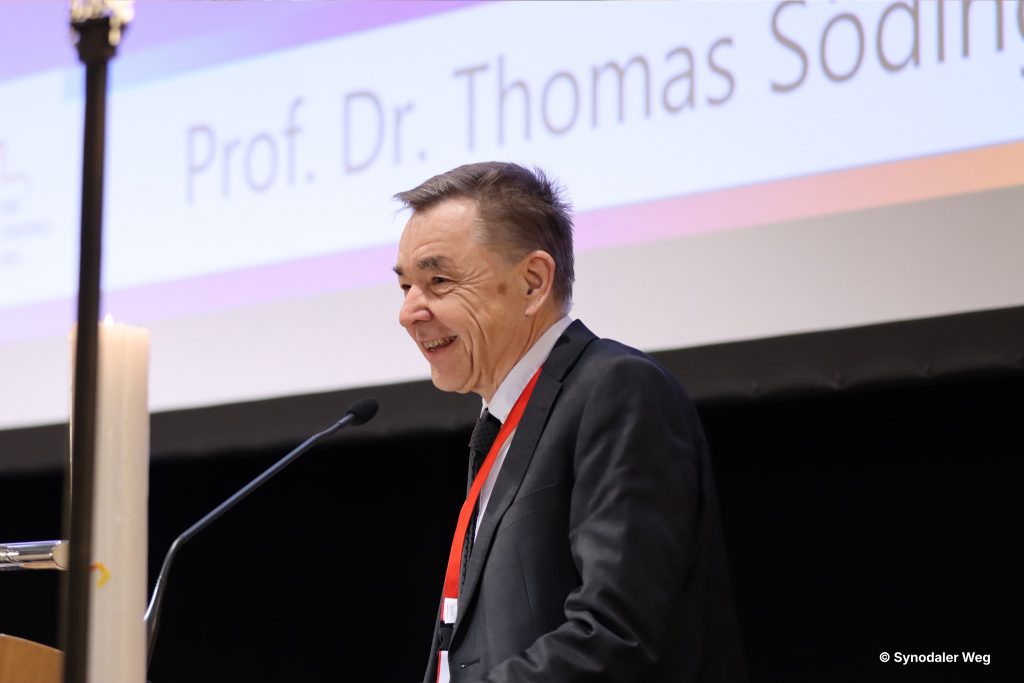
Vice presidents Michael Gerber and Thomas Söding described the Synodal Way as a “school of listening,” one that survived intense tensions and generated new energy. Now, Söding said, “a new chapter begins.”
Whether that chapter will be written in harmony with Rome—or under renewed strain—remains to be seen. What is clear is that Germany’s Catholic Church has crossed a threshold. The Synodal Way may be over, but the debate it unleashed is far from finished.
Thank you for reading our content. If you would like to receive ZENIT’s daily e-mail news, you can subscribe for free through this link.

Publicaciones relacionadas:
 20% of the Congressmen of the New U .S. Congress Are Catholics
 Report Reveals That Children Inherit Their Parents’ Faith and Political Ideas
 Was There a Schism or Not? The Situation in India after the Pope’s Liturgical Ultimatum
 From Saddam to Assad, the collapse of regimes and the danger of an ‘Iraqisation’ in Syria
