

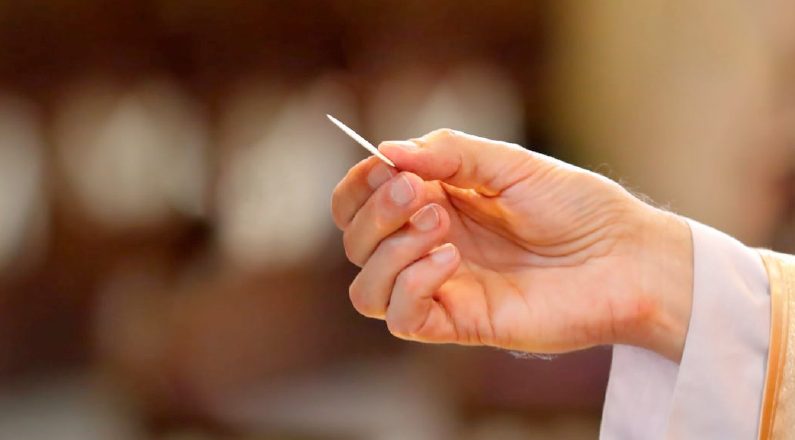
(ZENIT News / Washington, 09.23.2025).- A new academic study suggests that how Catholics encounter the Eucharist during Mass may shape how deeply they believe in the mystery at its heart.
Natalie A. Lindemann, a psychology professor at William Paterson University, has published research in the Catholic Social Science Review indicating that traditional liturgical experiences—such as receiving Communion on the tongue, hearing consecration bells, or attending parishes that celebrate the Traditional Latin Mass—are associated with a stronger conviction in the Real Presence of Jesus Christ in the Eucharist.
The survey of 860 English-speaking Catholic adults in the United States, weighted to reflect national demographics, revealed a spectrum of belief. Only about a third of respondents said with certainty that Christ is truly present under the forms of bread and wine, while nearly a quarter were equally certain the Eucharist is purely symbolic. The remainder fell along a continuum of doubt, probability, or indecision.
What made a difference, Lindemann found, was not gender, age, or ethnicity, but liturgical context. Catholics who had ever received Communion on the tongue scored significantly higher in belief than those who had never done so. The effect was stronger among those who always received in that way, and strongest still among those who insisted that Communion ought to be received on the tongue.
Similar patterns emerged with other markers of traditional practice. Participants whose parishes consistently rang bells at the consecration, a practice meant to draw attention to the moment of transubstantiation, showed a substantially higher level of belief than those who had never heard them. Likewise, Catholics exposed to the Traditional Latin Mass—whether or not they regularly attended—were more likely to affirm the Real Presence than those without such exposure. Positive attitudes toward the older liturgy correlated with firmer belief, while negative perceptions aligned with greater skepticism.
The findings come at a time when U.S. bishops have voiced concern about declining Eucharistic belief, launching a three-year national revival to renew devotion to the sacrament. Lindemann’s research offers data-driven evidence that ritual gestures and sensory cues may reinforce theological conviction in ways catechesis alone does not.
She also noted lingering effects of the COVID-19 pandemic, when many dioceses mandated reception of Communion in the hand. A number of respondents said they still follow that practice reluctantly, suggesting that shifts in ritual can carry long-term consequences for how belief is lived.
While the study identified connections between Eucharistic devotion and broader cultural factors—such as higher Mass attendance and politically conservative leanings—it found no significant influence from age, sex, ethnicity, or even the placement of the tabernacle.
Taken together, the results point to a paradox: in an age that often prizes personal choice, Catholics who embrace uniformity of ritual and traditional forms of worship appear more likely to profess with confidence the mystery that lies at the heart of their faith.
Thank you for reading our content. If you would like to receive ZENIT’s daily e-mail news, you can subscribe for free through this link.

Publicaciones relacionadas:
 From Amazon to Turkey: Indigenous children ‘kidnapped’ and converted to Islam
 The Problem of Suicide Among the Catholic Clergy: Alarm Raised Given the Increase in Some Countries
 Italy’s Shrinking Wedding Numbers: A Cultural and Demographic Shift
 Leo XIV, Trump, and the moral legitimacy of war in the Middle East: diplomacy as the Vatican’s only “weapon”
