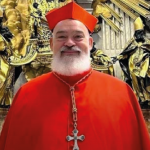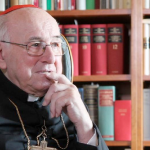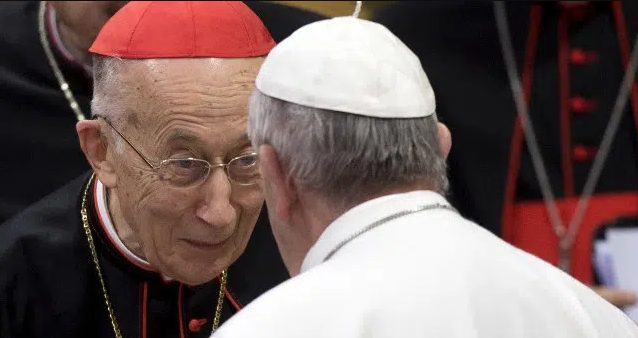
(ZENIT News / Rome, 02.05.2025).- Following is an English translation of a reflection published by Cardenal Camillo Ruini, Vicar Emeritus of the Pope for the Diocese of Rome, and one of the most measured and highly regarded ecclesiastics for his spirituality and personal life testimony. This reflection is offered in the context of the General Congregations prior to the beginning of the Conclave.
* * *
Prayer for the Church in the Near Future
By Cardinal Camillo Ruini
The legacy of Pope Francis is a question that challenges and profoundly shakes the Church. In these lines, I will approach it from a perspective of trust, because it is founded on the merciful power of God who guides our steps along the path of the good. I will formulate four wishes — which are also invocations — for the Church in a future that I hope is very near. I trust in a good and charitable Church, doctrinally secure, governed according to the rule of law, and deeply united internally. These are my prayer intentions, which I would like to see widely shared.
- In the first place, therefore, a good and charitable Church. Love, brought to the fullest effect of life, is indeed the supreme law of Christian witness and, therefore, of the Church. And it is what people, even today, are most thirsty for. All unnecessary harshness, pettiness, and dryness of heart must, therefore, be eliminated from our style of government.
- As Benedict XVI wrote, faith today is a flame that threatens to go out. Rekindling this flame is, therefore, another great priority for the Church. To achieve this, we need much prayer; we need the capacity to respond in a Christian way to today’s intellectual challenges, but we also need the certainty of truth and the security of doctrine. We have experienced for too many years that if these are weakened, all of us, Pastors and faithful alike, are gravely penalized.
- Then there is the question of government. Benedict XVI’s pontificate has been undermined by the lack of capacity to govern, and this is a concern that applies to all times, including the near future. The issue is governing the very special reality that is the Church. Here, as I have said, the fundamental law is love: the style of government and the recourse to the law must conform as closely as possible to that law, which is very demanding for anyone.
- In recent years, we have perceived some threats — which I do not wish to exaggerate — to the unity and communion of the Church. To overcome them, and to bring to light what I like to call the «catholic way» of the Church, mutual charity is once again decisive, but it is also important to awaken awareness that the Church, like every social body, has her own rules, which no one can ignore with impunity.
At 94, silence is more appropriate than words. However, I hope these lines of mine are a small fruit of the good I wish for the Church.
Translation of the Italian original by ZENIT’s Editorial Director and, into English, by Virginia M. Forrester