

Hu Zimo
(ZENIT News – Bitter Winter / Beijing, 02.01.2026).- On January 19, Beijing hosted the annual National Procurators’ Meeting—China’s highest gathering of prosecutors, though “prosecutors” may no longer be the most accurate job description. Judging from the speeches that are now being published in various outlets, they have been reassigned to a different profession: ideological clergy. Their task is not so much to enforce the law as to enforce the correct thought, and the correct thought, as always, comes with a proper name attached.
The meeting opened with the usual invocation: a solemn call to “thoroughly study and implement General Secretary Xi Jinping’s important instructions on comprehensively governing the country according to law, on political‑legal work, and on procuratorial work.” The 2025 work summary and 2026 task list were presented. Still, the real agenda was simpler: prosecutors must “uphold Xi Jinping Thought on Socialism with Chinese Characteristics for a New Era as the guiding principle,” “firmly support the ‘Two Establishes’,” and “resolutely achieve the ‘Two Upholds’.” In other words, the rule of law begins with the rule of Xi.
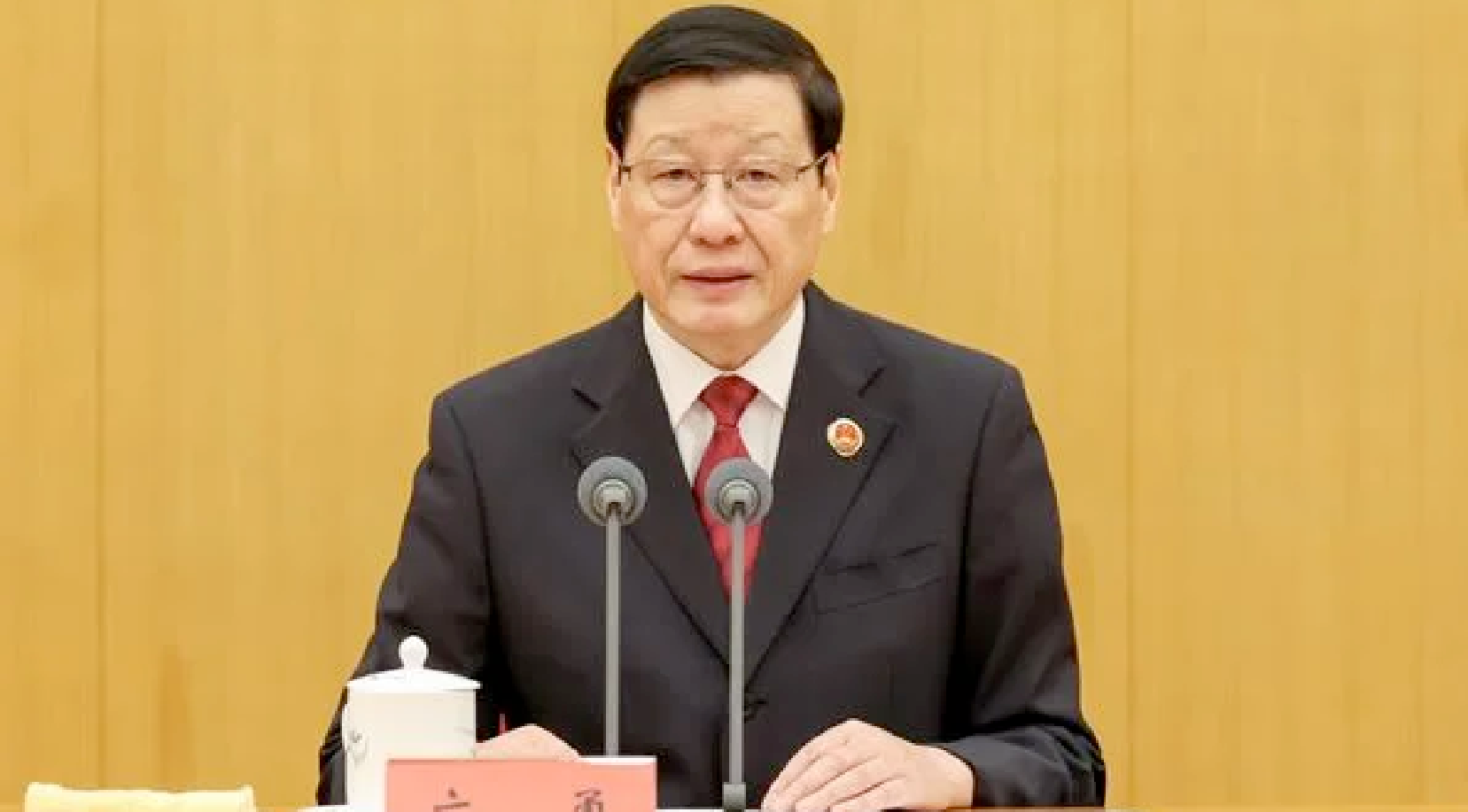
Procurator-General Ying Yong delivered the keynote sermon. He praised the past year’s achievements, attributing them—naturally—to “the strong leadership of the Party Central Committee with Comrade Xi Jinping at its core.” The prosecutors’ successes, he explained, were not due to legal expertise, investigative skill, or judicial independence (perish the thought), but to “the scientific guidance of Xi Jinping Thought on Socialism with Chinese Characteristics for a New Era.” One could almost hear the collective sigh of relief from the legal professionals in the room: no need to worry about jurisprudence when ideology does all the heavy lifting.
Ying then clarified the true nature of the procuratorate: “Procuratorial organs are first and foremost political organs; being clear-cut in stressing politics is the primary requirement.” Justice, it seems, is a secondary hobby. The primary requirement is to “firmly safeguard the authority and centralized, unified leadership of the Party Central Committee,” and to “consciously implement the Party’s absolute leadership in all aspects and all links of procuratorial work.”
To avoid any confusion, Ying listed the forbidden doctrines: Western “constitutionalism,” “separation of powers,” and “judicial independence.” These, he warned, are “erroneous viewpoints.” The prosecutors nodded dutifully, perhaps relieved that they would not be burdened with such dangerous concepts as checks and balances.
Instead, they were instructed to “organically unify the implementation of the Party’s line, principles, and policies with the implementation of national laws.” In practice, this means the law must follow the Party, not the other way around. Xi Jinping’s “Thought on the Rule of Law” thus reveals its true nature: a theory of replacing the rule of law with the rule of loyalty. The legal system becomes a conveyor belt delivering political directives into judicial outcomes.
The meeting also reaffirmed the sacred duty of defending “political security” above all else. Prosecutors were told to “severely crack down on all types of crimes endangering national security,” a category so elastic it can include anything from espionage to posting the wrong meme. They must also “resolutely safeguard the security of the state power, the system, and ideology”—a trinity of insecurities that keeps the prosecutorial apparatus permanently mobilized.
Economic crimes, cybercrimes, juvenile crimes, and public‑interest litigation were all mentioned, but always framed within the same ideological scaffolding. Even the protection of minors was presented as part of the Party’s grand political mission. The message was that every legal task is political, and every political task is a legal obligation.
The meeting concluded with a reminder that prosecutors must “study, think, and practice Xi Jinping Thought on the Rule of Law,” a phrase that roughly translates to “absorb, internalize, and apply the correct ideology.” One imagines a future where law schools offer courses titled “Advanced Xi Jurisprudence” and “Applied Loyalty Studies.”
In the end, the National Procurators’ Meeting was one of the usual Chinese political liturgies. The participants were not asked to uphold justice, but to uphold the Party. They were not asked to interpret the law, but to interpret Xi Jinping Thought. And they were not asked to defend citizens’ rights, but to protect the state’s ideological security.
If justice is blind, China’s prosecutors have been instructed to remove the blindfold, check which way the political wind is blowing, and proceed accordingly. The rule of law, in this system, is not a shield protecting the people from power—it is a tool ensuring the people remain obedient to it.
Thank you for reading our content. If you would like to receive ZENIT’s daily e-mail news, you can subscribe for free through this link.

Publicaciones relacionadas:
 Chinese Communist government takes advantage of Pope’s death to unilaterally impose new bishops
 The last historic Christian village in the Holy Land, threatened with annexation by the Jewish state of Israel
 China: Children Barred from Church Doors. A Mother Speaks Up
 U.S. Court Orders Access for Clergy Amid Immigration Crackdown
