

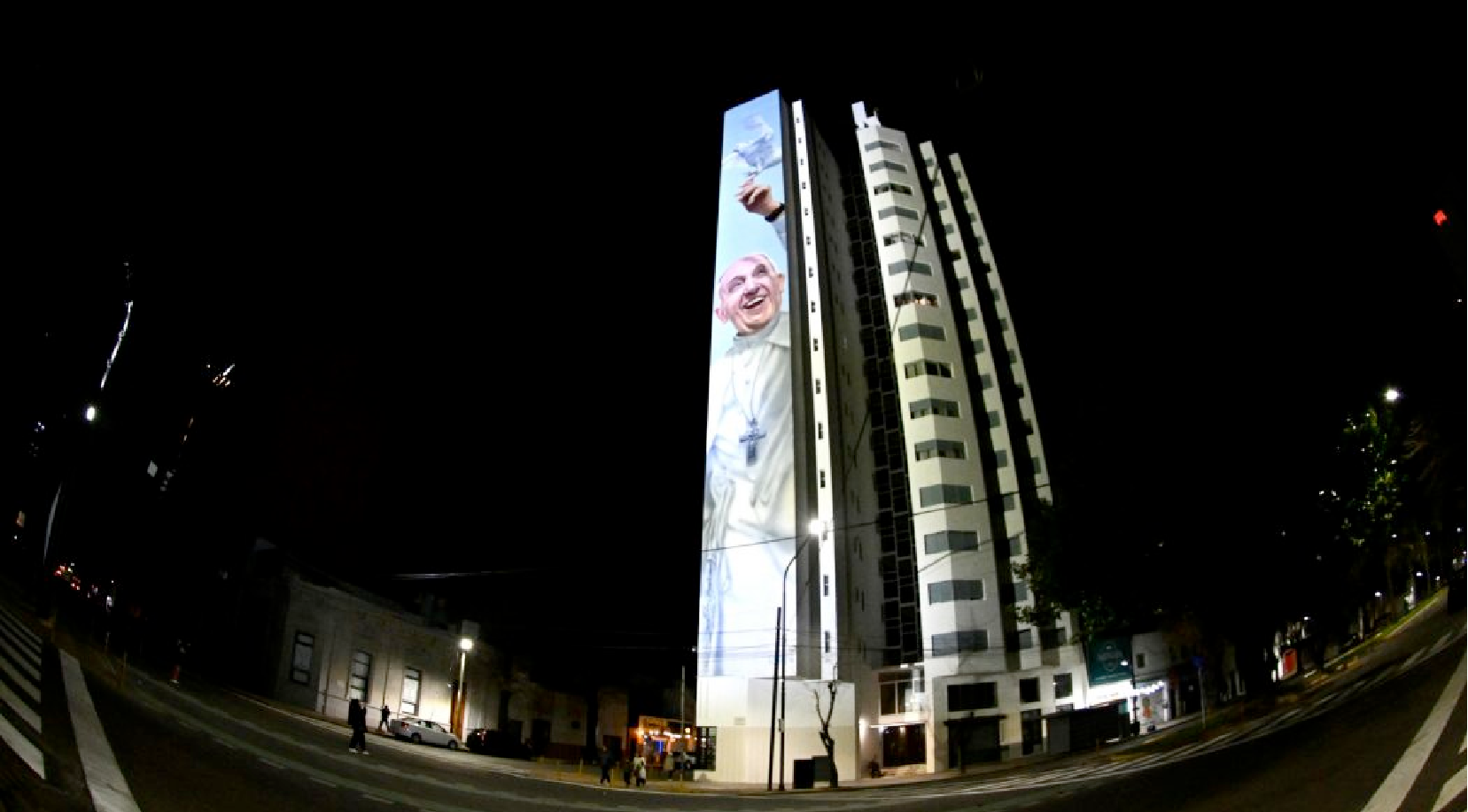
(ZENIT News / La Plata, 04.08.2025).- Martin Ron painted a large-scale portrait of Pope Francis on a building located in Plaza Moreno at 14th and 54th Streets in La Plata, capital of the Province of Buenos Aires, Argentina. It was inaugurated on July 26, and local authorities noted that it is the largest mural in the world dedicated to the first Argentine Pontiff.
The work rises 50 meters from the ground, using a hyper-realistic technique that portrays the Pope with a white dove flapping its wings. Pope Francis is seen smiling and extending his arm, as if inviting it to take flight. It depicts a real scene that took place in 2013, shortly after Jorge Mario Bergoglio was elected Pontiff.
Ron said to EFE Agency: «We wanted it to be a posthumous tribute, one that would have a connection with the sky. That’s why we chose a well-known image in which Francis appears smiling, extending his arm, accompanied by a dove, symbol of peace and spirituality.”
The image originated in Rome, where pilgrims gave the dove to Pope Francis, and the bird refused to leave his hand. The image was selected
Ver esta publicación en Instagram
after several months of creative work and meets the technical challenges of the mural to adapt to the vertical format, 50 meters high and five meters wide.
The 44-year-old artist led a team of five people and explained: «It was a very difficult wall because of its verticality. The chosen image resolves everything: it has a long ribbon, a cross, an arm that emerges from the plane and connects with the sky.»
The Archbishop of La Plata, Monsignor Gustavo Carrara blessed the mural and said that «the city must be a place of encounter, of integration, where neighbors help each other to walk together.» He expressed the hope «that the figure of Francis may make us work in this city for a culture of encounter and may inspire us to pursue paths toward fraternity and social friendship.»
La Plata Mayor Julio Alak participated in the ceremony with other municipal authorities. Guest orchestras provided the rhythm and color, which included religious communities, Catholic schools, representatives from across the political spectrum, museums, cultural heritage institutions, universities, and Chambers of Commerce from La Plata.

Publicaciones relacionadas:
 Pope in Wheelchair Put on Plane to Canada: Pontiff Prays Angelus with Journalists and Remembers “Grandparents” of Consecrated Life
 Cardinal Eijk, Archbishop of Utrecht, Asks Pope for An Encyclical on Gender Ideology
 Pope’s Harsh and Scathing Words: “The German Experience Doesn’t Help. It’s Not a Synod or a Serious Synodal Path
 Pope Francis Creates His Confessor a Cardinal: The Priest Who Asked God’s Pardon for Forgiving Too Much
