

(ZENIT News / Taybeh, Palestine, 07.15.2025).- Taybeh, a quiet village nestled in the hills of the West Bank, is no longer merely a footnote in the complex story of the Israeli-Palestinian conflict. This village, home to the last entirely Christian community in the region, has become the flashpoint of a deepening crisis—a place where history, faith, and geopolitics now intersect under the shadow of violence.

In recent weeks, Taybeh has suffered a series of coordinated attacks by extremist Israeli settlers. Fields were set ablaze, livestock driven onto farmland in acts of intimidation, and the historic Church of Saint George—dating back to the 5th century—was nearly consumed by fire. Graves in the local Christian cemetery were desecrated. The message left by some of the assailants was blunt: “There is no future for you here.”
But Taybeh refuses to go quietly.

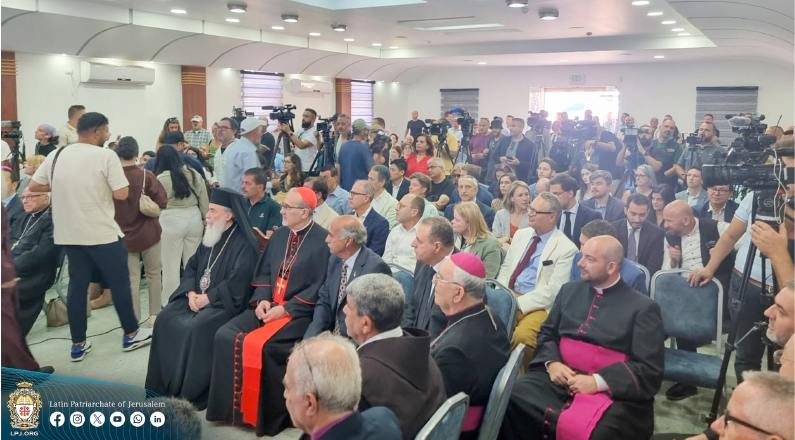
On July 14, in an unprecedented show of ecumenical solidarity, patriarchs and bishops from across the Christian world—Latin, Orthodox, Armenian, Melkite, Lutheran, Anglican, and Franciscan—walked side by side through the streets of Taybeh. They came not only to pray but to make a statement: that the Christians of this land, rooted here since apostolic times, are not alone.
Cardinal Pierbattista Pizzaballa, Latin Patriarch of Jerusalem, joined the Greek Orthodox Patriarch Theophilos III and other church leaders in a prayer procession to the ancient church. A message of solidarity from King Abdullah II of Jordan was read aloud, warning that these escalating assaults are part of a systematic campaign against Christians in their historic homeland.

More than 20 diplomats were present, standing shoulder to shoulder with the 1,300 residents of Taybeh. The choice to remain here, despite fear and isolation, was described by Bishop Theophilos not as mere resilience but as “the greatest act of courage.”
Taybeh is not an isolated case. Just days before the July 14 visit, two Palestinian youths—one holding American citizenship—were killed in Al-Mazraa al-Sharkiya, less than four kilometers away. Three others were killed in June in nearby Kufr Malik. The violence is part of a pattern. In the last two years alone, over 100 Christian families have left Bethlehem, Beit Jala, and Beit Sahour, unable to bear the suffocating pressure.

Father Bashar Fawadleh, the Latin pastor of Taybeh, stood before the gathering with the quiet fury of a man whose people are slowly disappearing. “We are not strangers here,” he said. “We are the people who turned olive trees into prayers and earth into altar.” But he warned that if the assaults continue and livelihoods disappear, “Taybeh may become not a living community, but a silent monument to what once was.”
The local clergy are calling this not simply persecution, but a systematic erasure. Residents speak of nighttime raids and daytime sieges. Their fields are now grazing grounds for settlers’ cattle, their access to land increasingly restricted, and their cries for help often ignored. Church leaders say that the Israeli government and its security forces bear responsibility—not only for failing to stop the attacks, but for enabling them.

What the Christians of Taybeh are asking for is not privilege, but protection. Church officials have issued urgent appeals for international oversight, legal accountability, and inclusion of Taybeh in global programs that safeguard religious heritage sites. Specific demands include prosecution of perpetrators, dismantling of illegal settlements, restoration of land access, and consistent humanitarian support.
Bishop Nicholas Hudson of England and Wales, who visited Taybeh earlier this year, described the situation as a moral litmus test. “All the Christians we met asked for one thing: to live and work in peace, on their own land,” he said. “If the Holy Land is to remain holy, it cannot lose the people who have been its stewards for two millennia.”

In a region overwhelmed by conflict, Taybeh’s story may seem like one of many. But what distinguishes it is precisely its singularity—a Christian village clinging to faith, memory, and soil amid growing threats. What happens here is a bellwether for the wider Christian presence in the Holy Land.
The stakes are clear. If communities like Taybeh vanish, the Christian voice in the land of its origin risks fading not by decree, but by attrition. And the Holy Land, instead of a mosaic of faiths, may become a monologue.

For now, the candles still burn in Saint George’s Church. But each attack is a gust of wind. And what Taybeh is asking the world—governments, churches, citizens—is simple: shield the flame.
Thank you for reading our content. If you would like to receive ZENIT’s daily e-mail news, you can subscribe for free through this link.



Publicaciones relacionadas:
 Christian Leaders Unite Against Jerusalem Municipality’s Move to Seize Armenian Patriarchate Properties
 3 seminarians kidnapped and guard killed in assault on minor seminary in Nigeria
 Between Drones, Settlers and Classrooms: How Violence and Administrative Israeli Pressure Are Reshaping Palestinian Life
 The last historic Christian village in the Holy Land, threatened with annexation by the Jewish state of Israel
