

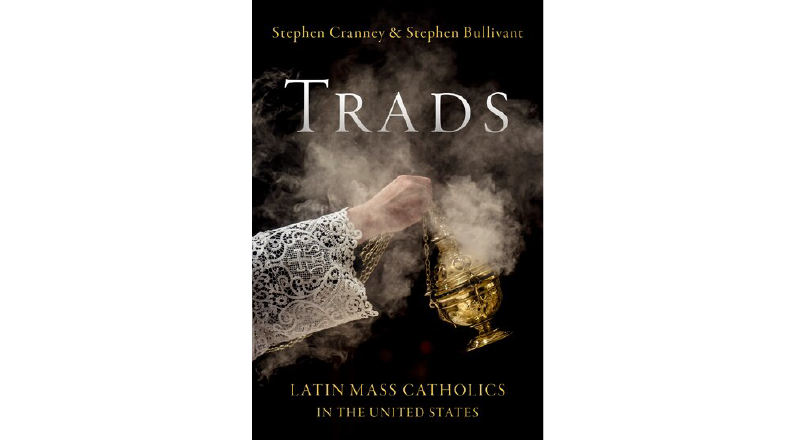
(ZENIT News / Rome, 13.11.2026).- Who are the Catholics attached to the traditional Latin Mass? Are they opponents of the Second Vatican Council, critics of the modern Church or, as some of their detractors suggest, a marginalised movement with divisive tendencies? A new sociological study published by Oxford University Press seeks to move beyond these competing assumptions, offering an evidence-based portrait of a community that remains at the centre of one of the Catholic Church’s most sensitive debates.
The book, Trads: Latin Mass Catholics in the United States, by sociologists Stephen Cranney and Stephen Bullivant, is now available in digital format. Its publication carries particular significance because both researchers presented their findings personally to Pope Leo XIV during a private audience on March 5, giving the Pontiff an opportunity to hear directly about the social composition, religious convictions and experiences of Catholics attached to the older Roman liturgy.
Drawing on original surveys, ethnographic observation and in-depth interviews, the authors examine not only who attends the traditional Latin Mass but also why these Catholics choose it, how they understand their relationship with the wider Church and what distinguishes them from other American Catholics. Their central contribution is to replace generalisations with empirical evidence in a debate frequently dominated by ideological positions.
One of the most revealing aspects concerns the relationship between traditionalist Catholics and the Second Vatican Council. The assumption that attachment to the pre-conciliar liturgy necessarily entails rejection of the Council or disobedience to Rome is challenged by the figures collected in the researchers’ earlier work, published in 2024.
Nearly two-thirds of those surveyed expressed at least some agreement with the teachings of Vatican II. Specifically, 22% said they strongly agreed with them, 27% agreed and 15% somewhat agreed. Only 4% expressed outright disagreement. The research also found an exceptionally high level of adherence to central Catholic teaching on the Eucharist: 98% of respondents said they believed in Christ’s Real Presence.
The findings suggest that liturgical preferences should not automatically be confused with doctrinal positions. Disagreement with particular disciplinary decisions or interpretations of the Council does not necessarily amount to rejection of the Church’s teachings or its authority. Indeed, the University of Notre Dame Australia, which reported on Bullivant’s presentation to Leo XIV, also highlighted the substantial recognition of papal authority among those surveyed.
The distinction is important at a time when the traditional Mass has often become a symbol of wider tensions over Catholic identity. For many of its adherents, the attraction lies in the experience of reverence, sacred beauty and continuity with centuries of liturgical tradition. The researchers also investigate the presence of young families and converts, as well as the relationship between traditionalist communities and parishes celebrating the post-conciliar Roman Missal. Rather than treating these Catholics as a single ideological bloc, the book examines the diversity of their motivations and ecclesial attitudes.
The publication also brings renewed attention to the consequences of Pope Francis’s 2021 motu proprio Traditionis Custodes, which significantly restricted the celebration of the Mass according to the 1962 Roman Missal and placed its authorisation under tighter episcopal and Vatican control.
The scale of the subsequent changes in the United States is considerable. According to figures cited by Cranney and Bullivant, more than 800 American parishes offered the traditional liturgy before the restrictions were introduced. That number subsequently fell to fewer than 500 parishes not affiliated with the Priestly Fraternity of St Peter’s? No: the relevant distinction in the study is the Society of St Pius X, which operates separately from the diocesan structures in which the restrictions are being implemented. The researchers also identify 103 chapels belonging to the Society in the United States.
These figures illustrate why the debate cannot be reduced to a disagreement over liturgical aesthetics. Decisions concerning access to the traditional Mass have tangible consequences for parish communities, families and the religious formation of younger generations. They also raise questions about how ecclesiastical authority can preserve unity without unnecessarily alienating Catholics whose attachment to an established form of worship is deeply rooted in their spiritual lives.
Leo XIV’s meeting with the researchers took place amid a series of encounters that attracted attention among Catholics concerned about the future of the traditional liturgy. The March 5 audience was recorded in the Holy See’s official bulletin, although the Vatican did not disclose details of the conversation. Notre Dame Australia subsequently confirmed that Bullivant and Cranney had presented their research to the Pope.
The Pontiff had also met Cardinals Raymond Burke, Robert Sarah and Gerhard Müller, as well as Bishop Athanasius Schneider, figures who have expressed varying degrees of concern about the restrictions affecting traditionalist communities. Shortly before the audience with the sociologists, Leo XIV had received representatives of the personal ordinariates established for former Anglicans, which preserve elements of their liturgical and spiritual heritage within full communion with Rome.
Taken together, these meetings have encouraged speculation that the new Pope is examining how to address divisions surrounding the liturgy. They do not, however, establish that a change in policy has been decided.
The significance of Trads lies precisely in the evidence it brings to that discussion. By documenting the beliefs, aspirations and experiences of traditional Latin Mass Catholics, Cranney and Bullivant provide material that can help Church authorities distinguish genuine challenges to ecclesial communion from legitimate differences in liturgical sensibility.
The Catholic Church’s unity does not require every community to express its faith through identical liturgical forms. Nor does respect for tradition eliminate the legitimate authority of the Pope and bishops to regulate worship. The challenge is to hold these principles together, ensuring that fidelity to the Church and continuity with its liturgical inheritance are not unnecessarily presented as opposing realities.
With Traditionis Custodes still in force, the new book offers Leo XIV and the wider Catholic community something that has often been missing from this controversy: a detailed sociological account of the people behind the debate. Whether its findings will contribute to a new approach in Rome remains to be seen. But they make it increasingly difficult to discuss traditionalist Catholics responsibly without first understanding who they are, what they believe and why the ancient liturgy continues to speak so powerfully to them.
Thank you for reading our content. If you would like to receive ZENIT’s daily e-mail news, you can subscribe for free through this link.

Publicaciones relacionadas:
 Communion in the Hand or in the Mouth? Results Are Published of the Largest Survey in the U.S. on the Eucharist
 What are the most searched saints on Google in the United States?
 On the “liturgical war”: For God’s sake: “Lay down your arms!” (a statement by Cardinal Brandmüller)
 A major survey on the revival of faith among young people has been deemed “flawed”
