

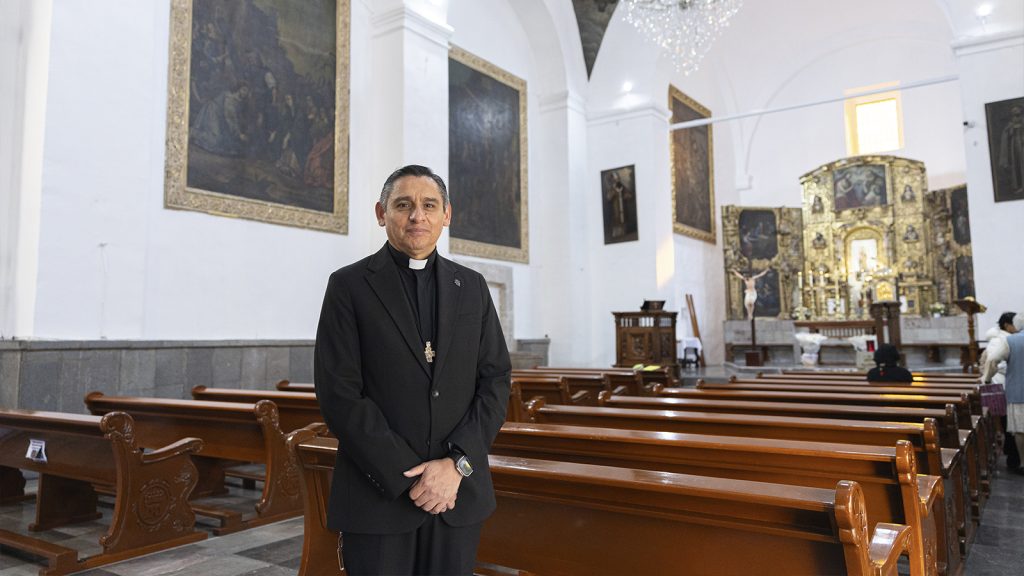
(ZENIT News / Rome, 11.14.2026).- Father Alberto Medel, parish priest of Santa María Tepepan in Xochimilco, Mexico City, recounted on social media that staff from the Mexican Government’s Secretariat of Foreign Affairs refused to issue his passport because he was wearing ecclesiastical attire in his photograph.
Father Alberto went to a passport office in the Coyoacán borough of Mexico City to renew his document. An employee informed him that he could not appear in the photograph wearing his religious attire and that he would have to remove it before proceeding. The priest expressed his disagreement, noting that his attire is part of his religious identity and does not hinder facial identification. A supervisor consulted with another authority, who initially allowed the photograph to be taken and his biometric data to be recorded. However, he was called back, and another employee informed him that the document could not be issued with the captured image because he was wearing ecclesiastical attire.
The priest asked for the basis of this requirement, and he was shown an internal policy that prohibits religious symbols in official photographs. He agreed to remove his attire to continue with the application process, while describing the demand as discriminatory.
A complaint was filed, and following the public disclosure of the grievance, Valeria Nápoles, head of the Administration and Finance Unit at the Secretariat of Foreign Affairs, informed the priest that the incident would be reviewed. The priest subsequently received a message in which the official acknowledged the difficulties he encountered during the process and requested information to evaluate the conduct of the staff: «I offer a sincere apology for the inconvenience this situation has caused. Since becoming aware of your case, I have been closely monitoring it.»
The official’s intervention marked the first institutional response to the complaint; however, it did not clarify how the rights guaranteed under Mexican law apply in this context.
Roberto Velasco Álvarez, an official at the Secretariat of Foreign Affairs, confirmed that instructions had been issued to correct the procedure and allow Father Alberto Medel to appear in his religious attire in the photograph. He noted that the Foreign Ministry respects religious freedom and that both the conduct of the employees and the internal policy used to justify the initial refusal would be reviewed.
Nevertheless, the directive to issue the passport does not confirm that the document has actually been delivered, nor does it constitute a formal determination regarding the administrative liability of the staff involved.
Article 14, Section IV, of the Regulations on Passports and Identity and Travel Documents sets out requirements for official photographs, stipulating that individuals must appear with their heads uncovered; however, this provision must be interpreted in a manner consistent with the fundamental rights recognized by the Constitution.
The Supreme Court of Justice of the Nation addressed the issue of religious attire on December 11, 2025, when it ruled on (constitutional protection) appeals 499/2024 and 418/2025, filed by women who requested to wear a hijab in their passport photographs. In those rulings, the high court established that authorities must accommodate the use of religious garments, provided that such items do not prevent the proper identification of the individual and that there is a justification linked to the person’s beliefs. Although the cases examined by the Court specifically concerned the Islamic veil, this legal standard is also relevant to other situations in which an individual wears religious attire during an official administrative process. This does not mean that any such item is automatically permitted; rather, authorities must evaluate whether the garment interferes with identification and whether any restriction is compatible with the individual’s rights.
Mexican legislation establishes protection mechanisms to prevent individuals from being subjected to discriminatory treatment based on their religious beliefs, specifically under Articles 1 and 24 of the Constitution, aimed at avoiding discrimination and ensuring that human rights are upheld with respect, protection, and guarantees.
In the case of Father Alberto Medel, these provisions allow for an analysis of whether the instruction to remove his religious attire had sufficient legal justification or whether it constituted a disproportionate restriction. Velasco’s statements suggest that «the internal regulations of any government department cannot take precedence over the Constitution or the rights we possess, known as human rights.»

Publicaciones relacionadas:
 Lent pro-life volunteers alarmed as Germany considers UK-style censorship zones to criminalise help and prayer near abortion organisations
 Sweden denies asylum to 84-year-old Iraqi Christian. Dies on repatriation flight
 Amid Tight Restrictions, Nicaragua Allows Rare Clergy Ordinations in Managua
 The Grammar of Hate: An Interview with Bishop Rafic Nahra, Auxiliary Bishop of Jerusalem, on the Situation in the Holy Land
