

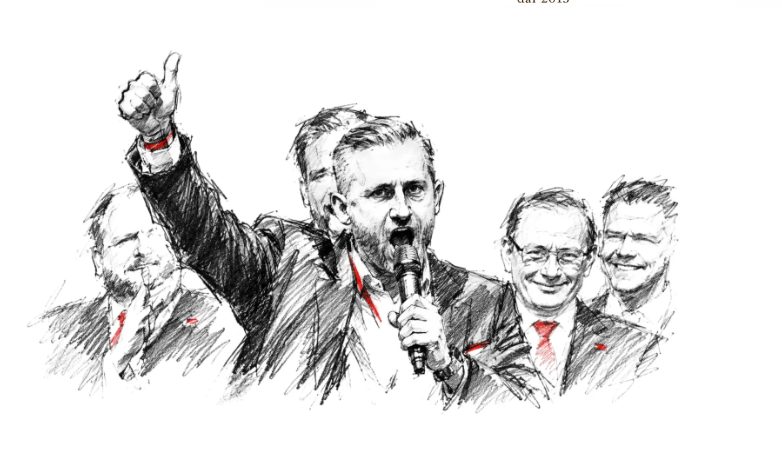
(ZENIT News – Caffe Storia / Rome, 09.09.2026).- In 2021, I wrote in these pages about a wall that continued to cut across Germany: the one between the East t and West that was never truly torn down. It is a political barrier and, less visible but no less real, a divide between those who believe and those who say they have ceased to do so. The vote on September 6 in Saxony-Anhalt does not contradict that assessment; on the contrary, it places it in an even more uncomfortable context.
The future of the Saxony-Anhalt government remains uncertain. Much will depend on the political forces’ ability to find a balance within the Landtag (state parliament) resulting from the election. The only certainty, for the moment, is the clear victory of Alternative for Germany (AfD), which has come within a hair’s breadth of an absolute majority.
This represents growth of more than double compared to 2021, a surge counterbalanced by the Christian Democrats (CDU), the party of Friedrich Merz, seeing their support cut in half. The Left Party (Die Linke), SPD, Greens, and the Sahra Wagenknecht Alliance (BSW) are left to share the remaining scraps, pieces that are nonetheless highly coveted for forming a state government. Voter turnout is also striking; according to ZDF, it reached 80%, a jump of nearly twenty points from the 2021 figure.
For the first time since 1945, a far-right party has a real chance of governing a German state. It is worth noting that Thuringia had already gone to the AfD in 2024, though a political «cordon», often called a cordon sanitaire, kept them out of government. Now, Saxony-Anhalt, Luther’s homeland, is in the spotlight. The Reformer was born and died in Eisleben; in Wittenberg; he nailed up the theses that provided the pretext for splitting Western Christianity in two (or more). Today, that same land vies for the global record in secularization: just under 90% of the population in the former East Germany declares itself non-religious (compared to roughly 10% Protestants, 3% Catholics, and a handful of Jews and Muslims). The Guardian British newspaper has bluntly described the former GDR as the most godless place on earth: forty years of State atheism caused such a radical disappearance of religious practice that it has no equivalent in the West. After reunification in 1990, religious freedom returned, but the faithful did not.
And the cradle of the Reformation has, statistically speaking, become its grave.
This is no minor detail. For a decade now, political scientist Andreas Püttmann has observed that the de-Christianization of East Germany was one of the reasons for the AfD’s success. The void, which nationalist movements have successfully exploited, is being filled by an ideological identity that presents itself as a substitute.
This gives rise to the paradox of recent election campaigns: democratic parties, unable to halt the AfD through political argument, look to Lutheran pastors, few in number, yet in some cases still socially influential, as a final bulwark, framing the effort in explicitly anti-identitarian terms. The Frankfurter Allgemeine newspaper coined a play on words, as cruel as it is effective, calling it «Alternative for Christ»: a phrase that speaks volumes more about the crisis of politics than about the vitality of the Church.
Added to this is the inevitable collision course between the AfD and Christian Churches. This is well exemplified by Ulrich Siegmund, the 35-year-old leader of the AfD in Saxony-Anhalt.
Baptized and raised in the Catholic Church, Siegmund formally withdrew his membership in 2017. He has not renounced the faith — declaring that he still carries Catholic values in his heart — but he has rejected the institution.
Once again, the point of contention is the controversial Kirchensteuer (church tax), an income tax paid by German citizens to fund the activities and structures of their religious community (whether Christian or Jewish, the latter involving the analogous Kultussteuer), receiving «religious services» such as Baptisms, Confirmations, weddings, and funerals in return. Failure to pay the tax and deregistering from the community result in the cessation of these services.
It is a choice with serious consequences, yet one that, in Saxony-Anhalt, does not lead to isolation but rather to «normalization.» Ulrich Siegmund is a product of a society where leaving the Church is no longer a sensational act, but a nearly natural step. It is no coincidence, then, that the AfD’s political platform includes various measures targeting what it disparagingly calls Kirchensteuerkirchen («church-tax Churches»): the abolition of the church tax, the end of State subsidies for the Protestant and Catholic Churches, and financial liability for the reception of migrants.
To grasp the scope of the AfD’s economic-religious challenge, it is worth looking at the figures. In total, the church tax alone generates over 12 billion euros annually. In 2025, Germany’s 27 Catholic dioceses received approximately 7 billion euros from the church tax. That same year, more than 300,000 Germans left the Catholic Church. Over the past twenty years, the German Church has lost more than a quarter of its faithful, yet its revenues have risen by 70%, driven by contributions from the now-retired baby-boom generation. Were the church tax to be abolished, the State would also stand to lose out, as it currently collects the tax, retains a 3% commission, and transfers the remainder to the Churches.
Beyond the arguments raised by the AfD, the Kirchensteuer (church tax) system has always revealed significant areas of concern. Above all, formal Church membership is largely tied to the payment of a tax, whereas the indelible nature of the sacramental bond remains, even for those who stop paying without necessarily challenging the entire taxation system.
Faced with the «Siegmund whirlwind,» the German Churches have not remained silent. On the contrary, they have openly challenged the AfD on various fronts: from the urgent need to defend values such as human dignity, charity, and solidarity, to the necessity of safeguarding social peace and coexistence. It is understandable that the AfD has found it easy to attribute the Churches’ opposition to a supposed attachment to economic benefits, thereby raising new and pressing questions about the damage that excessive financial resources can inflict on the credibility of the Christian witness.
But there is more. Despite the concrete commitment of numerous ecclesiastical organizations in Germany, Caritas above all, the AfD accuses Christian Churches of having abandoned the most vulnerable population to their fate, just as traditional political parties have done. On a doctrinal level, the AfD accuses the Churches of having opportunistically aligned themselves with the prevailing mindset, supporting theories regarding climate change, gender ideology, and «woke» culture. Furthermore, Islam is explicitly defined as alien to German culture.
It is worth noting that Ulrich Siegmund is not a product of the GDR’s State atheism; rather, he is a young man raised within the Catholic Church who chose to leave. His personal story represents a new form of German secularization: it is no longer a consequence of a political regime, but an individual choice made against a Church perceived as bureaucratic, progressive, and distant. This has created fertile ground for the far right to take root, an ideological affiliation that serves as a substitute for a community in crisis.
The question raised in these pages in 2021 has a more complex and dramatic answer today. Religion matters, but in a negative sense: not as a lived affiliation, but as an absence. The void left by secularization does not last long; it fills with politics, identity, and nationalism, often fueled by fear and hatred. The year 2026 introduces new elements: while five years ago the far right could, erroneously, be interpreted as indifferent to religion, today it presents itself as an active anti-ecclesial force, at least on the financial and institutional levels.
Saxony-Anhalt is merely the first act. At the end of September, it will be Berlin and West Mecklenburg-Pomerania’s turn; we will then see if the «wall» of 2021 has become the norm in East Germany. The issue now affects the entire architecture of German politics: how many states in Luther’s homeland must fall before Germany stops calling a “sign”, what has already reached the proportions of a landslide?
Translated from the Italian original into Spanish by ZENIT’s Editorial Director and, into English, by Virginia M. Forrester.

Publicaciones relacionadas:
 Governments Complain About Low Birth Rates at UN Population Conference
 Reading the Bible After the Destruction of Gaza
 Research reveals that 270 million human beings have died because of in vitro fertilization
 What keeps pastors in the pulpit, and why do some leave? The study that sheds light on departures by Catholic priests
