

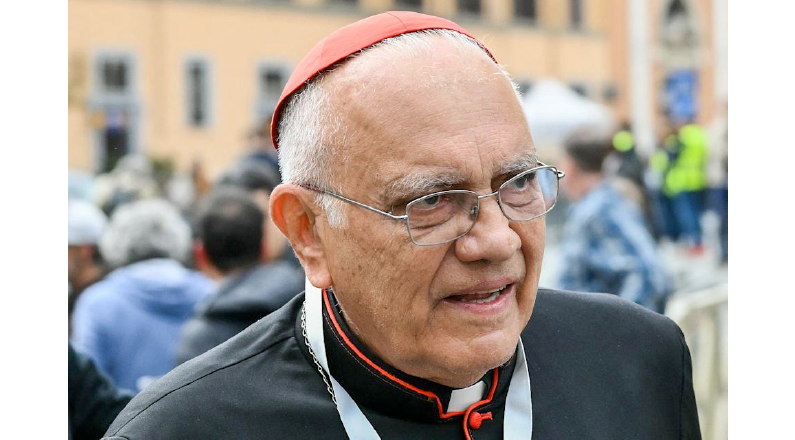
(ZENIT News / Caracas, 02.02.2026).- After tense weeks under an effective travel ban, Cardinal Baltazar Porras, archbishop emeritus of Caracas, has recovered his Venezuelan passport—an episode that sheds light on the fragile power dynamics between Nicolás Maduro’s regime, international diplomacy, and the Catholic Church.
The document was returned on Friday, January 30, bringing to an end a month-and-a-half ordeal that began on December 10, when authorities abruptly prevented the 80-year-old prelate from leaving the country. His attempted trip to Madrid, where he was due to be invested as Protector of the Military and Hospitaller Order of St. Lazarus of Jerusalem, ended instead in a two-hour detention at Simón Bolívar International Airport, complete with drug-sniffing dogs, threats of arrest, and the immediate cancellation of his passport.
Porras later revealed to fellow Venezuelan bishops that an official informed him he appeared as “deceased” in the national passport system. He was also compelled to sign a document alleging regulatory noncompliance as justification for the travel ban—an accusation he categorically rejected.
A cardinal silenced after speaking out
The timing was hardly coincidental.
Only days earlier, Cardinal Porras had publicly called for the release of political prisoners and condemned Venezuela’s human rights record. His outspokenness intensified after October’s 2025 canonization of the country’s first two saints, when he described the national situation as “morally unacceptable” during events in Rome.
Soon after, he was blocked from traveling to Isnotú—the birthplace of one of the newly canonized saints—where he was scheduled to celebrate Mass. First stopped at Caracas airport, he then attempted to continue by road, only to be forced back to the capital.
The travel ban ultimately prevented him from attending Pope Leo XIV’s first extraordinary consistory in early January 2026, an especially symbolic exclusion for one of Venezuela’s most prominent churchmen.
Diplomatic corridors at work
Cardinal Porras confirmed the return of his passport via Instagram, writing simply: “As a Venezuelan citizen, I already have my passport.”
Behind that understated message lay weeks of diplomatic maneuvering. Multiple sources in Caracas and abroad say his case was raised in conversations between foreign delegations and the Vatican Secretariat of State, with several embassies reportedly pressing the Maduro government to restore his right to travel as a gesture of goodwill.
The intervention appears to have worked.
For decades, Porras has lived under varying degrees of intimidation, but the recent escalation marked one of the most direct attempts to curtail his international presence. His stature—both as a cardinal and as a moral voice in Venezuela—made the move particularly visible.
Ver esta publicación en Instagram
A shifting political landscape
The passport’s return comes amid a rapidly changing context.
Four weeks earlier, former strongman Nicolás Maduro had been captured by U.S. authorities, an event that sent shockwaves through Venezuela’s political establishment. Since then, more than 200 political prisoners have reportedly been released. Student demonstrations have taken place without violent repression—an anomaly in recent decades—and several opposition figures have emerged from hiding. Some media outlets have also begun cautiously easing long-standing self-censorship.
In Rome, the Vatican has signaled its own recalibration. On January 12, Pope Leo XIV granted a private audience to opposition leader and Nobel Peace Prize laureate María Corina Machado—an unprecedented gesture compared with the more restrained posture of the previous pontificate.
For seasoned Vatican watchers, such meetings are never merely symbolic. They suggest a Holy See increasingly willing to engage publicly with figures advocating democratic reform in Venezuela.
More than a passport
While few expect a sudden democratization of Venezuela, the cardinal’s restored freedom of movement, combined with recent prisoner releases and diplomatic gestures, points to a tentative opening—one driven as much by international pressure as by internal fatigue.
For now, Porras is once again able to travel and speak beyond Venezuela’s borders. Whether this moment marks the start of a sustained thaw, or merely a brief pause in a long history of repression, remains uncertain.
But in a country where even a passport can become a political weapon, its return is no small sign.
Thank you for reading our content. If you would like to receive ZENIT’s daily e-mail news, you can subscribe for free through this link.

Publicaciones relacionadas:
 Poignant: Was the Departure of Mother Teresa’s Nuns, Expelled from Nicaragua by Daniel Ortega’s Regime
 Nicaragua will be left without nuns and religious: government expels them all and sets date for their departure
 Catholic Church in China: The Strange Case of Bishop Ji Weizhong
 This is how the Venezuelan dictatorship revoked the cardinal’s passport and prevented him from leaving the country
