

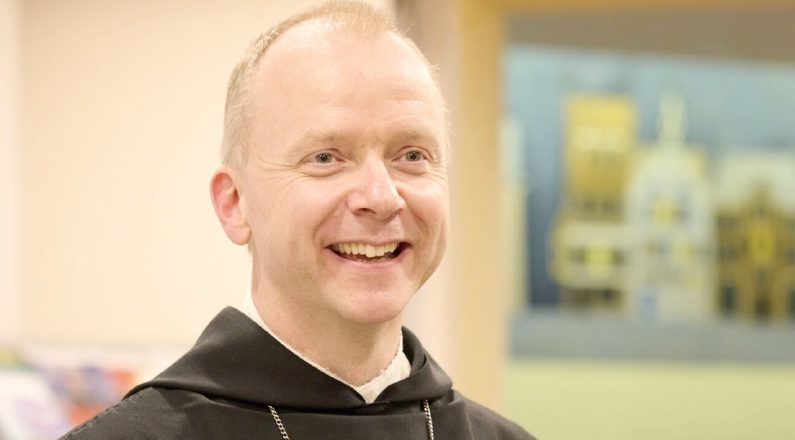
(ZENIT News / Rome, 02.05.2026).- When Pope Leo XIV gathers his closest collaborators for prayer this Lent, he will be guided not by a Roman curial heavyweight but by a soft-spoken Norwegian monk whose spiritual journey began in agnosticism and led him to the silence of a Trappist abbey.
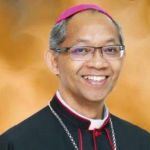
From February 22 to 27, 2026, the Pope, cardinals resident in Rome, and heads of Vatican dicasteries will take part in the traditional Lenten Spiritual Exercises in the Pauline Chapel of the Apostolic Palace. The retreat opens on Sunday, February 22, at 5 p.m., in the presence of Leo XIV himself. The preacher will be Bishop Erik Varden of Trondheim, a Cistercian of the Strict Observance (Trappist), who will reflect on the theme “Illuminated by a Hidden Glory.”
The program, released by the Prefecture of the Papal Household on February 4, foresees two daily meditations from Monday through Friday: one at 9 a.m., preceded by Midday Prayer, and another at 5 p.m., followed by Eucharistic adoration and Vespers. In total, Varden will offer eleven reflections, tracing a distinctly monastic and biblical itinerary through Lent.
The opening meditation, “Entering Lent,” sets the tone on Sunday evening. Over the following days, participants will hear talks on topics such as God’s help, interior freedom, the splendor of truth, human fragility (“A Thousand Will Fall”), divine glory, the angels of God, and the art of discernment. Two conferences are dedicated to Saint Bernard of Clairvaux—“Saint Bernard the Idealist” and “Saint Bernard the Realist”—a fitting homage to the great twelfth-century Cistercian reformer whose spiritual legacy still shapes Trappist life. The retreat concludes on February 27 with a final meditation entitled “Communicating Hope.”
For Leo XIV, this marks the first Lenten retreat of his pontificate, and he has chosen to remain in Vatican City rather than traveling outside Rome. His predecessor, Pope Francis, frequently brought the Curia to the retreat house in Ariccia, south of the capital, as to take out officials from their daily routines. This year’s exercises will instead unfold in the Pauline Chapel, adjacent to the Sistine Chapel—an architectural and symbolic return to the heart of the Apostolic Palace.
Several Vatican watchers have also noted the decision not to use the Redemptoris Mater Chapel, which had hosted the Curia’s Lenten retreats since the time of John Paul II. That chapel is adorned with mosaics by the former Jesuit Marko Rupnik, now at the center of serious abuse allegations, and its avoidance is widely seen as deliberate. Last year, with Pope Francis hospitalized, the exercises were held in the Paul VI Audience Hall.
The choice of Erik Varden is striking on multiple levels.
Born on May 13, 1974, in Sarpsborg, Norway, Varden studied theology at Cambridge, where he earned a doctorate, and later at Rome’s Pontifical Oriental Institute, receiving a licentiate in Eastern ecclesiastical sciences. Raised outside Catholicism and once an agnostic, he entered the Trappist Order in 2002 and made his solemn profession at Mount St. Bernard Abbey in England in 2007. Ordained a priest in 2011, he went on to teach at Sant’Anselmo in Rome while also collaborating with Vatican Radio’s Scandinavian section.
He eventually returned to Mount St. Bernard, serving first as superior ad nutum and then, in 2015, as abbot. Pope Francis appointed him bishop-prelate of Trondheim in 2019, and he was consecrated in 2020—becoming the first Catholic bishop ordained in Norway’s medieval Nidaros Cathedral since the Lutheran Reformation. Since then, he has also served as apostolic administrator of Tromsø (from 2023), president of the Scandinavian Bishops’ Conference (from 2024), and, as of 2025, a member of the Dicastery for the Clergy by appointment of Pope Leo XIV.
At 51, Varden shepherds a tiny Catholic minority in one of Europe’s most secularized regions, a pastoral context far removed from Vatican corridors. Yet he is widely respected as a spiritual writer and polyglot thinker; he has published books on chastity, woundedness, and solitude, and is known for his ability to move effortlessly between patristic theology and contemporary experience—even recording a podcast reading the Gospel of Mark in Greek.
That a Trappist bishop from Norway has been entrusted with preaching to the Roman Curia carries its own quiet message. Traditionally, popes invite an external figure for these exercises, signaling that spiritual renewal does not originate in bureaucracy but in contemplation. In Varden’s case, the choice also highlights the Church’s peripheries: a monk-bishop formed by silence, serving in a land shaped by centuries of Protestant history, now called to address the universal Church from the Vatican’s most intimate chapel.
As is customary, the retreat will entail a pause in Pope Leo XIV’s public activities, allowing him and his collaborators to step back from governance and enter a shared space of prayer. For six days, policy papers and pastoral strategies will give way to Scripture, Saint Bernard, and reflections on hidden glory—an invitation, at the start of a new pontificate, to rediscover hope not through power or visibility, but through interior conversion.
Thank you for reading our content. If you would like to receive ZENIT’s daily e-mail news, you can subscribe for free through this link.

Publicaciones relacionadas:
 Leo XIV to Personally Bestow Palliums in Return to Historic Ritual: A Subtle but Symbolic Shift in Papal Style
 Following complaints from cardinals in pre-Conclave meetings, Pope Leo XIV summons cardinals to Rome for early 2026
 Cardinals will return to Rome for a new Consistory in June 2026 requested by Pope Leo XIV
 Pope Leo XIV accepts resignation of bishop whom Pope Francis appointed cardinal, but who “did not want” to receive the appointment
