

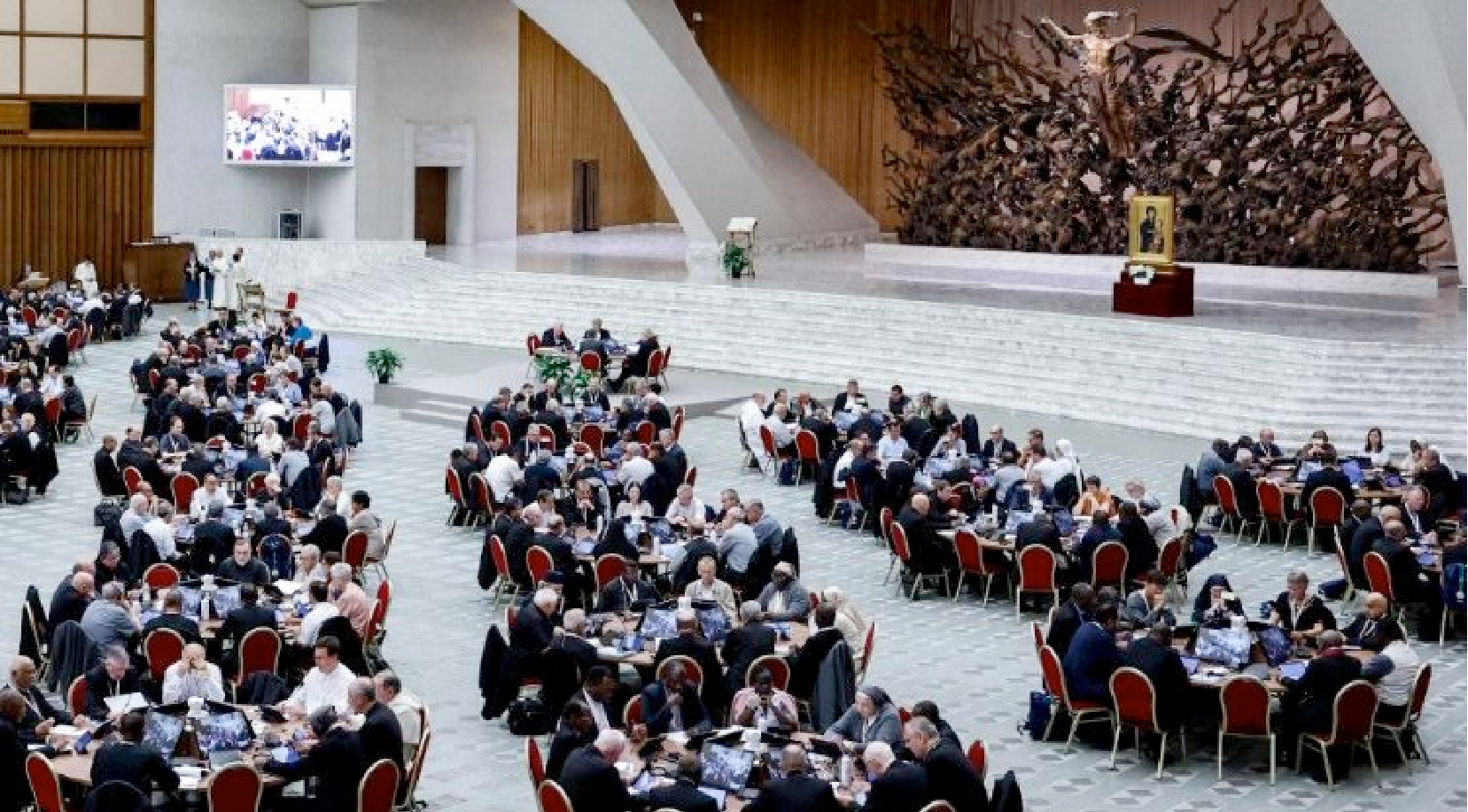
(ZENIT News / Rome, July 20, 2025) – On Monday, June 7, the Synod of Bishops published the document «Pathways for the Implementation Phase of the Synod» to prepare for the next synodal stage, which aims for October 2028 as the culmination of the process initiated by Pope Francis in 2020.
The Synod’s General Secretary, chaired by Cardinal Mario Grech, has prepared the new document for the local Churches, in order to «listen to them, support their efforts, and, above all, contribute to encouraging dialogue and the exchange of gifts among the Churches.»
Sister Nathalie Becquart, XMCJ, Under-Secretary of the Synod, spoke with Vatican News. She explained that this phase of the Synod’s implementation on synodality follows the Final Document of the Synod, approved directly by Pope Francis, and asserted that it «makes it part of the ordinary Magisterium of the Church. Therefore, we are now asked to agree on these recommendations.»
When asked if the implementation phase has a fixed period, she replied: «It is an open phase, but a three-year period has been planned, with defined steps, culminating in October 2028 with an Ecclesial Assembly in Rome to share fruits and evaluate the process.»
She added that «this path includes assemblies in dioceses, at the national and continental levels. We know that implementing synodality at all levels will take time, but the important thing is to move forward step by step. This document seeks to guide those who need concrete guidance.»
She was also asked about the definition of synodality, to which she replied: «There is a clear definition (cf. paragraph 28), but it can be understood in two very helpful ways. First, I quote the Australian theologian Ormond Rush: ‘Synodality is the Vatican Council II in a nutshell.’ What we are experiencing today directly responds to the vision of Vatican II. Synodality is simply continuing to receive it. It has not been fully implemented, and this is part of that process.»
She added another clarification: «The other way to understand it, perhaps simpler, is to remember our synodal logo: communion, participation, mission. Synodality is a way of being Church that helps us be more missionary and participatory.»
Regarding the purpose of the document, she explained: «This document answers specific questions. First, it supports the implementation of the Synod at the local level. Second, it promotes the ‘exchange of gifts’ between Churches, a key concept of the Final Document.»
She commented on an experience: «In my mission, I have been able to travel extensively and have seen the beauty of a Church that is one, yet diverse in contexts, cultures, and ways of living the faith. Each local Church has its own path, but it must not walk alone. This document emphasizes that there cannot be synodal conversion in isolation. That is why the Synod emphasizes the role of the local Churches, but also dialogue between them: in Ecclesiastical Provinces, Episcopal Conferences, and at the continental level.»
What will happen now with the arrival of Pope Leo? Sister Nathalie Becquart said: «The plan approved by Pope Francis and confirmed by Pope Leo includes local, national, and continental assemblies, up to the Ecclesial Assembly in Rome.» She added: «Since the beginning of his pontificate, Pope Leo has reaffirmed the desire to be a synodal Church. In fact, he already lived this when he was Bishop of Peru: he organized the listening phase in his diocese, participated in continental meetings, in the drafting of the Instrumentum Laboris, in the assemblies of 2023 and 2024, and in two study groups.»
The Under-Secretary also emphasized a basic concept of synodality: «Reception is actively accepting what has been discerned as God’s call in a Synod or Council.»
Among reactions to the document, the Vatican’s Synod Office said that «the final reports of the study groups on synodality, including views on women deacons and controversial doctrinal issues such as LGBT inclusion, have been postponed until the end of the year.» It highlights that «a spokesman for the Synod Secretariat told CNA that most of the 10 commissions had requested more time to complete their reports, following delays due to the death of Pope Francis and the See being vacant. In June, they received the green light from Pope Leo XIV to proceed.»
The fact that the Study Commissions are made up of Cardinals, Bishops, priests, and laypeople from the Vatican and elsewhere suggests that «the document did not say whether and when the two additional study groups would need to produce reports. And a spokesman for the Secretariat said he did not believe they would be providing reports by the same December 31 deadline.»
Another pending task is that «it is also the Secretariat’s responsibility to ensure that the Pope’s decisions, also developed on the basis of the findings of these groups, are harmoniously integrated into the ongoing synodal journey,» according to the document.
The recently published provisions are intended as a guide for Bishops to implement synodality in their churches and describe what is expected during the next phase of the Synod, which will culminate with the Church’s Assembly in October 2028.
Charles Collins of Crux notes that the document bills itself as a “framework for consideration” offered to local Churches, “inviting them to share their initiatives, contributing to broader ecclesial discernment.” And that a three-week meeting was held at the Vatican in October 2023, as well as another lasting several weeks in October 2024, on the assumption that this would end it all. However, further phases have now been announced through 2028. And this is being called a kind of addiction to meetings.
Collins indicated that «the worst aspect of synodality under the General Secretariat is the proliferation of office meetings, now and for some time imposed on participating ecclesiastical jurisdictions around the world.» He noted that the Synod’s Secretariat does not want synodal work to be like that of large transnational corporations, although the request for diocesan and national evaluations shows a profile similar to a multinational corporation in the Church with synodality, which will lead to «the death of meetings.» Sister Nathalie Becquart, however, admitted to Vatican News that it would be difficult to avoid another round of prolonged meetings.
Catholic World Report believes that the Synod leaders propose the period from June 2025 to December 2026 for the activation of the «implementation paths» of synodality in local Churches and groups of Churches. The announcement that the Synod’s Secretariat will organize diocesan evaluation assemblies in 2027, and then national ones, before holding continental evaluations in the first part of 2028, extends the synodal phase.

Publicaciones relacionadas:
 Pope Francis on Too Many Ecclesiastical Universities in Rome and the Challenge of What to Do About It
 The Successor of Francis According to Statements by the Cardinals (Part I)
 400,000 abortions and $2 billion in revenue: Planned Parenthood’s record year sparks outrage
 Pope Leo XIV, Father Dowling, and China
