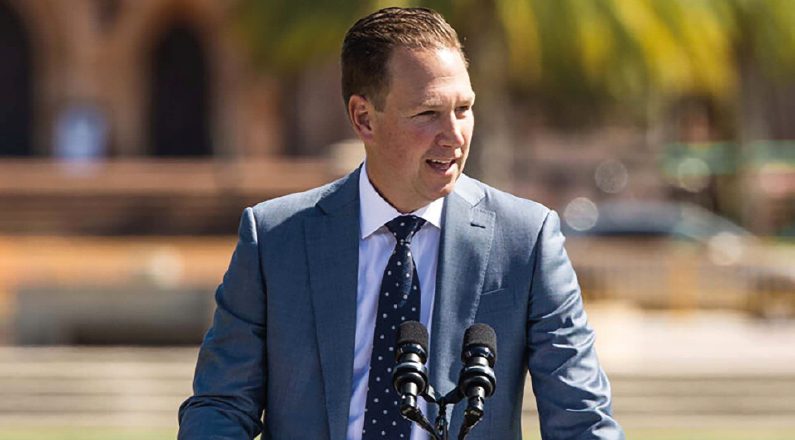
(ZENIT News / Washington, 08.04.2025).- The relationship between the United States and the Holy See entered a new and symbolic chapter on August 2, when the U.S. Senate confirmed Brian Burch as the new ambassador to the Holy See. While the appointment may seem like just another diplomatic rotation, it carries unique historic weight: for the first time, the U.S. ambassador to the Holy See will serve under a pope who is also a U.S. citizen. And not only that — they share the same hometown: Chicago.
Burch, co-founder of CatholicVote, brings to the post a profile that blends religious conviction, political activism, and family life. He is the father of nine children, a graduate of the University of Dallas, and an influential figure among American Catholic conservatives. His nomination, backed by former President Donald Trump, was confirmed quietly by the Senate on a Saturday, but its implications are anything but quiet.
Upon confirmation, Burch posted a message on social media expressing gratitude for the opportunity and describing his role as “an honor and privilege,” especially given the “historic election of the first American pope.” That line alone signals how unusual—and potentially momentous—his tenure could be.
Since Pope Leo XIV’s election, Vatican-watchers have speculated about the possible impact of a pope who shares not only language and culture with the world’s most powerful nation, but also geography and even a political temperament that seems, at times, remarkably attuned to American sensibilities. While the Holy See’s diplomatic tradition emphasizes neutrality and universality, the presence of an American pope, now matched with an ambassador deeply rooted in Catholic political advocacy, brings a new texture to U.S.–Vatican dialogue.
The Vatican, though a city-state of just over 100 acres, exerts a moral influence far out of proportion to its size. It maintains diplomatic relations with 183 of the world’s 195 recognized countries, and its nuncios (equivalent to ambassadors) are present in 106 nations, with non-resident coverage in 77 more. In terms of diplomatic footprint, only China and the United States rival the Holy See, and yet its soft power—especially in humanitarian and ethical spheres—remains unique.
That’s part of what makes the Vatican post so distinctive. The role of ambassador to the Holy See is not merely ceremonial; it often involves intense behind-the-scenes work on global issues ranging from religious freedom and migration to peacebuilding and climate change. Past U.S. ambassadors have dealt with questions as diverse as nuclear arms policy during the Cold War, international development, and even bioethics. Each has brought a different approach, shaped not only by U.S. presidential administrations but also by the Church’s evolving global priorities.
Burch now becomes the thirteenth U.S. ambassador to the Vatican since full diplomatic relations were established in 1984 under President Ronald Reagan. Before that, contacts between Washington and the Holy See were sporadic and largely informal, a reflection of historic American suspicions toward Catholicism and the principle of separation of church and state. Today, such suspicions have faded, but the role remains one of careful balance: representing a secular democracy to the world’s oldest and most influential religious institution.
For Burch, the challenge ahead is twofold. On one hand, he must communicate U.S. concerns and policies to a Vatican that is both diplomatic and pastoral in its outlook. On the other, he must faithfully relay the Vatican’s often morally-driven positions to an American administration—and electorate—that may not always be receptive.
Given his background in Catholic advocacy, Burch is likely to emphasize issues of conscience, religious liberty, and family. But he steps into a global context that also demands attention to war and peace, economic justice, and climate concerns—areas where the Vatican has been increasingly vocal, especially under recent popes.
The ambassador himself seems aware of the weight of the task. “I ask for the prayers of all Americans, especially my fellow Catholics,” he wrote, “that I may serve with honor and faithfulness in the noble adventure that lies ahead.”
That adventure is now underway, and it promises to be one to watch—not only for American Catholics, but for anyone interested in how religion and politics intersect on the global stage. With a Chicago-born pope at the helm of the Church and a fellow Chicagoan representing the United States, the spiritual and diplomatic conversation between two powers just became much more personal.
Thank you for reading our content. If you would like to receive ZENIT’s daily e-mail news, you can subscribe for free through this link.